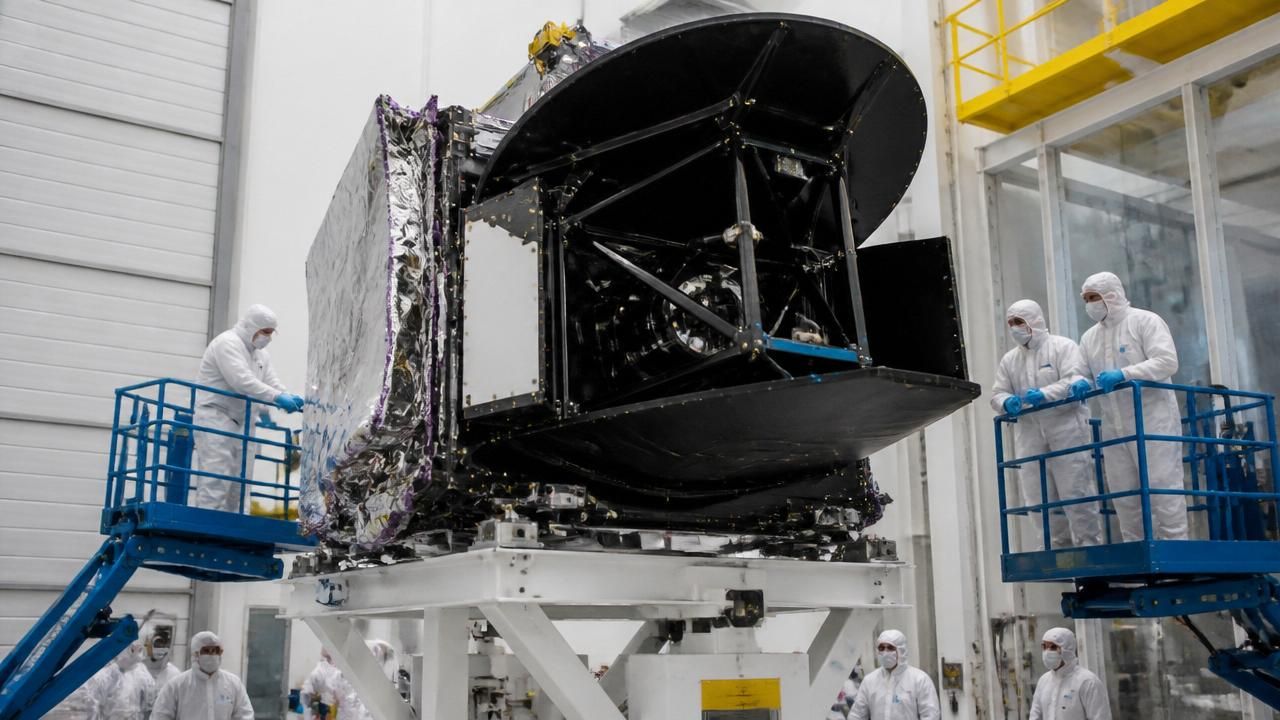
NASA is gearing up for the launch of its next flagship observatory, the Nancy Grace Roman Space Telescope, now scheduled for Sunday, August 30, 2026, from Kennedy Space Center in Florida. Originally planned for a later date, the mission has been accelerated by eight months, with technicians and engineers already lifting the telescope onto a specialized work stand at Kennedy Space Center on June 26, 2026. The Roman Space Telescope, named after NASA's first chief astronomer, promises to revolutionize our understanding of the cosmos with a field of view at least 100 times larger than the Hubble Space Telescope's, enabling sweeping surveys of the universe.
A Telescope Built for Discovery
The Roman Space Telescope is designed to tackle some of the biggest questions in astrophysics, from dark energy and exoplanets to the structure of the Milky Way. Its wide-field instrument will allow it to capture images of large swaths of the sky in unprecedented detail, while its coronagraph instrument will directly image exoplanets by blocking out starlight. According to NASA, Roman will survey billions of galaxies, millions of stars, and thousands of exoplanets, providing an 'atlas of the universe' that will serve as a legacy dataset for decades to come.
One of the key surveys planned for Roman is the Galactic Bulge Time-Domain Survey (GBTDS), which will target the densely populated center of the Milky Way. As reported by Universe Today, this survey will revisit six central regions of the galaxy for 72 hours each season over three years, aiming to detect exoplanets via microlensing and study the dynamics of stars near the galactic center. The region is obscured by dust and gas in optical light, but Roman's infrared capabilities will pierce through this veil.
Launch Details and Media Briefing
NASA has invited media to a virtual news conference on Wednesday, July 29, at 2 p.m. EDT to preview the mission. Participants include Shawn Domagal-Goldman, director of the Astrophysics Division at NASA Headquarters; Jackie Townsend, Roman telescope project manager at Goddard Space Flight Center; Julie McEnery, senior project scientist; and Jeremy Perkins, integration and test scientist. The briefing will cover the mission's status, science goals, and launch timeline. The launch itself will be carried by a SpaceX Falcon Heavy rocket, as confirmed by multiple sources including autoevolution.com and techspot.com, with liftoff scheduled for August 30.
While some sources, such as spacenews.com, initially reported an early September date, NASA's official media advisory confirms the August 30 target. The mission has faced threats of cancellation in the past, as noted by Universe Today, but has persevered through budget challenges and political headwinds. The accelerated timeline reflects the dedication of the engineering team and the importance of the science.
Scientific Capabilities and Goals
The Roman Space Telescope is often described as a 'super-Hubble' due to its massive field of view, but it also complements the James Webb Space Telescope (JWST). While JWST focuses on deep, narrow-field observations of the early universe, Roman will conduct wide-area surveys that can identify targets for JWST and other observatories. According to NBC News, Roman will be '1,000 times faster than Hubble' at surveying the sky, thanks to its 300-megapixel Wide Field Instrument.
Roman's primary science goals include studying dark energy, the mysterious force accelerating the expansion of the universe, by mapping the distribution of galaxies and measuring cosmic shear. It will also conduct a microlensing survey to find exoplanets, including free-floating planets not bound to any star. The coronagraph will directly image giant exoplanets and study their atmospheres, potentially paving the way for future missions like the proposed Pandora small satellite, which will focus on exoplanet atmospheres.
Exoplanet and Galactic Science
The exoplanet census currently stands at over 5,800 confirmed planets, and Roman is expected to add thousands more. Its microlensing survey will be particularly sensitive to planets in the galactic bulge, including Earth-mass worlds. The GBTDS will also monitor variable stars and probe the structure of the Milky Way. As Universe Today notes, the galactic center is a challenging target, but Roman's infrared vision and time-domain capabilities will allow it to detect transient events like supernovae and tidal disruption events.
Context and Historical Significance
The Roman Space Telescope is named after Nancy Grace Roman, who was NASA's first chief astronomer and is often called the 'Mother of Hubble' for her role in making the Hubble Space Telescope a reality. The telescope's wide-field design is a direct successor to Hubble's legacy, but with a modern twist. Its launch comes at a time when NASA's astrophysics portfolio is expanding, with JWST already operational and the upcoming Artemis missions returning humans to the Moon. Roman will operate from the Sun-Earth L2 Lagrange point, about 1.5 million kilometers from Earth, where it will enjoy a stable thermal environment and clear views of the cosmos.
Despite its promise, the mission has not been without controversy. Universe Today reported that the US administration once threatened to cancel the nearly complete telescope, but strong support from the scientific community and Congress ensured its continuation. The accelerated launch schedule is a testament to the project's resilience and the urgency of its science goals.
Looking Ahead
As the launch date approaches, excitement is building among astronomers and space enthusiasts. The Roman Space Telescope is expected to operate for at least five years, with the potential for extended missions. Its data will be publicly available, enabling discoveries by scientists around the world. The July 29 media briefing will provide further details on the mission's status and what to expect on launch day. For now, the countdown is on for what promises to be one of the most transformative space observatories of the decade.
'Roman will revolutionize our view of the universe, from the nearest exoplanets to the most distant galaxies,' said Julie McEnery, Roman senior project scientist, in a statement. 'We can't wait to see what it reveals.'
With its launch less than two months away, the Roman Space Telescope stands poised to unlock the universe's biggest mysteries, offering a new window into the cosmos that will inspire generations to come.