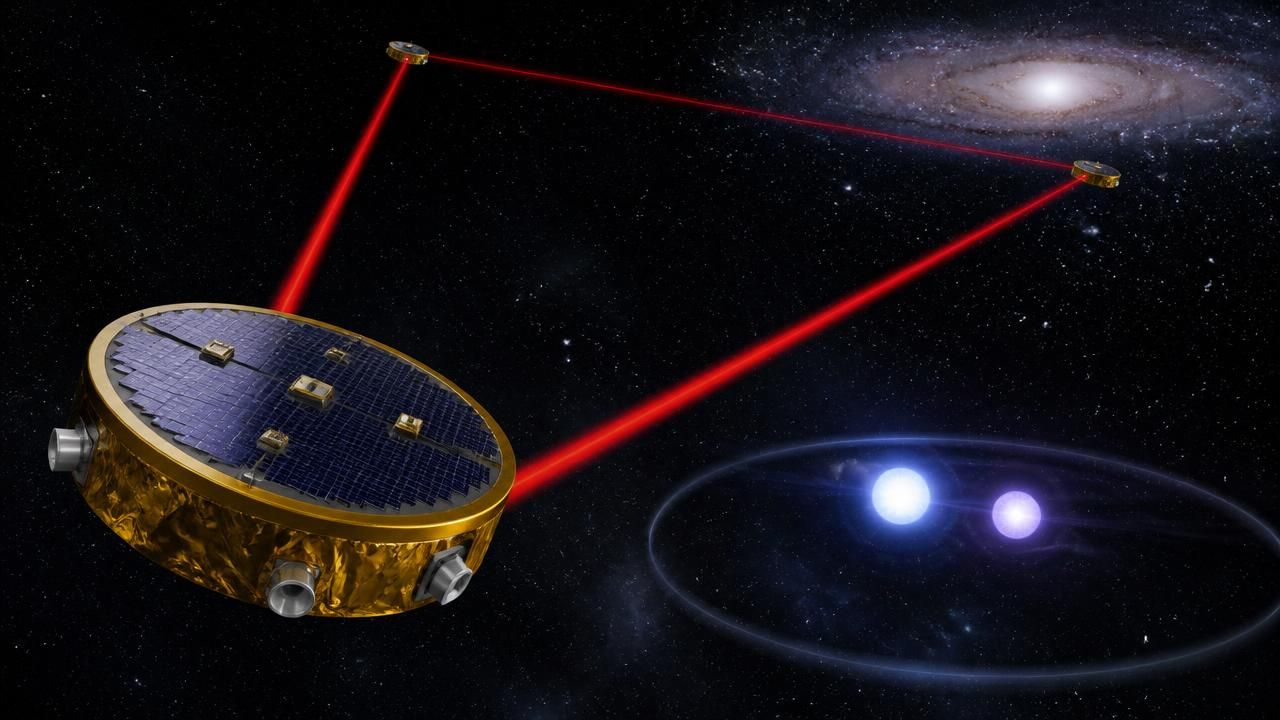
Astrophysicists have spent a decade learning to listen to the universe. Now they are beginning to read it. In two papers published Tuesday in The Astrophysical Journal, NASA-led researchers describe how a future space observatory could use the faintest ripples in space-time to discover planets that no telescope will ever see directly — a technique that would open an entirely new window on the Milky Way's planetary population.
The research centers on LISA, the Laser Interferometer Space Antenna, a European Space Agency mission now in development with substantial NASA participation. Unlike ground-based detectors that hunt for the violent collisions of black holes and neutron stars, LISA will measure lower-frequency gravitational waves — the long, slow undulations produced by compact objects orbiting one another at close range.
A planet's fingerprint in the fabric of space-time
The most common source for LISA is expected to be double white dwarf binaries: pairs of Earth-sized stellar remnants whirling around each other in orbits measured in minutes, sometimes seconds. These systems are so numerous that they will form a background hum across LISA's data. According to the new work, a planet orbiting within such a binary would subtly modulate that hum — a periodic wobble superimposed on the gravitational wave signal.
“The most common source for LISA is expected to be double white dwarf systems, which are binaries composed of white dwarfs in tight orbits. If an exoplanet also orbits within one of these systems, its presence becomes imprinted on the gravitational wave signal in a way we'll be able to uncover.”
That assessment comes from Casey McGrath, a postdoctoral researcher at the University of Maryland, Baltimore County working at NASA's Goddard Space Flight Center in Greenbelt, Maryland. McGrath is the sole author of the first paper, which maps out the detection method and identifies the combinations of planet mass and orbital period where the technique is most sensitive. A companion study, also led by NASA astrophysicists, extends the analysis to the wider population of candidate systems.
The headline figure is striking: a Jupiter-mass planet in a tight double white dwarf system could be detected out to thousands of light-years — distances at which conventional exoplanet surveys, which rely on starlight, struggle badly. White dwarfs are faint and often drowned out by brighter companions; a gravitational wave detector, by contrast, needs no light at all.
Why this matters for planet hunting
Since the first confirmed exoplanet around a Sun-like star in 1995, astronomers have catalogued more than 5,800 worlds using transits, radial velocity wobbles, microlensing and direct imaging. Each method has blind spots. Transits require favorable alignments; radial velocity favors massive planets close to bright stars; imaging favors young, wide-orbit systems.
- Gravitational wave detection would be sensitive to planets in dead, dim stellar remnants — environments essentially invisible to optical surveys.
- It would measure mass and orbital period directly, without the ambiguities introduced by stellar activity or planetary atmospheres.
- It would sample a population of planets that survived the catastrophic late stages of stellar evolution.
The implication, researchers argue, is not just a handful of exotic finds but a demographic census — a new way to ask how common planets are in the galaxy's oldest, quietest corners.
A field counting its bounty
The LISA work arrives as gravitational wave astronomy enters an era of abundance. The LIGO-Virgo-KAGRA collaboration's latest catalog, drawing on hundreds of signals collected during the most recent observing run, reports roughly 390 confirmed detections of merging compact objects. That volume — dozens of times the handful of events that made headlines in 2015 and 2016 — has revealed a population of black holes that models had not anticipated, including heavy binaries and systems that may have formed not from isolated dying stars but through repeated dynamical encounters in dense stellar clusters.
The contrast in framing between outlets is instructive. NASA's own coverage emphasizes the future and the instruments: what LISA, launching in the mid-2030s, might reveal about planets. Coverage of the 390-detection catalog, by contrast, emphasizes the present and the surprises — the sense that the universe's black hole population is stranger and more varied than theory predicted. Both stories, however, point at the same underlying shift: gravitational wave astronomy is graduating from discovery to survey science.
The Moon as an antenna
Meanwhile, a separate line of research has drawn attention to a novel way of extending the field's reach: using the Moon itself. Reports this week describe proposals in which the lunar environment — airless, seismically quiet in its deep interior, and offering an enormous natural baseline — could host or serve as gravitational wave instrumentation. Concepts range from placing laser interferometers on the lunar surface to reading gravitational wave signatures from how they excite the Moon's own vibrational modes, an idea sometimes likened to treating an entire world as a resonant detector.
Such proposals remain at an early, conceptual stage, and the practical obstacles — lunar dust, thermal extremes, the cost of landing precision hardware — are formidable. But the appeal is clear. Ground-based detectors are limited by seismic and Newtonian noise at low frequencies; space-based missions like LISA are limited by their own orbital mechanics. A lunar platform could, in principle, fill part of the gap between them.
Explainer coverage of the sort that circulated this week has also helped widen the audience, walking general readers through what gravitational waves actually are: not waves in space but ripples of space-time, produced whenever mass accelerates asymmetrically, stretching and squeezing anything they pass through by fractions of a proton's width.
What comes next
The immediate test for the exoplanet work is empirical. LISA's launch is still roughly a decade away, and the predicted signals are weak — detectable only because the underlying binary sources are so clean. Theorists will spend the intervening years refining which systems are worth targeting and how to disentangle a planet's fingerprint from other orbital perturbations, such as a distant third star or mass transfer between the white dwarfs.
If it works, the payoff would be a genuinely new sense organ for astronomy. “What we're really doing,” the NASA analysis suggests, “is listening for the presence of something that leaves no light of its own.” In a galaxy where most planets orbit stars we can barely see, that may prove the most valuable kind of hearing.