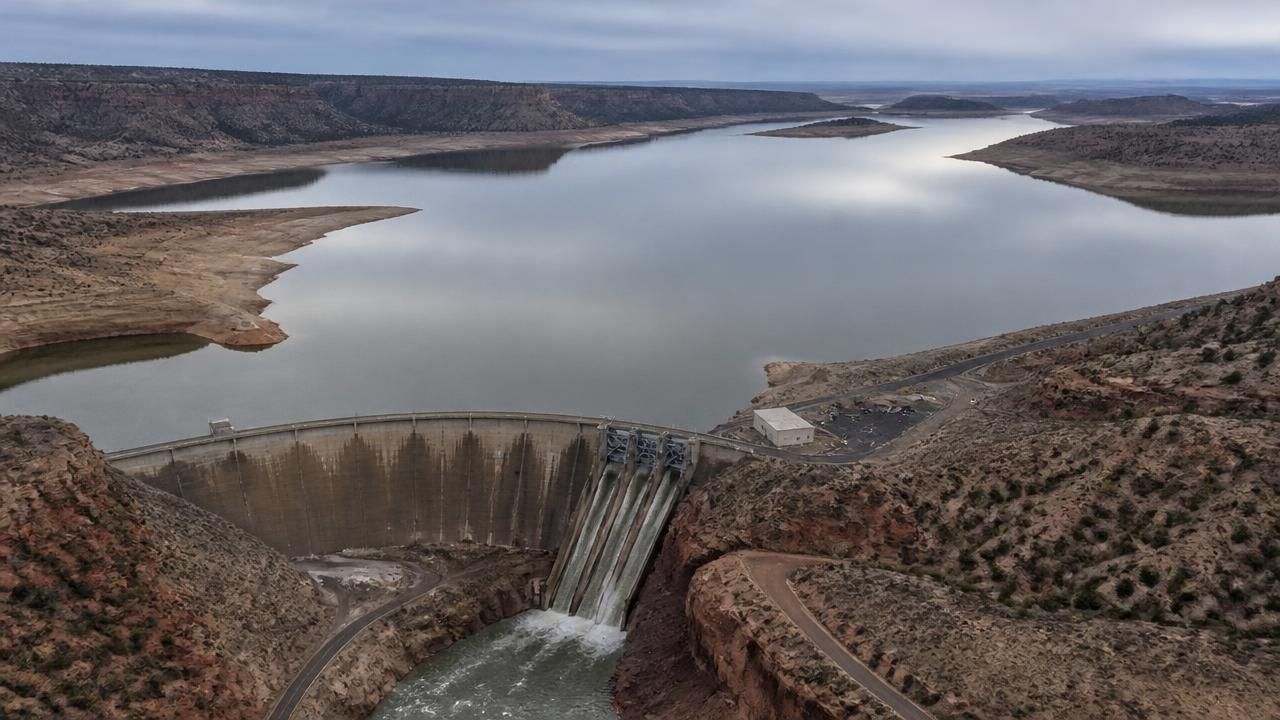
Back-to-back extreme rain events swept across the Four Corners region of the U.S. Southwest in late October and early November 2026, producing a dramatic hydrological swing that satellites could see from space. NASA Earth Observatory images acquired on September 20 and November 7 show water surging into Navajo Reservoir, a federal reclamation reservoir on the San Juan River. The storms brought short-term drought relief, but they also pushed rivers to record or near-record levels, caused damaging floods and set off a cascade of water-quality and economic consequences that extend far beyond the reservoir shoreline.
A reservoir on the rise
NASA's before-and-after imagery, captured with the Operational Land Imager, shows the reservoir expanding rapidly over roughly seven weeks. The visual change is one of the clearest signals of how intense the late-autumn storms were: rainfall that fell across the Four Corners—where Arizona, New Mexico, Colorado and Utah meet—ran off parched and burned landscapes and funneled into streams and rivers. Navajo Reservoir rose sharply as a result. The same runoff contributed to river levels that, in places, reached records or came close to them, according to NASA's Earth Observatory. That combination—relief for a reservoir and danger for communities downstream—is the central tension of the event.
Relief, but not a drought-buster
The rain did ease short-term drought conditions in the Southwest, but water managers and analysts cautioned against reading the surge as a long-term fix. Wyoming Public Media reported that the recent rains were a drop in the bucket for Colorado River reservoir water. That framing matters because the Colorado River Basin has been locked in a multi-decade structural deficit, with Lake Powell and Lake Mead hovering near critically low levels and federal officials repeatedly tightening delivery forecasts. Navajo Reservoir is part of the broader Colorado River system, and its rapid rise is welcome. But one wet season, even one with back-to-back extreme events, cannot erase years of accumulated depletion. The distinction between a short-term boost and a durable recovery is central to how scientists and water managers are interpreting the storms.
Recent rains were a drop in the bucket for Colorado River reservoir water, according to Wyoming Public Media.
When floodwater carries contamination
The floods were not only a story about water quantity. MSN reported that floodwaters carried untreated wastewater into a river on the Navajo Nation, raising immediate concerns about water quality and public health. In rural and tribal communities, wastewater infrastructure can be vulnerable to extreme runoff, and contamination can spread quickly through rivers that are used for drinking-water sources, livestock and irrigation. The Navajo Nation has long faced infrastructure gaps, and flooding can turn those gaps into acute hazards. The reported release of untreated wastewater adds a health dimension to a disaster that might otherwise be measured mainly in reservoir levels and road closures.
The contamination risk also complicates cleanup and recovery. Communities need water-quality testing, clear public-health guidance and, in some cases, alternative water supplies. The story is a reminder that floods in arid regions are not simply rare bursts of moisture. They can mobilize pollutants, overwhelm sanitation systems and leave lingering risks after the visible water recedes.
Hundreds of millions in damage
The economic toll is already significant. Hawaii Public Radio reported that Southwest flood damage estimates are hundreds of millions of dollars for New Mexico alone. That figure points to damage across roads, bridges, homes, businesses, agricultural land and public infrastructure. The phrase for New Mexico alone is important: it suggests that the full regional cost is likely higher once assessments are complete in Arizona, Colorado, Utah and tribal jurisdictions. Disaster estimates often rise in the weeks after floods as inspectors reach remote areas and as local governments tally emergency response, debris removal and repairs.
Southwest flood damage estimates are hundreds of millions of dollars for New Mexico alone, according to Hawaii Public Radio.
For a region accustomed to drought, the financial shock is a reminder that adaptation must cut both ways. Communities need to prepare for too little water and for sudden, violent excess. The same storm system that raised a reservoir can wash out the roads used to reach it.
Four outlets, one compound event
The various reports frame the same episode from different vantage points. NASA's Earth Observatory emphasizes remote sensing and the physical signal of water rising in Navajo Reservoir. MSN focuses on the environmental-health consequences of flooding on the Navajo Nation, where untreated wastewater entered a river. Wyoming Public Media keeps its eye on the basin-wide water-supply picture, warning that the rains do not solve the Colorado River's long-term crisis. Hawaii Public Radio brings in the fiscal ledger, reporting damage estimates in the hundreds of millions for New Mexico alone. Taken together, the coverage describes a compound event—meteorological, hydrological, infrastructural and social—rather than a simple drought-ending rainstorm.
What happens next
In the coming weeks, water managers will watch reservoir levels, dam operations and downstream flows. Public-health officials will monitor rivers and wells for contamination. Emergency managers will continue damage assessments, and tribal, state and federal agencies will face questions about how quickly aid reaches the communities most affected. Scientists will also examine whether the back-to-back storms fit a pattern of increasing precipitation extremes in the Southwest, where a warmer atmosphere can hold more moisture even as the region faces chronic aridity.
The Navajo Reservoir surge is an arresting image of nature's power to refill a landscape. But the floods, the wastewater releases and the hundreds of millions in damage show the other side of that power. The storms offered relief; they did not offer a solution. For the Southwest, the challenge is to capture the benefits of rare wet years while protecting people, water supplies and infrastructure from the increasingly costly ways that water arrives.