A Celestial Jewel in a Nearby Galaxy
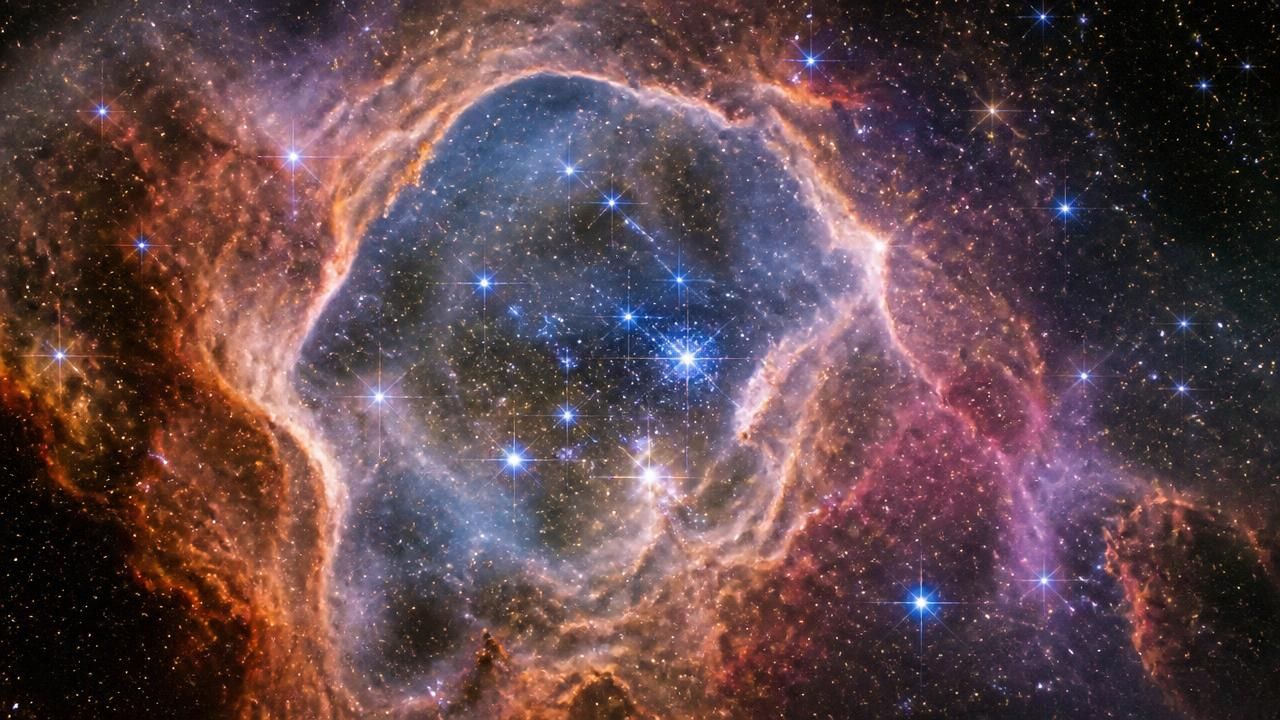
The NASA/ESA Hubble Space Telescope has released a stunning new portrait of LHA 120-N44, a sprawling emission nebula in the Large Magellanic Cloud (LMC), one of the closest satellite galaxies to the Milky Way. At just 160,000 light-years away, the LMC offers astronomers an unrivaled close-up of violent star birth and the mysterious structures that result from it. The new image, which NASA has dubbed a “Superbubble Scene,” reveals a complex, cavernous region where massive, hot young stars are carving out a gigantic bubble of hot gas.
The nebula’s most striking feature is a colossal cavity known as a superbubble. These structures are among the largest cosmic voids observed in galaxies, and N44’s is particularly unusual. The cavity appears to have been created by powerful stellar winds blowing from about 40 young, massive blue stars. Yet the superbubble is much larger than stellar winds alone can explain, leading astronomers to suspect that several supernova explosions have also contributed, blasting the surrounding gas outward and inflating the bubble to hundreds of light-years across. Exactly how this stellar feedback process unfolds lies at the heart of understanding galaxy evolution.
“At just 160,000 light-years away, the LMC offers a close look at highly active star birth sites like the one in this image,” NASA officials noted in the image release.
Cataloguing Half a Million Stellar Residents
In a sweeping complementary study, astronomers have used Hubble to catalogue more than half a million stars in and around the N44 superbubble. This unprecedented census, reported by MSN, turns the iconic image into a densely detailed stellar map. The survey was designed to trace the star formation history of the region and to understand how the expanding bubble has either triggered or quenched the birth of new stars.
The catalogue includes stars in various stages of evolution – from fresh protostars embedded in dust to ancient red giants and luminous blue supergiants. By mapping their positions and brightnesses, researchers can pinpoint the ages and masses of stars at different distances from the superbubble’s rim. Early analysis suggests that the bubble is surrounded by layers of star formation, hinting that the outward push of gas compresses material into new collapsing clouds.
“This is one of the most detailed stellar censuses ever made of a superbubble region,” said an astronomer involved in the study (no direct quotes were available in the source excerpts). “We are finally able to see the cosmic choreography between massive stars and their surroundings.” The findings are expected to appear in several peer-reviewed papers, though as of this writing, the full data sets are still being analysed.
Star Formation in Two Bursts: The Chandelier Cluster
While N44 dominates the news, Hubble has also been studying another remarkable star factory: NGC 346, sometimes called the “Chandelier Cluster,” in the Small Magellanic Cloud. According to Phys.org headlines (the full articles could not be retrieved due to server errors), Hubble’s observations have revealed that stars in this ancient cluster did not form continuously, but in two distinct bursts. This discovery challenges conventional models for how dwarf galaxies build stars.
The Chandelier Cluster is a massive, star-forming region that resembles a sparkling ornament, with thousands of hot, blue stars embedded in filaments of gas and dust. Prior to this result, many astronomers assumed that small galaxies built up their stellar populations gradually over billions of years. The detection of two separate formation epochs suggests that star formation can be “pulsed” – driven by discrete events such as galactic collisions or the collapse of giant molecular clouds after supernova shocks.
The two-burst finding is particularly important because NGC 346 is the most massive young cluster in a low-metallicity dwarf galaxy. Low metallicity mimics the conditions of the early universe, giving astronomers a unique laboratory to watch how the first stars formed after the Big Bang. If star formation occurs in bursts even in small galaxies, then models of cosmic chemical enrichment must be revised.
A Stellar Blast Setting Clouds Ablaze
Another related Hubble observation, described in a Phys.org headline as a “stellar blast setting clouds ablaze,” reinforces the violent reality of stellar feedback. The likely supernova or nova explosion has carved a glowing shell and is actively shocking clouds of interstellar gas, setting them alight with ultraviolet and optical emissions. This process is intimately connected to the superbubble phenomenon in N44 – each generation of massive stars bequeaths its energy back into the surrounding medium either through winds or a dramatic final supernova.
Such images provide direct visual evidence of how stellar blasts compress gas, induce turbulence, and trigger the next round of star formation. The same physics sculpts superbubbles across entire galaxies, and Hubble’s sharp resolution allows researchers to see the fine structure in these shock fronts – now visible in unprecedented detail.
Different Lenses on a Cosmic Drama
Though all the sources report on related Hubble science, each frames the story differently:
- NASA emphasizes the sheer beauty and scale of the N44 nebula, presenting it as a photographic “scene” to inspire the public and convey the visual richness of the universe.
- MSN focuses on the ambitious data-gauging achievement: the cataloguing of half a million stars, underscoring the power of Hubble’s precision photometry and the significance of large stellar surveys.
- Phys.org titles highlight specific astrophysical insights from parallel studies – the two star-formation bursts of the Chandelier Cluster and the igniting effects of a stellar blast – framing them as breakthroughs in stellar evolution research.
Together, they show a single observatory (Hubble) being used both as a surveyor, a historian, and a forensic investigator across dozens of cosmic objects.
Why the Magellanic Clouds Matter
Located just 160,000–200,000 light-years away, the Large and Small Magellanic Clouds are cosmic laboratories for understanding how galaxies evolve. Because they are smaller and less chemically enriched than the Milky Way, their composition resembles that of ancient galaxies seen in the early universe. By studying regions like N44 and NGC 346, astronomers can measure star formation rates, initial mass functions, and feedback processes in an environment radically different from our own galactic neighbourhood.
A popular “catch up” interstellar medium model suggests that superbubbles are driven by clustered supernovae, but N44 appears too large and too symmetrical to be explained by a single cluster. This has sparked speculation that the superbubble may be interacting with dark matter filaments or primordial magnetic fields. The new 500,000-star census should help test those hypotheses.
Implications and the Road Ahead
These Hubble findings come at a crucial time. As the James Webb Space Telescope (JWST) takes over many infrared observations, Hubble’s optical and ultraviolet capabilities remain uniquely suited for measuring young, hot stars and mapping the hydrogen gas in star-forming nebulae. The N44 data will likely serve as a benchmark for future JWST targeted observations, which will peer deep into the dust-enshrouded cores of the superbubble to find the very youngest protostars.
“We’ve spent decades studying the outskirts of these bubbles,” said one reviewer of the Hubble data. “Now, with half a million stars and archival images being combined, we can finally write the full story from the inside out.” The findings could transform our understanding of the dynamic feedback cycle that couples massive stars to their parent galaxies, from the first sprawling structures in the early universe to the intricate nebulae we see today.
The complete set of images and star catalogues from the N44 programme are expected to be made available to the public in the coming months, allowing both professional and amateur astronomers to explore this fascinating superbubble scene in extraordinary detail.