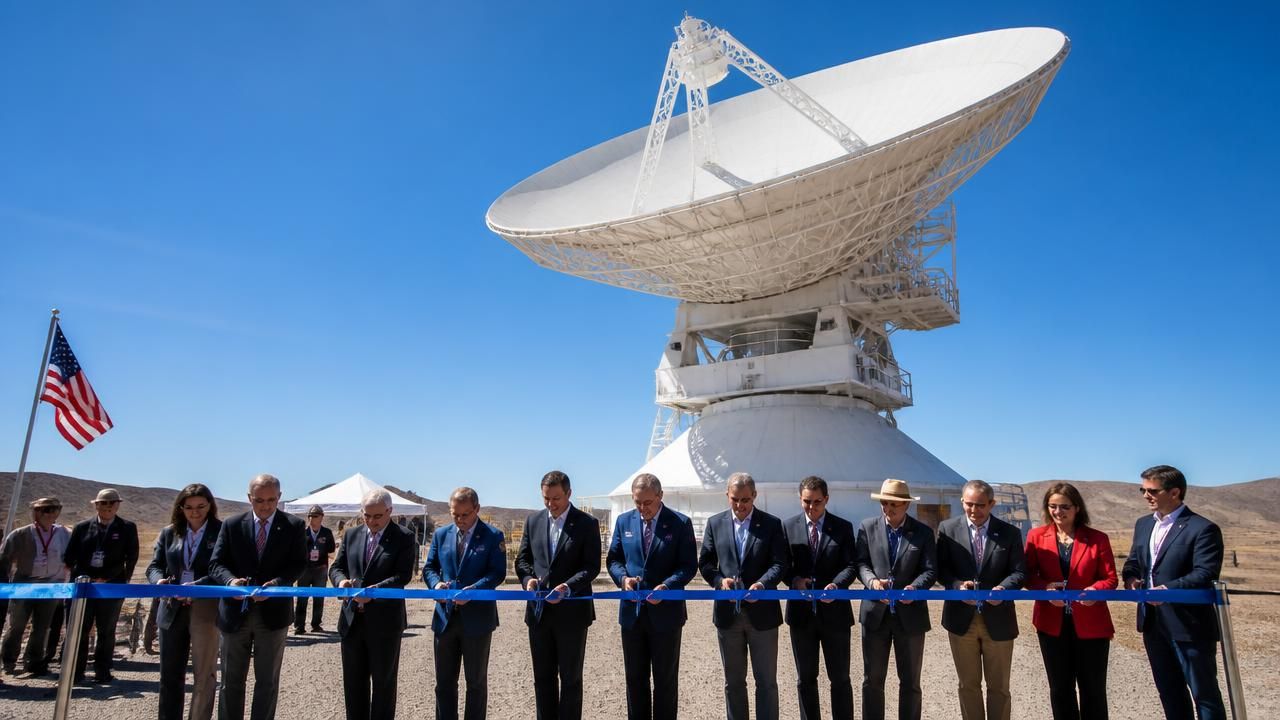
NASA's Deep Space Network (DSN) reached a significant milestone in August 2026 with the completion and activation of Deep Space Station 23 (DSS-23), a new 34-meter-wide (114-foot) radio frequency antenna at the Goldstone Deep Space Communications Complex near Barstow, California. The event marks the latest step in a multi-year effort to upgrade and expand the network that serves as humanity's communications lifeline to more than 40 spacecraft exploring the solar system and interstellar space.
A Ribbon Cutting for the Ages
NASA leadership, Jet Propulsion Laboratory (JPL) personnel, and local dignitaries gathered at Goldstone for a ceremonial ribbon cutting to mark DSS-23's official entry into service. The antenna is the most recent addition under the DSN's Aperture Enhancement Project, an initiative launched in 2009 to add six new 34-meter multifrequency beam-waveguide antennas across the network's three global facilities. These versatile dishes are designed to support a wide range of missions operating at different radio frequencies, from lunar explorers to deep-space probes.
“By expanding the Deep Space Network, we are strengthening the communications foundation NASA needs for the bold missions ahead — from exploring more of the Moon than ever before to peering deeper into the solar system,” said James Kenyon, associate administrator of NASA's Space Communications and Navigation program.
The new antenna is expected to enhance data rates and provide more robust coverage for missions including the Artemis program, Mars rovers, and interstellar voyagers like Voyager 1 and 2. The DSN currently operates three complexes spaced roughly 120 degrees apart around the globe — at Goldstone in California, near Madrid in Spain, and near Canberra in Australia — to ensure continuous communication with spacecraft as Earth rotates.
A Network Built for Future Deep Space Missions
The Aperture Enhancement Project has been central to modernizing the DSN, which was originally established in the 1960s. With missions growing in number and complexity, the network has faced increasing demands for bandwidth and signal fidelity. The new beam-waveguide antennas offer improved performance, particularly in harsh weather conditions, and can be reconfigured to support different frequency bands, including S-band, X-band, and Ka-band, making them more flexible than their predecessors.
DSS-23's completion comes at a critical time. NASA's Artemis II mission, the first crewed lunar flyby in over half a century, is slated for the coming years, and the agency is also planning a sustained presence on the Moon through the Artemis program. The DSN will be essential for maintaining communication with astronauts, relay satellites, and landing systems. In addition, the network supports dozens of robotic missions, including Mars Perseverance and Curiosity, the Europa Clipper, and the James Webb Space Telescope.
The Global Ground Segment
Each DSN complex typically operates several large antennas, including the iconic 70-meter dishes and the newer 34-meter beam-waveguide antennas. The addition of DSS-23 at Goldstone is part of a broader replenishment that has also seen new dishes at the other two complexes. When fully complete, the Aperture Enhancement Project will give NASA a significantly more capable and resilient communications backbone.
However, the DSN is not only about receiving data from distant spacecraft. It also serves as a critical tool for navigation, using Doppler and ranging measurements to precisely determine spacecraft positions and velocities. This capability is vital for trajectory corrections, planetary landings, and science operations. The new antennas are expected to improve navigation accuracy thanks to advanced slew rates and lower noise temperatures.
Complementary Technologies: AI and Nuclear Power
While DSS-23 bolsters the ground segment, other emerging technologies aim to make spacecraft themselves more independent and capable. In parallel, NASA's Jet Propulsion Laboratory has been developing artificial intelligence (AI) space chips that could allow spacecraft to think for themselves. These radiation-hardened processors are designed to run machine-learning algorithms onboard, enabling satellites to make real-time decisions — such as adjusting observations in response to changing weather or detecting anomalies without waiting for ground commands.
Similarly, L3Harris announced in 2026 that it had finalized the design of a deep space power source based on nuclear technology. The system, often referred to as a radioisotope or fission power source, is intended to provide steady electricity for missions where sunlight is too weak for solar panels, including the outer planets and interstellar space. Such power sources are critical for maintaining communications, operating science instruments, and even running AI processors in remote environments.
Together, these technologies paint a picture of the future of deep space exploration: more powerful ground networks like the DSN, smarter spacecraft capable of autonomous decision-making, and reliable power sources to sustain them across vast distances.
Why It Matters
The completion of DSS-23 is not merely a hardware upgrade; it is a strategic investment in the nation's space capabilities. As NASA and international partners push farther into the solar system, the ability to send and receive data becomes a limiting factor. The DSN's expansion ensures that the scientific and human exploration programs of the coming decades will have the bandwidth they need to return data, images, and video from ever more distant vantage points.
For scientists and engineers, the new antenna also symbolizes a continuity of purpose. The Goldstone complex, which began operations in 1958, has tracked everything from the earliest lunar probes to the Voyager spacecraft now crossing the heliopause. DSS-23 stands as a bridge between that legacy and a future that includes Moon bases, Mars sample return, and possibly human missions to the Red Planet.
As Kenyon emphasized, the expansion of the Deep Space Network is a foundational element for “the bold missions ahead.” With DSS-23 online, NASA has taken a concrete step toward turning those ambitions into reality.