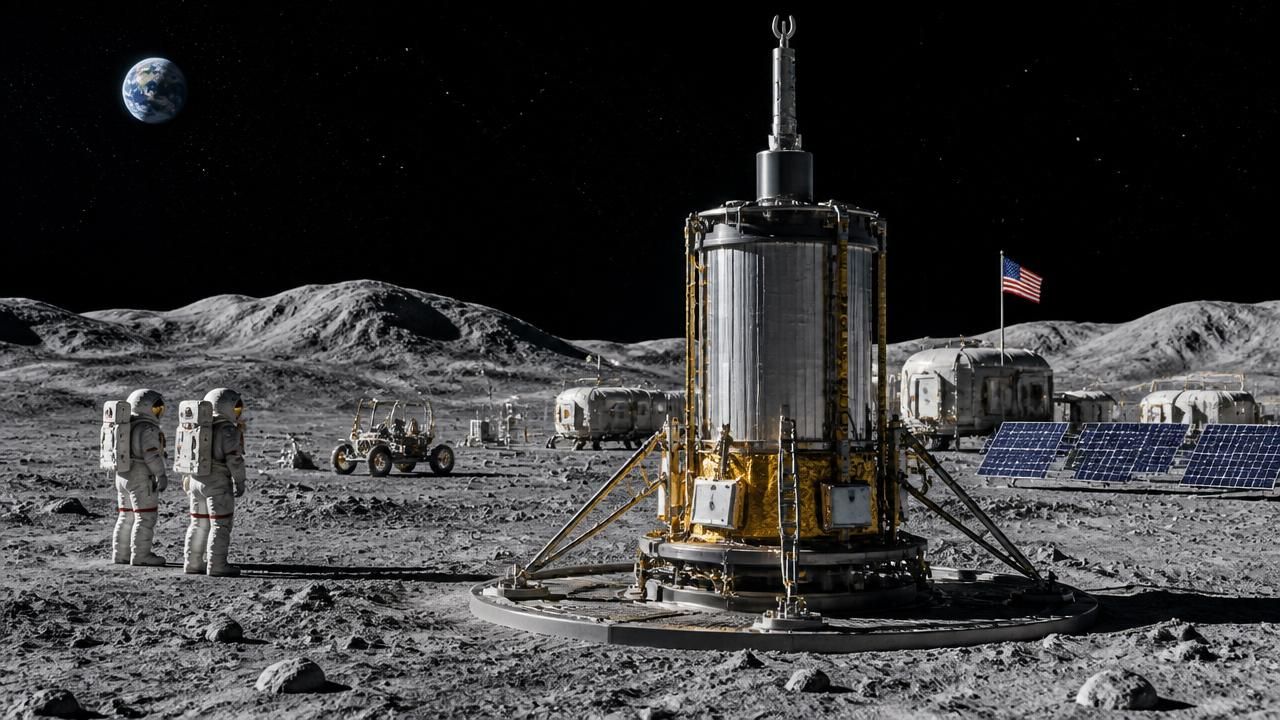
NASA has formally opened the competition to build the first nuclear fission reactor intended to operate on the surface of the Moon, issuing a request for proposals for a small power plant it calls Lunar Reactor-1, or LR-1. The agency says it wants a launch-ready system by 2030 and expects the reactor to run for at least five years after it is deployed — a timeline that, if met, would put American hardware on the lunar surface roughly six years ahead of a rival Russian effort.
The announcement marks a shift from decades of paper studies to procurement. Rather than designing the reactor in-house, NASA is asking industry to propose, build and test the flight unit, with the agency acting as anchor customer for a capability it says is a prerequisite for any sustained human presence beyond low Earth orbit.
What LR-1 Is Meant to Do
LR-1 is specified as a compact fission system generating about 20 kilowatts of electricity — enough, NASA notes, to power roughly 16 average American households for a year. On the Moon, that output would be routed to habitats, communications links, rovers, scientific instruments and other infrastructure that planners expect a lunar base to require.
The number sounds modest, and deliberately so. NASA is buying a demonstrator, not a utility-scale plant; the goal is to prove that a reactor can survive launch, land intact, start up autonomously and run unattended in a hostile environment. The agency's framing emphasizes reliability over raw capacity.
“This request for proposals represents an important step forward as NASA partners with industry to establish an enduring human presence on the lunar surface,” said Brian Giblin, NASA's Lunar Reactor-1 program manager. “A reliable source of safe and abundant energy will be vital to future exploration of the lunar and Martian surface.”
Why Nuclear and Not Solar
The central engineering argument for fission is the lunar day-night cycle. A single lunar day lasts about 29.5 Earth days, meaning any given spot on the surface spends roughly two weeks in continuous darkness and experiences extreme cold. Solar arrays paired with batteries can bridge a night on a small scale, but the mass of storage required scales badly as power demand grows.
A reactor runs through the night, through shadowed crater floors and through the permanently dark regions near the poles that scientists consider the most valuable real estate on the Moon because of their suspected water ice. That dual-use argument — power for exploration and power for science — is a large part of why the program has survived budget cycles that have killed other lunar initiatives.
- Continuous output: generation independent of sunlight, enabling operations through the two-week lunar night.
- Polar access: capability to operate in permanently shadowed terrain where ice deposits are thought to exist.
- Scalability: a modular fission unit can be replicated and clustered as power demand rises.
- Timeline: launch-ready by 2030, five years of surface operations thereafter.
A Race, Not a Research Project
The most revealing coverage of the announcement has framed it less as a science milestone than as a contest. Reports have emphasized that the U.S. schedule would land a reactor roughly six years before Russia's planned lunar nuclear system, and The New York Times characterized the broader dynamic bluntly: superpowers are racing to put nuclear reactors on the Moon.
That framing reflects real geopolitics. China and Russia have advanced plans for an International Lunar Research Station, with nuclear power listed among the technologies under study. Washington, meanwhile, leads the Artemis Accords, a set of bilateral principles on civil lunar activity that now counts dozens of signatories — but notably not China or Russia. Whoever establishes a working, refuelable, restartable reactor on the surface sets de facto technical standards for anyone who follows.
The Commercial Angle
Financial outlets picked up a secondary signal: space-focused exchange-traded funds reportedly snapped a seven-day slide on the day NASA's partnership call went public. It is a small data point, but a telling one — investors now read NASA procurement notices as revenue signals for a emerging cislunar supply chain rather than as pure science spending.
The Objections
Not everyone welcomes the direction. Sceptical commentary, including from Counterpunch, has raised the questions that nuclear power in space reliably provokes: what happens if a launch fails and a reactor re-enters the atmosphere; who safeguards fissile material on a body governed by no sovereign authority; whether a civilian power program becomes a cover for military energy infrastructure; and whether the money would be better spent on Earth-side problems or on cheaper robotic science.
NASA's answer has been procedural and technical. The reactor is designed to launch cold — not activated until it reaches space — a standard practice meant to eliminate the risk of a radioactive release during a launch anomaly. The agency also stresses that fission surface power is a civil program, distinct from the defense research the Pentagon has separately pursued for orbital power and propulsion.
Those assurances will be tested as the program moves through design review and, eventually, an environmental and nuclear safety approval process that has few precedents for flight hardware.
What Happens Next
Industry teams now have a defined window to submit proposals, with NASA expected to make selections and move toward prototype testing before committing to a flight unit. The critical unknowns are mass — every kilogram of shielding and containment costs launch capacity — and autonomy, since a lunar reactor must start, throttle and shut down safely with no one on site and limited bandwidth from Earth.
If NASA holds its 2030 target, LR-1 would become the first fission reactor operated on another world, eclipsing the small radioisotope power sources that have powered deep-space probes since the 1960s. That would make the program simultaneously an engineering milestone, a geopolitical marker and, if the sceptics are right, the opening argument in a long debate over who gets to bring nuclear energy to the Moon — and under what rules.