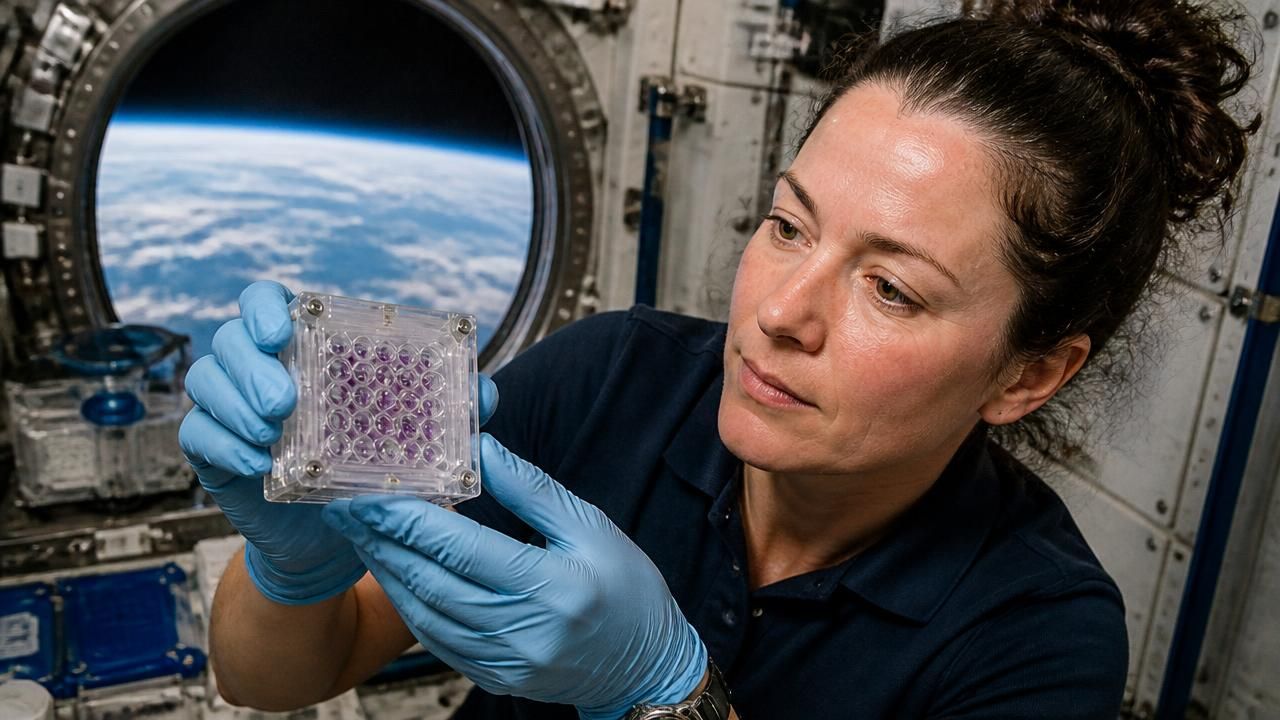
More than 200 miles above Earth, inside a biochip roughly the size of a postage stamp, clusters of human gastric cancer cells are growing in ways they never do on the ground. NASA's Image of the Day for Nov. 19, 2026, offered a rare look at those microtumors — patient-derived tumor samples cultivated aboard the International Space Station for an investigation known as Encapsulate-1.
The image, credited to Encapsulate Inc., is more than a striking photograph. It is a snapshot of a fast-maturing research pipeline in which the orbital laboratory is being used not just to study astronauts' health but to attack cancer itself, using the absence of gravity as a tool that cannot be replicated in any terrestrial lab.
Why microgravity matters for cancer
On Earth, cells grown in a dish are flattened by gravity and forced to spread across a two-dimensional surface. In orbit, they instead assemble into three-dimensional structures that more closely resemble real tumors — clumping together, forming cell-to-cell contacts, and behaving in ways that standard petri-dish cultures cannot reproduce. The station's microgravity environment also suppresses some of the mechanical cues that drive cell behavior, giving researchers a cleaner window into how cancer cells move, signal, and interact.
NASA frames the work in explicitly clinical terms. According to the agency, the Encapsulate-1 investigation studies patient-derived tumor samples aboard the station "to better understand how cancer cells move and interact in microgravity," with results that "could help researchers develop further testing to predict a patient's risk of metastasis and support more personalized cancer treatments."
The agency has long promoted the station as a scientific asset in its own right. "Orbiting more than 200 miles (320 km) above Earth, the space station is a powerhouse of cutting-edge science that is unlocking discoveries not possible on Earth," NASA notes in its release accompanying the image.
A crowded manifest of cancer research
Encapsulate-1 is one thread in a much larger tapestry. In recent months and weeks, the station has hosted a widening array of biomedical payloads:
- Colorectal tumor avatars. A separate station study is testing colorectal cancer "tumor avatars" — patient-derived organoids — in microgravity, examining how they grow and respond to treatment in orbit.
- Brain cancer organoids. Space-grown organoids are being positioned as a way to advance brain cancer treatment, giving researchers 3D models of gliomas and other tumors that are notoriously difficult to culture on Earth.
- Blood vessel printing. NASA has highlighted advances in 3D bioprinting of blood vessels in orbit, work that matters for understanding how tumors recruit a blood supply — and for tissue engineering more broadly.
- Mount Sinai's tissue models. Researchers at Mount Sinai are preparing to send human tissue models into space to study brain and heart health and the biology of aging under microgravity conditions.
Those threads converge in one place: the return capsule. A SpaceX Dragon spacecraft has splashed back down carrying cancer research samples, 3D-printed blood vessels, and other experiment hardware — the physical payoff of months of orbital work, now headed for laboratories on the ground.
Aging, radiation, and the limits of the model
One of the more consequential lines of inquiry links microgravity and space radiation to accelerated aging. If the combination of weightlessness and cosmic radiation speeds up processes associated with aging — changes in cardiovascular function, cellular stress responses, cognitive decline — then the station becomes a compressed testing ground for therapies that could one day benefit patients on Earth.
"The results could help researchers develop further testing to predict a patient's risk of metastasis and support more personalized cancer treatments." — NASA, on the Encapsulate-1 investigation
Mount Sinai's planned tissue-model mission fits squarely into that framework, extending the question from cancer to the heart and brain, and from tumor biology to the fundamental mechanics of how human tissue ages when gravity stops pulling on it.
How the story is being framed
Different outlets have approached the same orbital science from strikingly different angles. NASA and aggregators such as PetaPixel led with the imagery — a biochip glowing under a microscope, framed as a picture of the day. Specialist health outlets, including News-Medical, focused tightly on colorectal tumor avatars and the mechanics of the experiment. Newswise carried the institutional view, amplifying Mount Sinai's plans and timeline. Others, including MSN's aggregation feeds, framed the story around the Dragon splashdown and the cargo of breakthroughs returning with it.
That divergence reflects how space biology is now communicated: as spectacle, as clinical promise, and as logistics. All three are accurate. The photographs draw attention; the tumor models do the science; the return capsule decides whether any of it produces peer-reviewed results.
Opening the door — and the caveats
Access to orbit has historically been a bottleneck, with launch costs and safety reviews limiting experiments to a small circle of well-funded institutions. That is beginning to shift. In a notable sign of widening access, Oklahoma universities are set to send experiments to space for free in 2027, part of an effort to broaden the research base beyond established space-science hubs.
Yet researchers caution that microgravity cancer studies remain early-stage. Sample sizes are small, flight opportunities are limited, and biological changes observed in orbit must be untangled from the effects of launch stress, radiation, and short mission durations. Reproducibility — the ability to run the same experiment repeatedly — is a persistent constraint when each run requires a rocket.
Still, the direction of travel is clear. If tumor avatars grown in orbit can reliably predict which cancers will metastasize, or if space-grown organoids can screen drugs faster than Earth-bound models, the clinical payoff would be substantial. For now, the evidence sits in small plastic chips circling the planet — and in the returning capsules that bring it home.