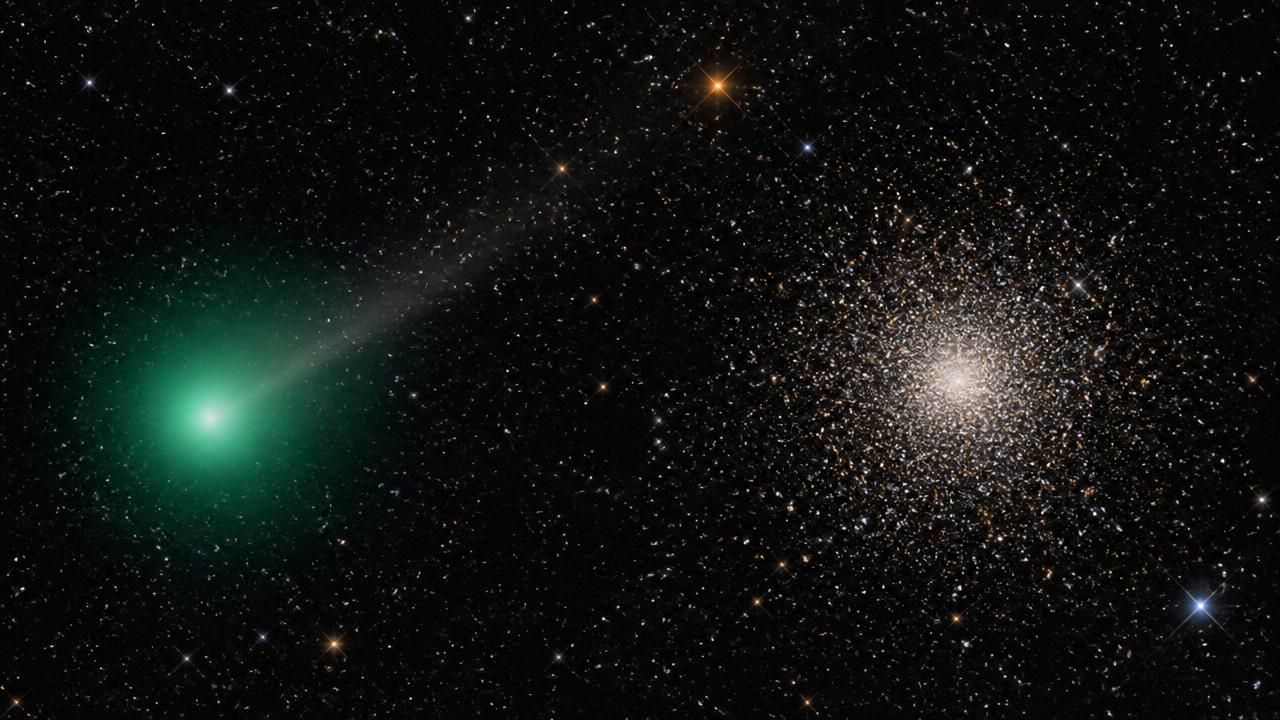
In the quiet expanse of the night sky, a rare and beautiful alignment has captured the attention of astronomers and stargazers alike. NASA's Astronomy Picture of the Day (APOD) for August 8, 2026, showcases periodic comet 10P/Tempel 2 as it swept dramatically close to the globular star cluster Messier 30 (M30). The striking image, recorded on July 29, reveals a fleeting celestial encounter that underscores the serendipity of cosmic observation.
A Cosmic Coincidence
The composite image, taken by a modern telescope, captures the diffuse greenish coma of Tempel 2 on the left, while the dense, ancient stars of M30 shine on the right. At first glance, the two objects appear to be neighbors, but appearances can be deceiving. The comet was a mere 3.5 light-minutes from Earth at the time of the observation, whereas M30 lies approximately 28,000 light-years away in the constellation Capricornus. The apparent proximity is purely a line-of-sight coincidence.
"Which of these is not a comet? You guessed it – the one on the right is a globular star cluster," explains the APOD narrative.
The Messier Connection
The juxtaposition of the comet and the cluster is particularly poetic because of the catalog that links them. Charles Messier, the 18th-century French astronomer, famously compiled a list of nebulous objects to help comet hunters avoid mistaking them for comets. M30 is the 30th entry in his celebrated catalog of "things which are not comets." Ironically, in this image, a real comet appears to pierce the very object that Messier documented as a comet imposter.
Messier's original telescope would have shown both objects as faint and fuzzy, almost indistinguishable in the eyepiece. The modern image, by contrast, reveals the comet's faint, narrow orbital dust trail seemingly threading through the globular cluster's core. This visual juxtaposition is a reminder of how far astronomical imaging has come since Messier's time.
About Comet 10P/Tempel 2
Comet Tempel 2 is a well-known periodic comet, discovered in 1873 by Ernst Tempel. It orbits the Sun every 5.4 years, making it a frequent visitor to the inner solar system. Its relatively short period and predictable path have made it a target for both professional research and amateur observation. This latest close approach to M30 was a fortunate alignment, offering astronomers a chance to study the comet's dust trail against a dense background of stars.
The comet's greenish coma, visible in the APOD image, is caused by the fluorescence of diatomic carbon and other molecules excited by solar radiation. This characteristic color is a hallmark of many comets, distinguishing them from the older, yellower stars of globular clusters.
M30: A Relic of the Early Universe
Globular cluster M30 is a spherical collection of hundreds of thousands of stars, bound together by gravity and orbiting the Milky Way's halo. It is estimated to be about 13 billion years old, making it one of the oldest known objects in the galaxy. Its stars are metal-poor, consisting mostly of hydrogen and helium, with heavier elements locked away in the cluster's formation epoch. Observing such clusters provides valuable insights into galaxy formation and stellar evolution.
The chance alignment of a solar system comet with a distant globular cluster is a visually stunning reminder of the vast scales of the universe. While the comet is just a few kilometers across, its tail extends for millions of kilometers, yet it appears as a small wisp next to an ancient metropolises of stars tens of thousands of light-years away.
Broader Implications and Observations
For amateur astronomers, the event served as a practical lesson in observational astronomy. Comets and globular clusters are both classified as "faint fuzzies" in binoculars, and this alignment offered a chance to differentiate between the two through careful observation. The APOD image itself is a testament to the capabilities of modern amateur and professional equipment, capturing details that would have been unthinkable in Messier's era.
The APOD feature also highlights the ongoing work of the astronomical community in monitoring near-Earth objects and periodic comets. Tempel 2's trajectory is well-documented, and close approaches to bright deep-sky objects are often predicted years in advance, allowing photographers and scientists to prepare.
How to See It
While the close approach has passed, observers in the Southern Hemisphere may still be able to spot Tempel 2 with a moderate telescope for a few more weeks. The comet is currently receding from the Sun and will gradually fade from view. M30, on the other hand, remains a beautiful target for small telescopes, appearing as a faint, fuzzy patch in Capricornus.
For those who missed the alignment, the APOD image stands as a permanent record of a fleeting cosmic moment. It also serves as a reminder that the sky is constantly changing, with new surprises awaiting those who look up.
A Legacy of Discovery
The Messier catalog, born from the frustration of confusing comets with static objects, now serves as a favorite list of deep-sky targets for amateur astronomers. The chance encounter between Tempel 2 and M30 brings that history full circle. It is a moment where a comet, the very type of object Messier sought to avoid, appears to interact with a catalog entry created specifically to exclude it.
As the APOD editors note, even Messier himself would have been able to tell the difference, though his telescope would have shown both as similar faint smudges. In the decades since, technological advances have transformed our view, allowing us to appreciate the beauty and complexity of the universe in ways that illuminate both the science and the history of astronomy.
The Astronomy Picture of the Day is a service of NASA and Michigan Technological University, providing daily images of the universe and expert explanations. This particular episode highlights the enduring relevance of Messier's work and the endless surprises of the night sky.
This celestial rendezvous is yet another chapter in humanity's ongoing exploration of the cosmos, reminding us that the universe is full of surprising and beautiful coincidences waiting to be discovered.