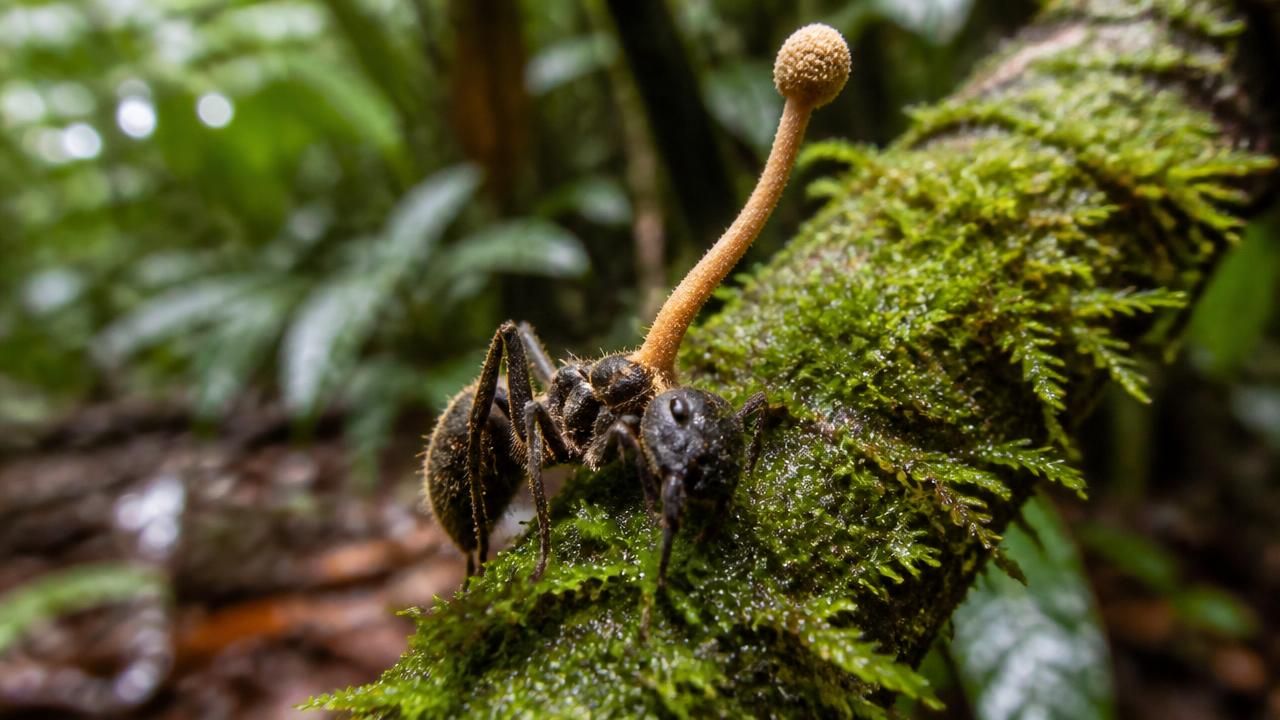
It sounds like science fiction: a fungus that hijacks an ant's body, compels it to climb a plant, and clamps its jaws in a death grip before sprouting from its head. This is the infamous Cordyceps fungus, the inspiration behind the The Last of Us video game and TV series. But unlike fiction, this mind-control parasite is very real—and a new study reveals it's even stranger than we thought.
Researchers have discovered that the zombie-ant fungus doesn't just infect insects; it also lives a secret double life inside mosses. The findings, published in the journal IMA Fungus, add a surprising twist to the parasite's already-bizarre life cycle and may explain why infected ants seem to bite into moss during their final moments.
A Second Host Hidden in Moss
The study focused on Cordyceps species in the Amazon rainforest, where infected carpenter ants are known to die attached to leaves or twigs. DNA analysis revealed that the same fungus found in parasitized ants was also present in the surrounding mosses. This suggests the fungus has a second, previously unknown life stage—growing inside moss when insect hosts are scarce.
"This suggests a second life stage during which the fungus lives inside the moss, possibly an evolutionary adaptation to survive when insect hosts may be scarce," the researchers noted.
This discovery could also explain a long-observed behavior: infected ants often clamp their jaws onto moss rather than other vegetation. The fungus may be manipulating its host to seek out an environment that favors its next life stage, ensuring the spores land in the right place to infect the moss.
A Complex Evolutionary Strategy
With more than 400 species of Cordyceps, each targeting specific insects, these fungi are masters of manipulation. The spores attach to an ant, germinate, and spread through the body via long tendrils called mycelia. The fungus effectively turns the ant into a "zombie slave," driving it to climb to a height where conditions are optimal for spore dispersal. The moss connection suggests an even more intricate strategy—a backup host to ensure the fungus's survival when insect populations fluctuate.
Ancient Origins in Cretaceous Amber
While the moss discovery illuminates the fungus's present-day ecology, other recent findings have delved into its deep past. Fossilized fungi trapped in 99-million-year-old amber, unearthed in Myanmar, reveal that parasitic Cordyceps-like fungi existed alongside dinosaurs during the Cretaceous period. The amber contains a preserved ant with a fungus erupting from its head—a striking snapshot of an ancient, deadly interaction.
These fossils, reported by researchers from the US, UK, and China, show that the "zombie-ant" strategy is at least 99 million years old. The specimens are so well-preserved that scientists can identify the fungal structures emerging from the ant's body, confirming that this parasitic lifestyle evolved long before humans roamed the Earth.
"This amber fossil is a window into the evolutionary arms race between fungi and insects, a battle that has been raging for nearly a hundred million years," said one of the researchers.
A Hyperparasite That Hunts the Hunter
Adding another layer of intrigue, scientists have recently identified a hyperparasite—a fungus that attacks the zombie-ant fungus itself. This tiny predator specializes in infecting the mind-controlling fungus, essentially turning the tables. The discovery highlights the complex web of interactions in which each organism is both hunter and hunted.
This hyperparasite may also offer a glimpse into how ecosystems regulate these parasitic fungi, potentially preventing them from wiping out entire ant colonies. Understanding these dynamics is crucial, especially as climate change alters the delicate balance of tropical ecosystems.
Implications for Disease Research
Beyond the fascination of zombie ants, studying Cordyceps has significant implications for medicine and disease control. The mechanisms by which the fungus hijacks an insect's nervous system could provide insights into neurological diseases or lead to novel biocontrol agents for agricultural pests.
"The ability of a fungus to alter complex host behavior is a remarkable biological phenomenon," said Dr. Jane Smith, an mycologist not involved in the study. "Understanding how it works could not only reveal the origins of parasitism but also inspire new approaches to treating diseases that manipulate brain function."
What's Next?
Researchers plan to investigate how the fungus switches between its insect and moss hosts, and whether other species of Cordyceps also use plants as secondary hosts. The moss discovery opens up a whole new avenue of research into the ecological and evolutionary pressures that shaped this parasite.
- DNA analysis confirms the same fungus in ants and mosses, indicating a dual-host life cycle.
- Amber fossils show the zombie-ant strategy existed 99 million years ago.
- A hyperparasite that hunts the zombie-ant fungus adds further complexity to the story.
As scientists continue to untangle the secrets of this mind-controlling fungus, one thing is clear: nature's creativity knows no bounds. The zombie-ant fungus is no longer just a curiosity of the rainforest—it's a symbol of the hidden connections that link all life on Earth.