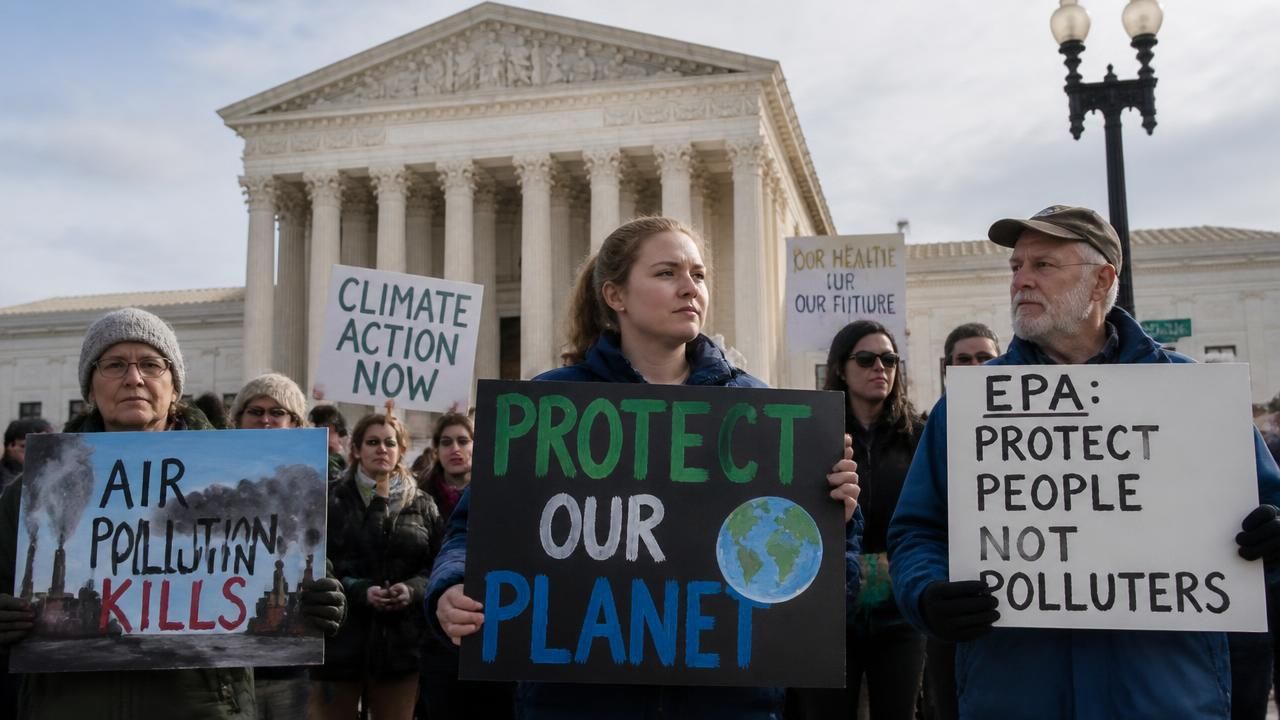
The Trump administration’s sweeping rollback of environmental protections has ignited a legal war with blue states, environmental groups, and public health advocates. At the center of the conflict are three fronts: the Environmental Protection Agency’s repeal of the landmark climate “endangerment finding,” the Department of Justice’s unprecedented intervention in a pollution lawsuit against Elon Musk’s xAI, and a broader assault on the citizen suit provisions that have empowered ordinary Americans to hold polluters accountable for decades.
Gutting the Legal Foundation of Climate Action
The EPA’s decision to rescind the 2009 endangerment finding—the legal cornerstone for federal regulation of greenhouse gases—was hailed by the Trump administration as a victory for industry and dismissed by critics as a gift to “billionaire polluters.” The finding had declared that carbon dioxide and other heat-trapping gases threaten public health and welfare, justifying rules on tailpipes and power plants. Environmental advocates argue the repeal is not only scientifically indefensible but also legally fragile, since the Supreme Court has acknowledged EPA’s authority under the Clean Air Act.
California Governor Gavin Newsom immediately vowed to challenge the repeal, stating that the administration is “breaking the law to put polluter profits before American lives.” A coalition of 22 blue states, led by California and New York, has filed suit in the D.C. Circuit, arguing the repeal violates the Clean Air Act and ignores overwhelming scientific evidence. The Natural Resources Defense Council and other groups have also launched parallel challenges.
The DOJ and the xAI Lawsuit
In a separate but equally consequential case, the Justice Department has intervened to support Elon Musk’s xAI in a citizen suit over air pollution from its Memphis data center. The facility, powered by natural gas turbines, has been operating without a federal permit, according to the Southern Environmental Law Center, which filed suit on behalf of local residents. The DOJ argues that the lawsuit is preempted by federal law and that xAI should not be subject to state enforcement.
Critics see the move as an attempt to cripple citizen suits—a mechanism Congress created in the 1970s to allow individuals and advocacy groups to enforce environmental laws when the government fails to act. “Since the 1970s, those provisions have been used in over 2,000 lawsuits,” notes Ars Technica, “and a majority of environmental cases are citizen suit cases.” The Trump administration has repeatedly sought to narrow these provisions, including by backing legislation that would make it harder for communities to sue polluters.
“The administration is not just rolling back protections—it is trying to silence the very people who have historically held industry accountable.” — Legal analyst quoted in The Guardian
States Fight Back
The resistance extends well beyond the courtroom. In Michigan, the state’s largest climate polluter, a coal plant, was forced to shut down despite a federal order to keep it open, reflecting a growing defiance from state officials. Meanwhile, Vermont’s Climate Superfund Act, which requires fossil fuel companies to pay for climate damages, has drawn a direct DOJ lawsuit. The administration’s move against Vermont has been mocked by critics as hypocritical, given Trump’s campaign trail rhetoric about states’ rights.
Washington state’s largest carbon emitter also closed its doors, citing the economic calculus of clean energy. These developments illustrate a widening gap between federal policy and state-level action. As Politico reports, “Trump’s big climate reversal sets up a courtroom clash” that could ultimately reach the Supreme Court.
Public Health at Stake
Health experts warn that the rollbacks will have immediate consequences. A report from the Center for American Progress estimates that weakening pollution rules could trigger millions of additional asthma attacks and thousands of premature deaths. The EPA has also announced it will stop calculating the monetary benefits of air pollution curbs, a move critics say is designed to obscure the human cost of deregulation.
“The Trump administration’s attack on environmental protections will increase cancer-causing pollution,” warns another CAP analysis. The same theme is echoed by the Union of Concerned Scientists, which has documented the administration’s year-long assault on climate science and clean energy. Even the administration’s own health agenda is under strain: Vox notes that Trump’s environmental rollbacks are undermining RFK Jr.’s “Make America Healthy Again” initiative.
The Broader Rollback
The administration has also moved to repeal Biden-era power plant rules, abandoned a rule restricting deadly soot pollution (a decision later rejected by an appeals court), and exempted 12 Louisiana chemical facilities from new pollution controls. Ohio, meanwhile, scrapped a key air pollution enforcement tool, leaving advocates demanding its restoration. The pattern is unmistakable: every lever of federal environmental regulation is being pulled back.
Industry groups applaud the deregulation as necessary to boost economic growth and competitiveness, especially as AI data centers and manufacturing surge. The American Petroleum Institute and the U.S. Chamber of Commerce have filed briefs in support of the rollbacks, arguing that overregulation stifles innovation. Yet the rise of artificial intelligence is creating new energy demands—xAI’s Memphis facility among them—that are colliding with aging coal and natural gas infrastructure. As Politico reported, “Pollution from coal plants was dropping. Then came Trump and AI.”
What Comes Next?
The legal battles are just beginning. With multiple cases pending in federal courts, the outcome will hinge on the judiciary’s interpretation of the Clean Air Act, the Administrative Procedure Act, and the limits of executive power. Legal scholars say the Trump administration’s aggressive approach is likely to produce contradictory rulings, ultimately setting up a Supreme Court showdown.
For now, the administration, states, and environmental groups remain locked in a high-stakes confrontation over the future of America’s air, water, and climate. As the nation’s courts weigh in, the public—and the planet—will be watching closely.