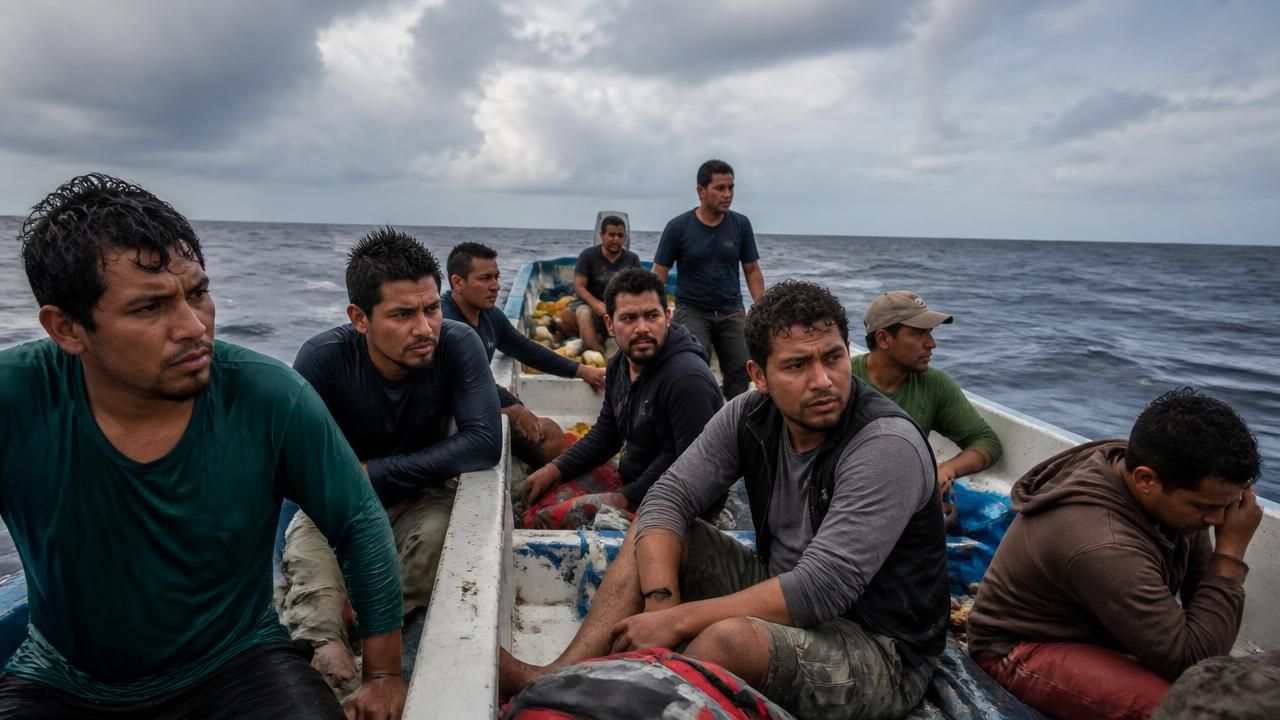
Ten Ecuadorian fishers were drifting in the eastern Pacific on 9 September, their vessel destroyed by United States forces, while US Secretary of State Marco Rubio stood beside Ecuador’s president in Quito receiving a decoration for “helping to promote peace in the region.” The two scenes — one of rescue and survival at sea, the other of ceremony and diplomacy — have come to define a quietly escalating confrontation over Washington’s expanding maritime campaign against drug trafficking in Latin American waters.
The Strike on the Don Rufo
According to reporting by The Guardian, the fishing boat Don Rufo was intercepted on 8 September — a day before Rubio arrived in Ecuador — by a US patrol vessel in international waters near the Ecuadorian coast. US officials linked the vessel to Los Choneros, one of Ecuador’s largest and most feared criminal organizations, which Washington has designated as a drug trafficking outfit responsible for moving cocaine from the Andean interior toward the Pacific corridor.
The boat was destroyed. Its crew of ten survived, but were left adrift until recovered. Details of the encounter remain contested: Al Jazeera, framing its coverage around the testimony of those aboard, reported that crew members described being “handcuffed and blindfolded” during and after the interdiction, raising questions about how the US characterizes the men it targets — traffickers, or ordinary fishers caught in the dragnet of a militarized drug war.
Rubio in Quito: A Ceremony and a Warning
The timing has proven politically explosive. Rubio’s visit to Quito, where Ecuadorian President Daniel Noboa praised him for regional peacemaking, coincided almost precisely with the strike. Rather than softening after the mission, the secretary of state doubled down. Washington, he said, remains willing to “blow up ships if need be” — a statement that converted what might have been dismissed as a single errant operation into an explicit declaration of policy.
“We are still willing to blow up ships if need be.” — US Secretary of State Marco Rubio, speaking during his visit to Ecuador
The remark underscored a doctrinal shift in US counter-narcotics strategy: from interdiction and prosecution toward kinetic military action in international waters, often without evident judicial process for those aboard.
A Widening Legal Crisis
TeleSUR, reporting on what its headline called “11 controversial attacks,” framed the Don Rufo incident not as an isolated error but as the latest data point in a pattern of strikes that is deepening a legal crisis. The core questions are jurisdictional: Under what authority does the US military destroy a private vessel flying a foreign flag in international waters? What evidentiary threshold is applied before lethal force? And what obligation exists to rescue survivors?
International law specialists have long debated the limits of maritime self-defense and counter-trafficking operations under the UN Convention on the Law of the Sea. Targeting a vessel linked to a criminal gang — rather than a state actor or an armed conflict — exists in a legal grey zone that critics say is being deliberately widened.
- The strikes take place in international waters, outside any declared armed conflict zone.
- Crew members report being restrained and blindfolded, with no reported charges or judicial process.
- Vessels are destroyed rather than seized, eliminating physical evidence.
- Survivors are left adrift, complicating rescue and accountability.
Humanitarian Fallout on the Water
For Ecuador’s coastal communities, the practical consequences are immediate. An attorney representing the fishers told The Guardian that the crews are “losing their livelihoods.” Fishing boats represent not just income but family capital, often financed over years. A destroyed hull is an uninsured loss, and the stigma of an alleged cartel link can make future licensing, insurance, and employment nearly impossible.
The humanitarian critique does not stop at economics. Families of the crew have questioned why men operating a working fishing vessel were treated as combatants. Ecuadorian officials have thus far avoided directly rebuking Washington, a reflection of Quito’s deepening security partnership with the US under Noboa, whose government has declared internal armed conflict against organized crime.
How Different Outlets Frame the Story
The divergence in coverage is itself revealing. The Guardian centers the human and diplomatic irony — Rubio honored for peace while fishers float in the Pacific. Al Jazeera foregrounds testimony of “handcuffed and blindfolded” crew members, pushing the accountability question. MSN’s framing, emphasizing the US blow up of a ship “linked to Los Choneros,” reflects how much of the mainstream US coverage has adopted Washington’s justification. TeleSUR aggregates the incidents into a systemic critique, escalating from one boat to eleven strikes and a broader rule-of-law challenge.
Together, the accounts show a story being pulled in two directions: a security narrative of cartel interdiction, and a legal-humanitarian narrative of due process and livelihood destruction.
Why It Matters
The Don Rufo strike matters beyond Ecuador. It tests whether the US can conduct lethal maritime operations against non-state criminal networks without triggering the legal frameworks that govern armed conflict, or the diplomatic backlash of allied nations whose citizens are killed or displaced. Rubio’s refusal to waver suggests Washington believes the political costs are manageable.
But Ecuador’s fishers — and the attorneys and families behind them — are assembling the record of what that policy looks like from the waterline: burned hulls, blindfolded crews, and livelihoods that, unlike the ships, cannot be rebuilt with a press statement.