The universe is under no obligation to make sense to us, but this week it seemed particularly eager to confound physicists. A flurry of new results—from a hidden 'dark force' that slows cosmic growth to the first direct measurement of antimatter falling downward—has upended assumptions and reinvigorated debates about the fundamental laws of nature.
A Dark Force in the Dark Sector
One of the most striking findings comes from theoretical work highlighted by Science Daily. Dark matter, the invisible substance that outweighs ordinary matter by a factor of five, may exert a hidden 'dark force' on itself. But this force does something unexpected: while an extra attraction helps dark matter particles cluster together, it also makes dark matter effectively lighter as the Universe expands. That reduces its gravitational pull and slows the growth of cosmic structure rather than accelerating it.
This counterintuitive result flips the usual assumption that adding attraction only enhances structure formation. "It's a strange thing," say the researchers, "the force does the opposite of what scientists expected." The finding also hints at a possible 'fifth force' lurking in the solar system, a possibility investigated by NASA scientists. Meanwhile, after nearly a century of searching, researchers may have finally detected dark matter directly—a claim that, if confirmed, would be revolutionary.
"An extra attraction helps the particles cluster, yet it also makes dark matter effectively lighter as the Universe expands. That weakens its gravitational impact and usually slows the growth of cosmic structure rather than accelerating it."
Antimatter Falls Down, and the Standard Model Cracks
At CERN, the ALPHA experiment has confirmed that antimatter responds to gravity exactly as Einstein's general relativity predicts—it falls down. While this may sound unsurprising, it is the first time anyone has directly measured the gravitational behavior of antiprotons. The result rules out any large 'antigravity' component and validates a cornerstone of physics.
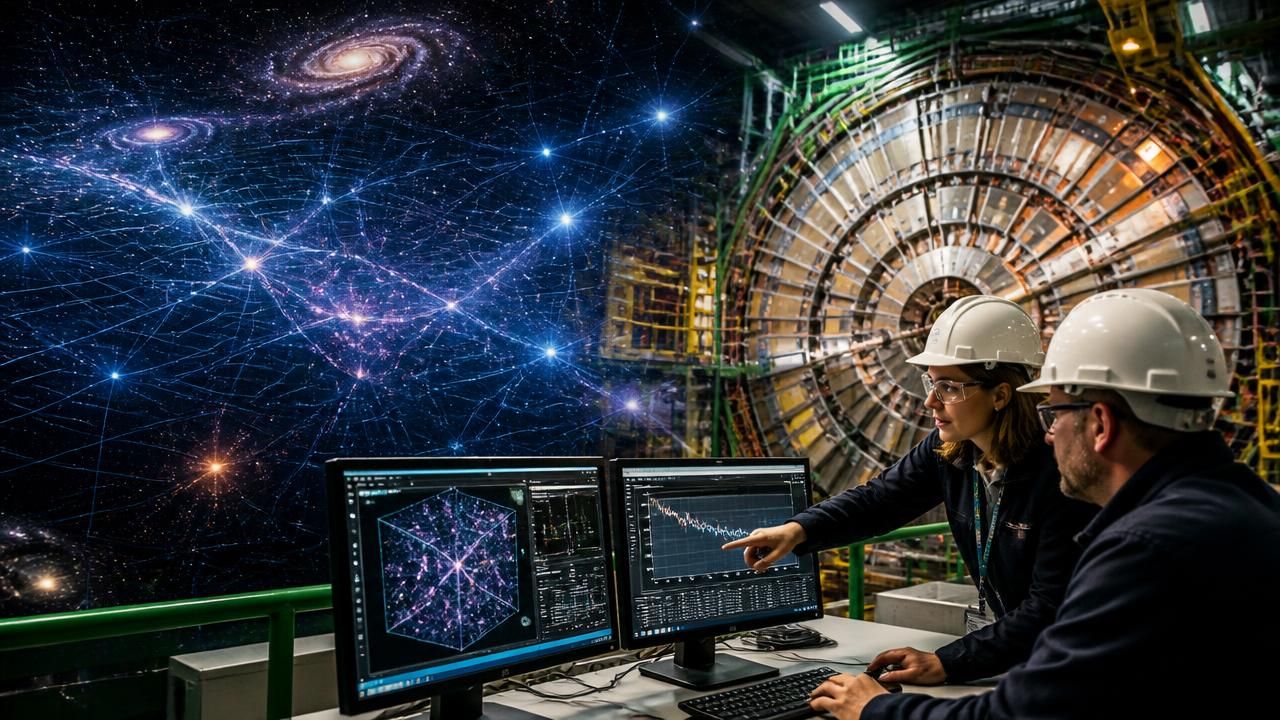
Antimatter remains deeply mysterious: why is the Universe made almost entirely of matter if the Big Bang should have produced equal amounts? New results from the Large Hadron Collider (LHC) add to the puzzle. The LHC has detected strange particle behavior—decay patterns that deviate from Standard Model predictions. If confirmed, they could point to a new physics beyond what we know, potentially rewriting textbooks.
Cosmic Anomalies and New Frontiers
Astronomers have also found a galaxy that appears to be missing dark matter entirely, a head-scratching cosmic anomaly that challenges galaxy-formation models. And the surprises don't stop there:
- A neutrino factory powered by stars was discovered where scientists expected a black hole.
- AI discovered new physics in plasma, the fourth state of matter, identifying a previously unseen transition.
- An 80-year-old theory of turbulence was upended by new experiments.
- NASA's Hubble captured a giant chaotic planet nursery unlike anything seen before.
- Scientists finally explained Antarctica's mysterious 'gravity hole' using deep-Earth structural models.
- A reversed electric field around Earth shocked researchers, with implications for atmospheric escape.
- A new study suggests the Universe might collapse far sooner than expected, providing a dark twist to cosmic destiny.
- Even a sealed envelope opened after ten years revealed that gravity still doesn't make sense in the quantum realm.
The Bigger Picture
Together, these findings don't just add data points—they challenge the simplifying assumptions that have guided cosmology for decades. Whether it's dark matter's self-interactions, antimatter's gravitational fall, or the strange behavior of particles at the LHC, each result invites us to think more deeply about the true nature of reality.
As one physicist put it, "We're at the edge of what the standard model can describe. The next few years may rewrite the textbooks." For now, the universe is proving to be far stranger—and far more exciting—than we ever imagined.