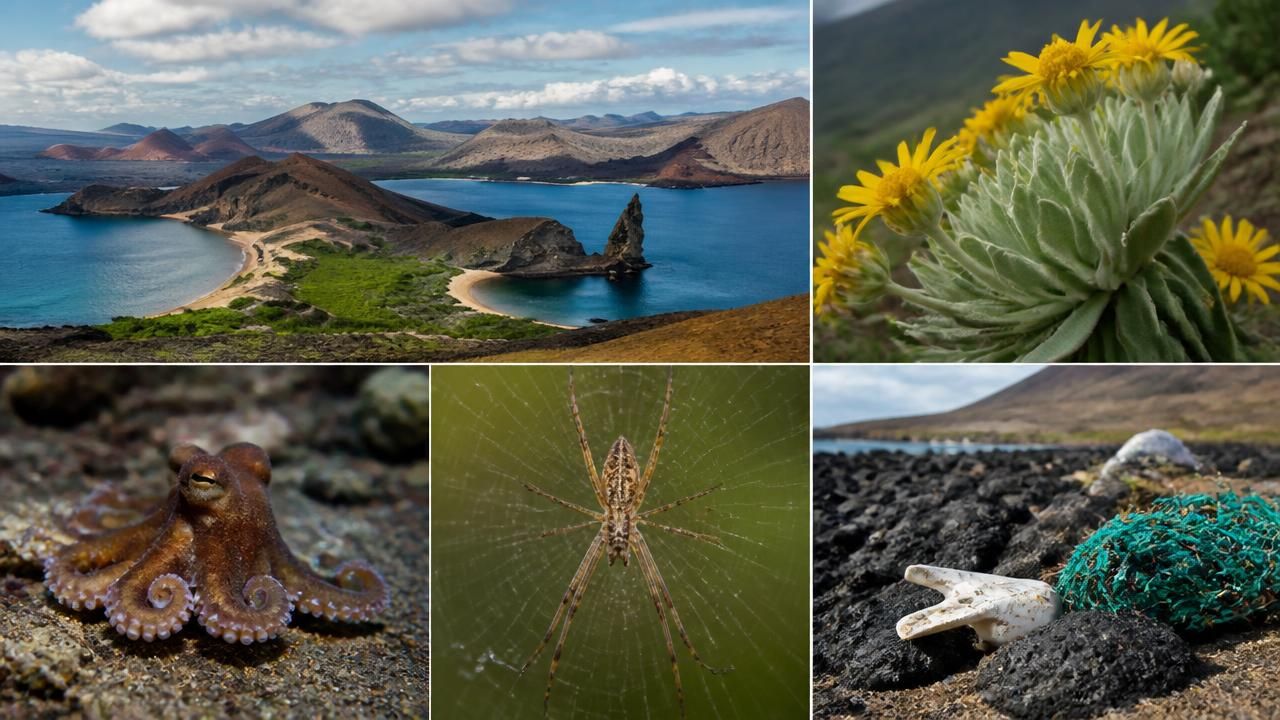
More than 150 years after Charles Darwin's finches helped reshape biology, the Galápagos Islands continue to yield evolutionary surprises. A new study on giant daisies published in Science Daily reveals that these plants repeatedly evolved similar heat-tolerant leaf shapes, but each lineage used a different combination of genes. Meanwhile, research on spiders and a newly discovered octopus underscores a pattern of convergent evolution across the archipelago. Yet, as Undark reports, human activities pose an enduring threat to this living laboratory.
Daisies: Convergent Evolution at the Genetic Level
The Scalesia daisies, often called the 'Darwin's finches of the plant world,' have long fascinated biologists. A team led by researchers from the University of Cambridge analyzed the genomes of multiple Scalesia species across the islands. They found that different populations independently evolved thicker, more succulent leaves to cope with arid conditions. However, the genetic pathways differed—some populations altered genes involved in water storage, while others tweaked those for leaf surface area. 'This shows that evolution can repeat itself at the phenotypic level even when the underlying genetics vary,' said lead author Dr. Maria Torres. The study also identified significant genetic divergence among isolated populations, suggesting that new species may be in the process of forming.
Octopus and Spiders: Parallel Evolution Across the Tree of Life
In a separate discovery, a team from the Schmidt Ocean Institute found a tiny blue octopus nearly 6,000 feet beneath the surface near the Galápagos. The species, tentatively named Octopus galapagensis, appears to have convergently evolved its coloration and body shape with other deep-sea octopuses, despite being separated by vast distances. 'This is a clear example of how similar environmental pressures can drive identical adaptations,' said marine biologist Dr. James Chen.
Meanwhile, Smithsonian Magazine reported on a group of spiders (genus Theridion) that have repeatedly evolved the same web-building behaviors and body forms across different islands. Each lineage independently arrived at the same solution to capturing prey, even though they started from different ancestral traits. This mirrors the pattern seen in the daisies, suggesting that convergent evolution may be more common than previously thought.
Human Impact: A Growing Threat
While evolutionary discoveries abound, the Galápagos face mounting pressures. An opinion piece in Undark highlights how introduced species, tourism, and climate change are eroding the very isolation that drives evolution. Invasive rats and plants have disrupted food webs, while rising sea temperatures affect marine life. 'The same forces that create unique species can also be undone by human activity,' the article warns. Conservationists are calling for stricter regulations on shipping and tourism to protect this UNESCO World Heritage site.
Darwin's Finches: The Original Inspiration
The Guardian recently revisited the mystery of where Darwin's finches originated. Genetic studies now suggest they arrived from the Caribbean or South America roughly 1–2 million years ago, long before Darwin's visit. The finches' beaks—adapted to different food sources—remain one of the most iconic examples of adaptive radiation. The new research on daisies and spiders adds a layer of complexity: not only do species diversify, but they can also converge on similar forms through independent genetic routes.
Implications for Evolutionary Biology
These findings challenge the notion that evolution is a one-way street. 'We often think of evolution as branching out, but these studies show it can also collapse into the same solutions,' said Dr. Torres. The work has implications for predicting how species might respond to climate change: if multiple genetic pathways can achieve the same trait, populations may be more resilient. However, the rapid rate of human-induced change might outpace natural selection.
Looking Forward
The Galápagos remain a crucible for evolutionary science. As researchers continue to uncover hidden patterns—from deep-sea octopuses to web-weaving spiders—they also stress the urgency of preservation. 'Every species lost is not just a loss of biodiversity, but a loss of a living experiment,' the Undark piece concludes. With new technologies like genome sequencing and deep-sea submersibles, the islands are poised to reveal even more about how life evolves—and how fragile that process can be.