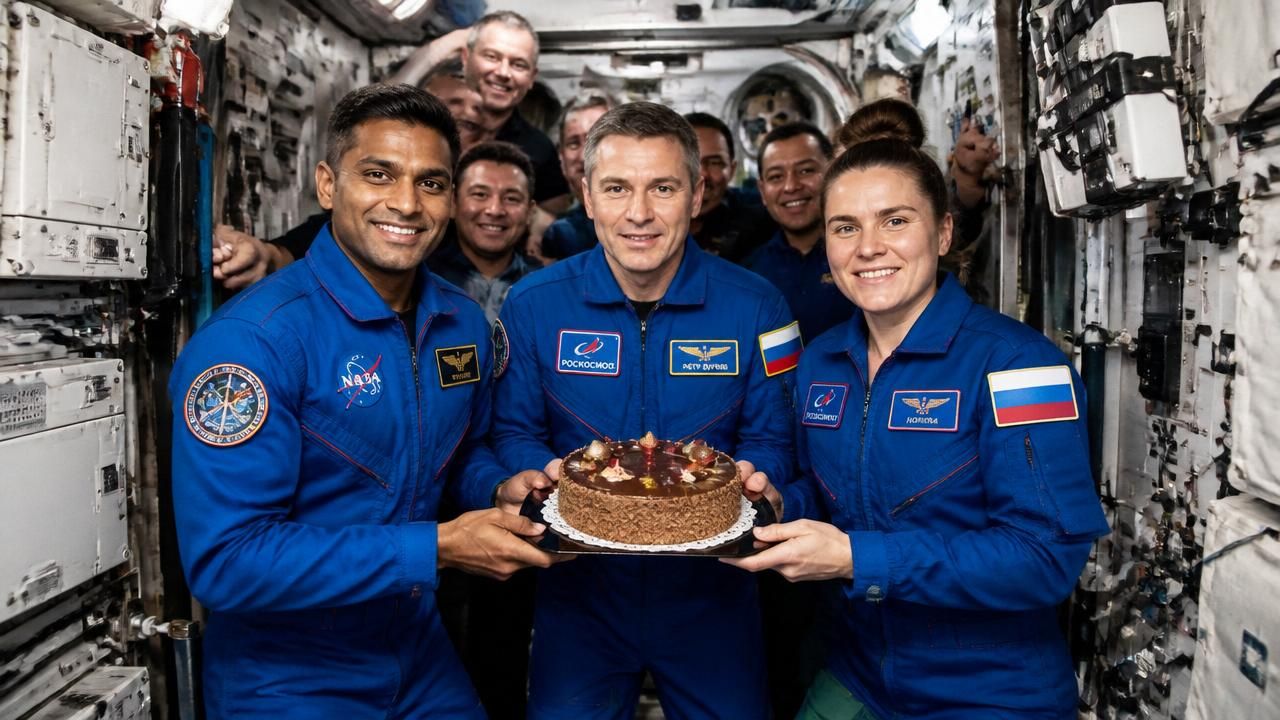
The International Space Station (ISS) welcomed three new crew members on July 14, 2026, as NASA astronaut Anil Menon and Roscosmos cosmonauts Pyotr Dubrov and Anna Kikina docked their Soyuz MS-29 spacecraft to the orbital outpost. The trio launched earlier that day from the Baikonur Cosmodrome in Kazakhstan, marking the beginning of their planned eight-and-a-half-month mission as part of Expedition 74.
The arrival boosts the station's crew to ten, temporarily, before a scheduled departure of other members. The new crew members were greeted warmly by the existing Expedition 74 team, a moment captured in a NASA photo showing the three holding a cake. "We are thrilled to have Anil, Pyotr, and Anna aboard," said NASA via the International Space Station blog. "They are already settling in and beginning their research."
A Mission of Science and Cooperation
Menon, a NASA astronaut making his first spaceflight, joins Dubrov and Kikina, both veterans. The crew will conduct a wide range of scientific experiments, including studies on human physiology, materials science, and Earth observation. Their mission underscores the ongoing collaboration between NASA and Roscosmos despite geopolitical tensions, a partnership that has sustained the ISS for over two decades.
"This mission is a testament to the power of international cooperation in space," said NASA Administrator Bill Nelson in a statement. "We're excited to see what discoveries Anil, Pyotr, and Anna will make."
The Soyuz MS-29 spacecraft employed a fast-track rendezvous, docking just over three hours after launch, a record time for Russian spacecraft. This efficiency allows crews to begin work sooner and reduces the physical strain of long-duration spaceflight.
Context and Broader Significance
This mission is part of a busy period for the ISS, which has seen a flurry of arrivals and departures in 2026. Earlier in the year, SpaceX's Crew-12 mission brought a multinational crew, and private missions like Axiom-4 have also docked. The station has hosted astronauts from over 20 countries, and this launch continues that tradition of inclusivity.
Menon's flight is particularly notable as it marks the first time an Indian-American astronaut has launched to the ISS on a Soyuz. "Anil's journey inspires a new generation of explorers," noted NASA's Johnson Space Center director Vanessa Wyche. Meanwhile, Kikina's presence highlights Roscosmos's commitment to gender diversity; she is one of only a few Russian women to fly to space.
The mission also comes amid discussions about the ISS's future beyond 2030. While NASA and its partners have committed to operating the station through 2030, private companies like Axiom Space are planning to attach commercial modules, and Russia is considering its own orbital station. The continued success of Soyuz launches reinforces the reliability of Russia's human spaceflight program.
Differing Perspectives
Western media outlets have framed the mission primarily through the lens of international cooperation. MSN and CBS News emphasized the "eight-month stay" and the welcoming ceremony. France 24 and ESA highlighted the European angle, noting that ESA astronaut Sophie Adenot is scheduled for a future mission. In contrast, Russian state media focused on the technical achievement of the fast rendezvous and the professionalism of the cosmonauts.
Some outlets, like Reuters, drew parallels to previous "stranded" astronaut stories, such as the Boeing Starliner delays and the extended stays of Crew-9 astronauts. However, this mission is routine, with no such complications. The crew is expected to return to Earth in March 2027.
Expert Views and Data
Dr. Emily Calandrelli, a space policy expert at West Virginia University, commented: "Every crew rotation is a reminder of the incredible logistical and engineering efforts required to keep humans alive in space. The Soyuz remains a workhorse, and this mission shows that even in a changing geopolitical landscape, the ISS remains a symbol of what we can achieve together."
The Soyuz MS-29 spacecraft is the latest in a long line of Soyuz vehicles, which have been flying since the 1960s. It features upgraded avionics and a more comfortable interior. The crew will have access to the station's facilities, including the U.S. Destiny laboratory and the Russian Zvezda module.
What Comes Next
Over the next eight months, Menon, Dubrov, and Kikina will participate in dozens of experiments. They will also perform spacewalks for station maintenance. Their return is slated for late February 2027, by which time they will have logged over 200 days in space.
The ISS continues to be a beacon of human achievement, and the arrival of Expedition 74's newest members is a testament to the enduring spirit of exploration.