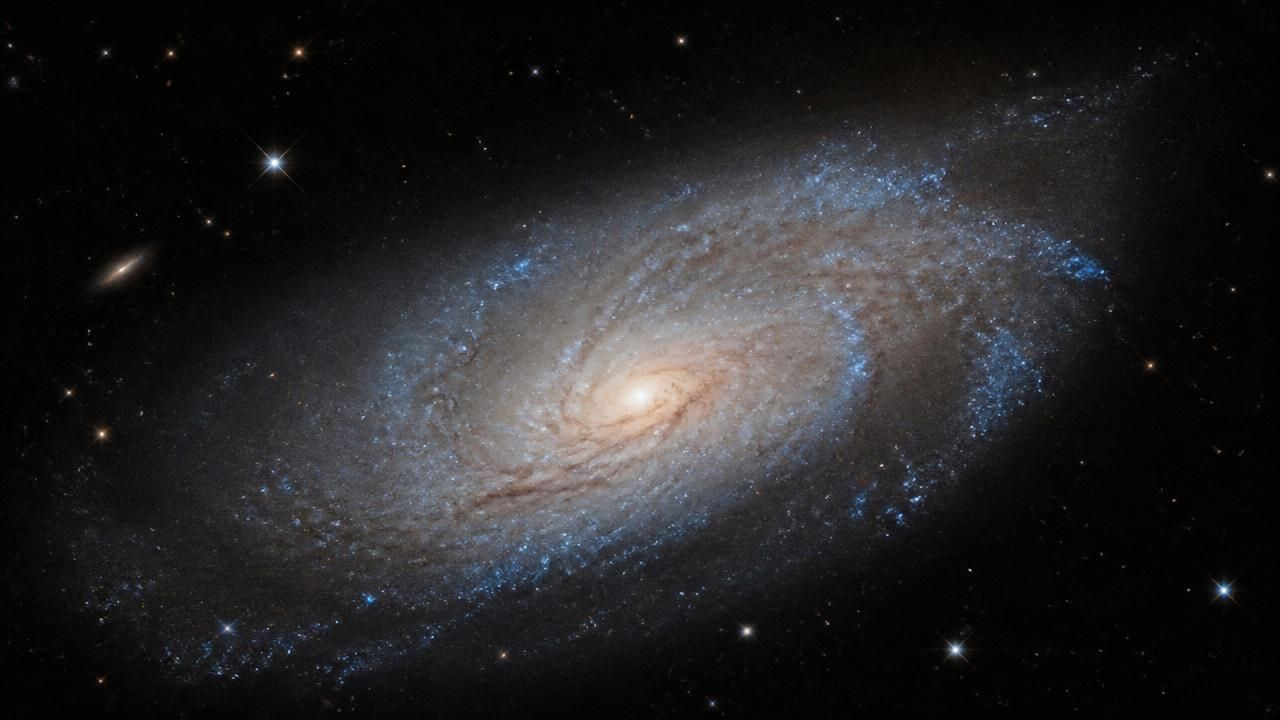
In a new image released by NASA and the European Space Agency (ESA), the Hubble Space Telescope has captured a striking view of the spiral galaxy NGC 4654, located 72 million light-years away in the constellation Virgo. The galaxy appears distinctly one-sided, a result of gravitational forces that have distorted its structure. The image, obtained as part of the PHANGS-HST survey, offers astronomers a detailed look at how galaxies evolve under the influence of their surroundings.
What Makes NGC 4654 Unique?
NGC 4654 is classified as an intermediate spiral galaxy, meaning it possesses properties between a barred and unbarred spiral. However, its most notable feature is its asymmetric appearance: one side of the galaxy appears stretched and diffuse, while the other is more compact. According to NASA, this lopsidedness is likely due to a combination of two factors: a recent close encounter with a companion galaxy, NGC 4639, and the galaxy's motion through the Virgo Cluster's intracluster medium, which strips gas and alters star formation.
“This galaxy is struggling against titanic forces that appear on galactic scales in space,” NASA officials wrote in a statement accompanying the image.
The interaction with NGC 4639, a barred spiral galaxy, is thought to have triggered gravitational tides that pulled material from one side of NGC 4654, creating the asymmetry. Meanwhile, ram pressure from the hot gas in the Virgo Cluster is stripping away the galaxy's gas reservoir, further influencing its star formation activity.
Context and Broader Significance
The Virgo Cluster, home to over 1,300 galaxies, provides a dynamic environment where galaxies frequently interact. NGC 4654 is part of this cluster, and its distorted shape exemplifies the processes that shape galaxy evolution. The Hubble image, captured by the telescope's Wide Field Camera 3, uses filters that highlight both visible and ultraviolet light, revealing regions of active star formation as bright blue knots along the spiral arms.
This observation is part of the Physics at High Angular resolution in Nearby GalaxieS (PHANGS) project, which aims to study star formation across different galactic environments. By combining Hubble data with observations from the Atacama Large Millimeter/submillimeter Array (ALMA) and the James Webb Space Telescope, scientists hope to build a comprehensive picture of how stars are born.
Differing Perspectives from Sources
While the core story is consistent across outlets, different sources emphasize various aspects. Space.com highlighted the galaxy's “lopsided” and “deformed” appearance, framing it as a dramatic cosmic struggle. Sci.News focused on the galaxy being observed “edge-on” in some images, noting the peculiar perspective. Yahoo! News and MSN featured the image as a “Space photo of the day,” emphasizing its aesthetic appeal. Meanwhile, NASA's official release provided the most detailed scientific context, explaining the forces at play.
Some sources, such as phys.org and space.com, encountered technical issues with their pages, but their headlines indicate a shared focus on the galaxy's asymmetry and gravitational interactions. The PHANGS-HST team, credited with the image, underscores the collaborative nature of modern astronomy.
Historical and Scientific Context
Galaxy interactions are common in the universe. Approximately 25% of all galaxies are currently interacting with a neighbor, and such events can trigger bursts of star formation or even lead to mergers. NGC 4654's lopsided shape is a transient phase, lasting only a few hundred million years, before the galaxy eventually settles into a more symmetric form or merges with its companion.
The Hubble Space Telescope, launched in 1990, has revolutionized our understanding of galaxy evolution. Its sharp resolution allows astronomers to resolve individual star clusters and gas clouds in distant galaxies, providing insights into the processes that drive cosmic change.
What's Next?
Future observations with the James Webb Space Telescope will peer through dust clouds to study the hidden regions of NGC 4654, revealing the earliest stages of star formation. Combined with radio observations, these data will help astronomers model the galaxy's past and predict its future.
For now, the image of NGC 4654 serves as a stunning reminder of the dynamic and often violent nature of the cosmos. As NASA notes, this is a galaxy “struggling against titanic forces,” and through Hubble's eyes, we witness that struggle in exquisite detail.