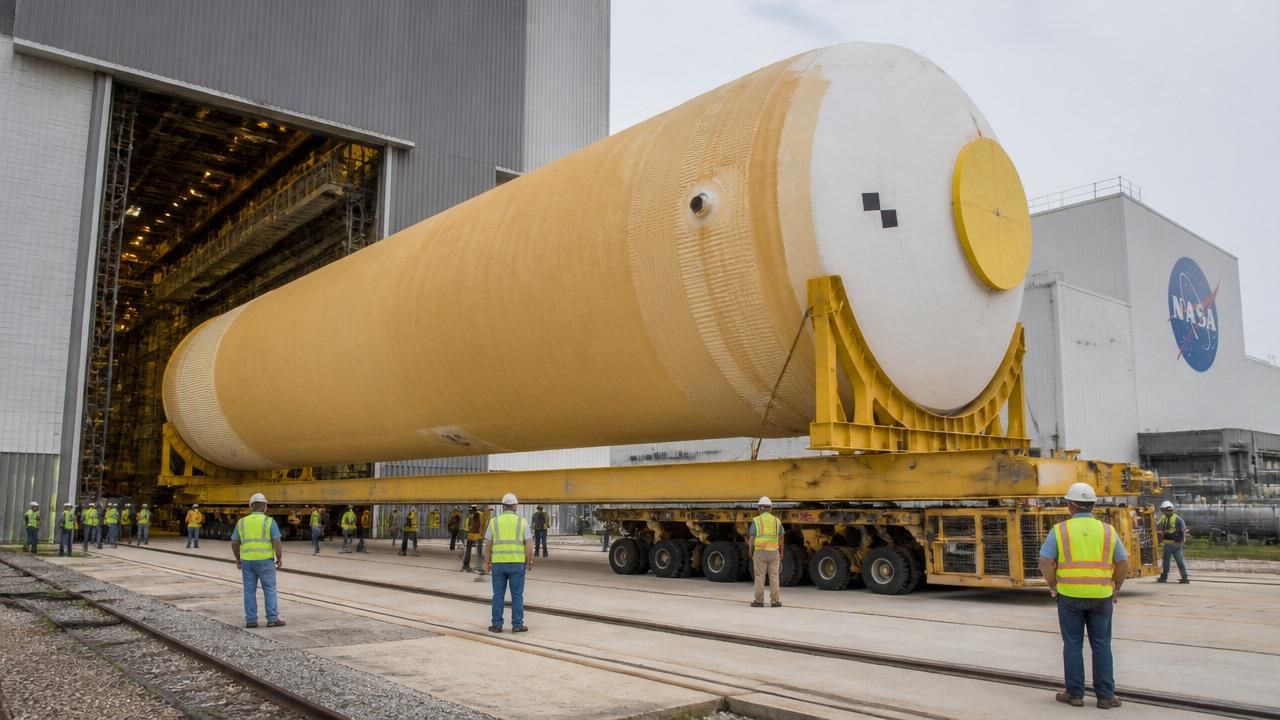
NASA achieved a major milestone on May 15, 2026, when crews at the Michoud Assembly Facility in New Orleans moved the 130-foot-tall liquid hydrogen tank for the Artemis IV mission out of its production cell and into a test building. The tank, which will form part of the core stage for the Space Launch System (SLS) rocket, is designed to hold thousands of gallons of super-cold propellant for one of four RS-25 engines. This event marks a critical step toward assembling the mega rocket for the fourth Artemis mission, which aims to return humans to the lunar surface.
Milestone at Michoud
The transport of the liquid hydrogen tank across the 829-acre facility was captured by NASA photographer Michael DeMocker. The tank's journey from the factory floor to the test building is part of a meticulous process to ensure the hardware meets all safety and performance standards. According to NASA, the SLS core stage is the backbone of the rocket, and the liquid hydrogen tank is one of its largest components. The move comes as NASA prepares to ship the core stage to Kennedy Space Center in Florida for final assembly.
Assembly at Kennedy Space Center
While Source 2 (autoevolution.com) was inaccessible due to a JavaScript requirement, its headline indicates that assembly of the Artemis III rocket is beginning at Kennedy. However, the tank moved is for Artemis IV, suggesting a parallel flow of hardware for different missions. The Orlando Sentinel (Source 4) reported that Kennedy Space Center has received its "biggest Artemis III puzzle piece," likely referring to the core stage or another large element. This indicates that while Artemis III hardware is arriving, Artemis IV components are also advancing through production.
Delays and Risk Assessments
CNN (Source 3) reported on a delay for a historic moon mission, though the specific mission was not identified due to content restrictions. However, Source 5 from CNN noted a "unanimous vote in risk assessment" that cleared four astronauts to launch on a moon mission. This suggests that despite delays, safety protocols are being rigorously followed. The risk assessment vote likely pertains to the Artemis II or III crewed mission, which will send astronauts around the Moon before Artemis IV lands on the surface.
SpaceX's Role
Source 6 (spacex.com) displayed a generic updates page, but SpaceX is a key contractor for Artemis, providing the Human Landing System (HLS) for the lunar landing. The company's Starship vehicle is being developed to ferry astronauts from lunar orbit to the surface. SpaceX's involvement underscores the public-private partnership driving the Artemis program.
Context and Implications
The Artemis program, named after the Greek goddess of the Moon, aims to establish a sustainable human presence on the lunar surface by the end of the decade. Artemis I, an uncrewed test flight, successfully launched in 2022. Artemis II will carry astronauts around the Moon, and Artemis III will land the first woman and the next man on the lunar south pole. Artemis IV, currently in development, will build on these missions with more advanced hardware.
The movement of the liquid hydrogen tank is a tangible sign of progress, even as the program faces technical and budgetary challenges. NASA's ability to manufacture and test large rocket components at Michoud—a facility that also built the Space Shuttle's external tanks—demonstrates continuity in American space manufacturing. Meanwhile, the integration of commercial partners like SpaceX highlights a shift toward a more collaborative, cost-effective approach to exploration.
Experts note that the success of Artemis depends on timely delivery of hardware and rigorous testing. The unanimous risk assessment vote suggests confidence in the Orion spacecraft and SLS rocket, but delays have plagued the program. The Artemis II mission, originally slated for 2024, has been pushed to 2025 or later. Nevertheless, each milestone, such as the tank move, brings the goal of returning humans to the Moon closer to reality.
As the Artemis IV liquid hydrogen tank undergoes testing in New Orleans, the eyes of the space world are on Kennedy Space Center, where the puzzle pieces of America's return to the Moon are coming together.