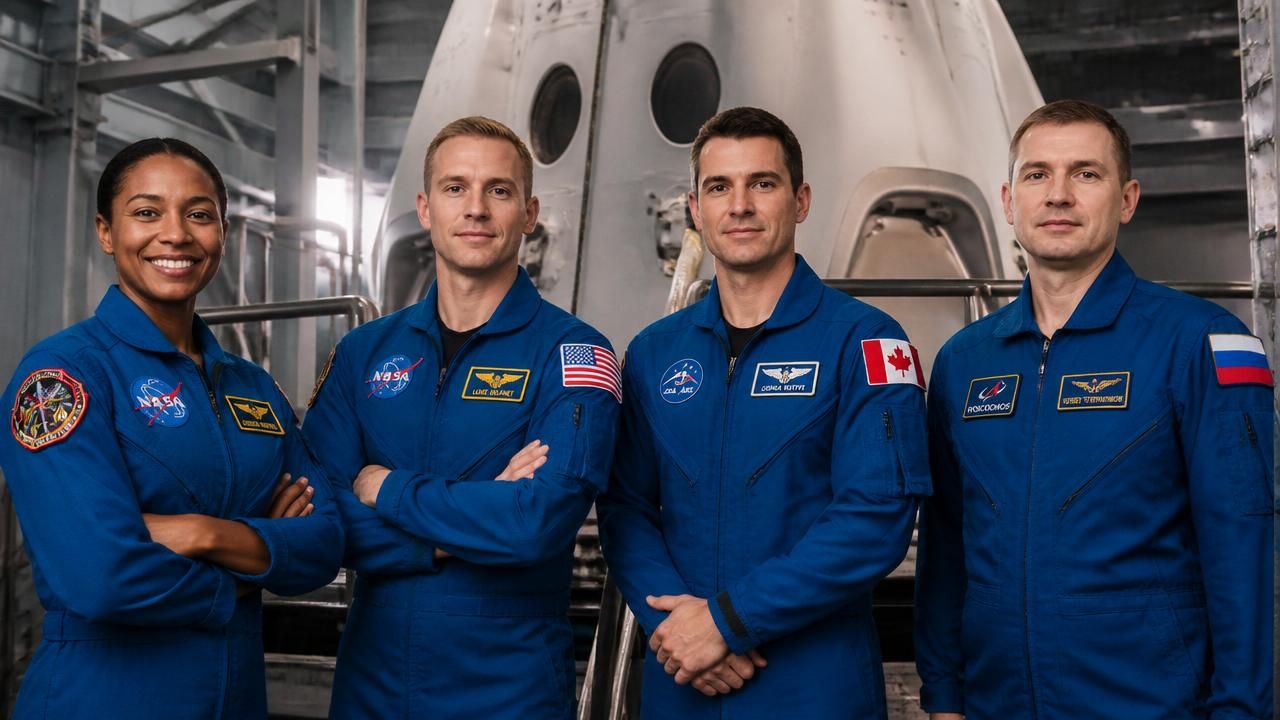
NASA and SpaceX are pressing forward with a packed schedule of crew rotations to the International Space Station, with the newly announced Crew-13 mission set to launch no earlier than mid-September. The mission will carry NASA astronauts Jessica Watkins and Luke Delaney, Canadian Space Agency astronaut Joshua Kutryk, and Roscosmos cosmonaut Sergey Teteryatnikov aboard a SpaceX Dragon spacecraft atop a Falcon 9 rocket from Cape Canaveral Space Force Station's Launch Complex 40.
In preparation, NASA will hold two news conferences on Monday, August 3, from Johnson Space Center in Houston. The first, at 12 p.m. EDT, will feature mission leadership providing an overview. The second, at 2 p.m., will allow the crew to discuss their training and mission preparations. This will be the final media availability before the crew travels to Kennedy Space Center in Florida for launch. The events will be streamed live on NASA's website.
A Crew of Veterans and First-Timers
The Crew-13 team brings a mix of experience and fresh perspectives. Jessica Watkins, a NASA astronaut and geologist, previously served on ISS Expeditions 67 and 68, becoming the first Black woman to complete a long-duration mission. Luke Delaney, a former U.S. Navy test pilot, will be making his first spaceflight. Joshua Kutryk, a Canadian astronaut and fighter pilot, also embarks on his maiden voyage. Sergey Teteryatnikov, a Roscosmos cosmonaut, adds international collaboration, continuing the integrated crew exchange program between NASA and Russia.
“We are thrilled to welcome Joshua Kutryk to his first mission to the International Space Station,” said a CSA spokesperson. “This flight underscores the strength of international partnerships in space exploration.”
Recent Missions Face Weather and Medical Challenges
The Crew-13 announcement comes amid a flurry of activity. Crew-12, originally scheduled for an early Friday launch, faced weather delays. Spaceflight Now reported that poor conditions scrubbed the launch twice, though forecasts later improved. Meanwhile, SpaceX's Cargo Dragon mission also experienced weather-related postponements. Separately, a Crew-11 mission targeting July 31 was declared “go” for launch by NASA and SpaceX, according to Space.com.
In a rare incident, a NASA crew made an early return to Earth after a medical issue on the ISS. CNN reported that the unscheduled departure highlighted the risks of long-duration spaceflight and the need for robust contingency plans. The crew landed safely, and NASA emphasized that the situation was handled without emergency.
Broader Context: Artemis, Starliner, and Commercial Space
Beyond crew rotations, NASA is advancing its Artemis program. Artemis II, which will carry astronauts around the Moon and break humanity's all-time distance record, could launch as early as February 2026, according to NASA. The mission will test the Orion spacecraft's life-support systems and pave the way for a lunar landing.
Meanwhile, Boeing's Starliner continues to work toward its return to flight after technical issues, as reported by SpaceNews. SpaceX's Crew Dragon remains the primary U.S. vehicle for crew transport, with the company also preparing for private astronaut missions with Axiom Space. Lockheed Martin has proposed a dual-use “Jupiter” space freighter for station resupply and deep space exploration, indicating growing commercial interest in cislunar infrastructure.
Implications for the Future of Spaceflight
The steady cadence of Crew Dragon missions demonstrates SpaceX's reliability and NASA's commitment to maintaining a continuous U.S. presence on the ISS. The inclusion of Canadian and Russian crew members reinforces the collaborative nature of the station. As Artemis II approaches, the experience gained from Crew-13 and other missions will be invaluable for longer-duration lunar and Martian voyages.
Experts note that the increasing frequency of launches also tests ground infrastructure. The activation of SpaceX's upgraded SLC-40 pad, following a successful static fire test for the CRS-13 mission, adds redundancy. However, weather remains a persistent factor, as seen with Crew-12 and Cargo Dragon delays.
With Crew-13's launch window opening in mid-September, all eyes will be on Cape Canaveral as the next chapter in human spaceflight unfolds.