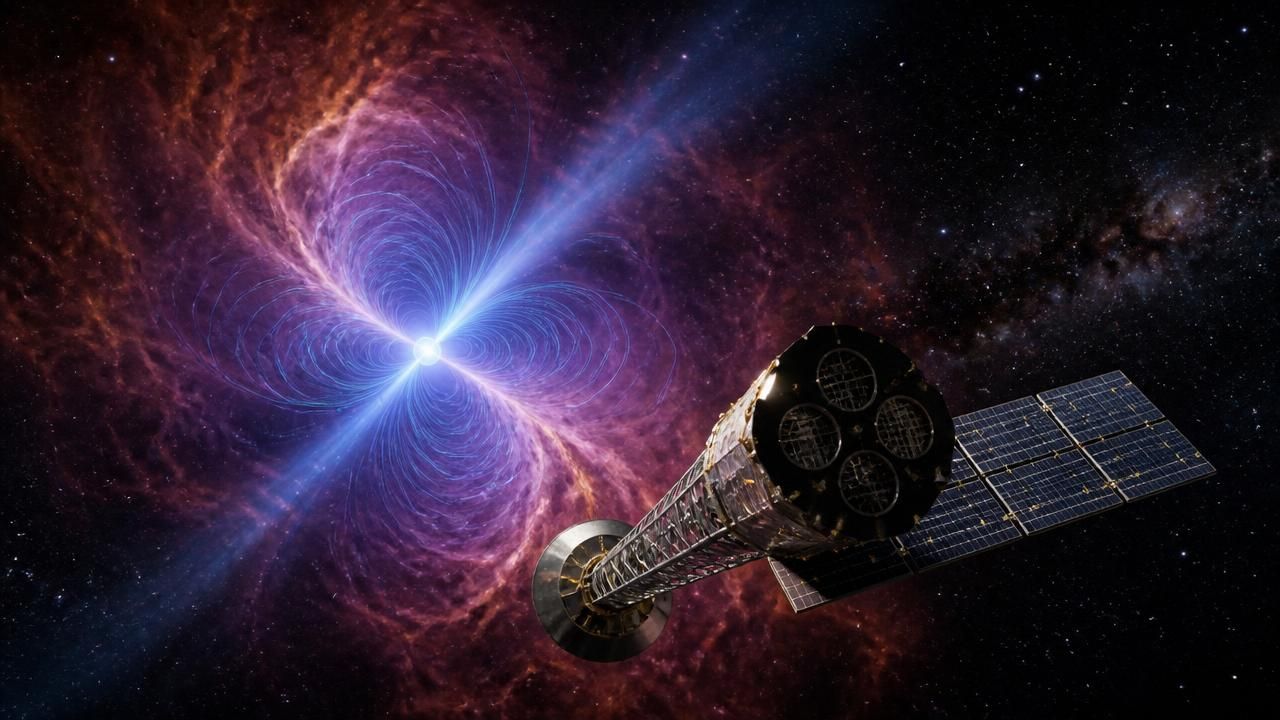
In a landmark achievement for astrophysics, NASA's Imaging X-ray Polarimetry Explorer (IXPE) has, for the first time, directly measured the magnetic fields of a pulsar—the rapidly spinning neutron star known as PSR J1101−6101, located within the aptly named Lighthouse Nebula. The findings, published July 9, 2026, in the Astrophysical Journal, offer an unprecedented view of the magnetic structures that govern some of the most extreme objects in the universe.
A New Window into Pulsar Magnetism
Pulsars are the ultra-dense, spinning remnants of massive stars that have exploded as supernovae. They possess magnetic fields trillions of times stronger than Earth's and beam radiation like cosmic lighthouses. Until now, astronomers could only infer the geometry of these magnetic fields indirectly. IXPE's X-ray polarimetry—measuring the direction and intensity of X-ray light's polarization—has changed that, providing a direct map of the magnetic field lines around PSR J1101−6101.
“This is the first time we've been able to directly measure the magnetic field structure of a pulsar,” said Jack Dinsmore, a graduate student at Stanford University and lead author of the study. “IXPE is opening a new window onto these extreme environments.”
The research team combined IXPE data with observations from NASA's Chandra X-ray Observatory and radio data from the Australia Telescope Compact Array. The composite image reveals a complex magnetic field geometry, with the field lines aligning along the pulsar's jet and toroidal structures wrapping around the neutron star.
The Lighthouse Nebula: A Cosmic Beacon
PSR J1101−6101, often called the Lighthouse pulsar, is a relatively young neutron star with a spin-down age of only 63,000 years. It rotates at an astonishing 16 times per second—once every 63 milliseconds. Its powerful beams of radiation sweep across the sky, making it a natural laboratory for studying pulsar physics. The nebula itself, shaped by the pulsar's wind and magnetic fields, extends over several light-years.
How IXPE Works
IXPE, launched in December 2021, is the first space observatory dedicated to measuring the polarization of X-rays from cosmic sources. By analyzing the polarization angle, scientists can trace the direction of magnetic fields. For the Lighthouse pulsar, IXPE detected a high degree of polarization, indicating highly ordered magnetic fields. The polarization angle changes across the nebula, revealing a magnetic field that is both toroidal (wrapping around the pulsar) and poloidal (extending along the jet).
Implications for Astrophysics
This breakthrough has far-reaching implications. Understanding pulsar magnetic fields is key to explaining how these objects accelerate particles to near-light speeds, produce powerful jets, and generate gamma-ray bursts. The results also help refine models of neutron star interiors and the behavior of matter under extreme densities.
“Measuring these magnetic fields directly is like seeing the bones of the pulsar's magnetic skeleton,” said co-author Dr. Roger Romani of Stanford University. “It gives us a new way to test theories of how pulsars work.”
The findings are also relevant to the study of magnetars—neutron stars with even more extreme magnetic fields—and to the search for gravitational waves, as pulsars are used as natural clocks in pulsar timing arrays.
Context and Collaboration
The study is part of a broader effort by NASA to explore the high-energy universe with complementary observatories. Chandra provides high-resolution X-ray imaging, while IXPE adds the crucial polarimetry dimension. This synergy is essential for unraveling the physics of cosmic accelerators.
The research team includes scientists from NASA's Marshall Space Flight Center, the University of Stanford, and international partners. The paper is titled “X-ray Polarimetry of the Lighthouse Pulsar PSR J1101−6101” and appears in the Astrophysical Journal.
What Comes Next
IXPE will continue to observe other pulsars and neutron stars, building a census of magnetic field structures. Future missions, such as the proposed X-ray Polarimetry Probe (XPP), could expand on these measurements with greater sensitivity.
For now, the Lighthouse Nebula stands as a beacon of discovery, illuminating the magnetic hearts of the universe's most extreme objects.