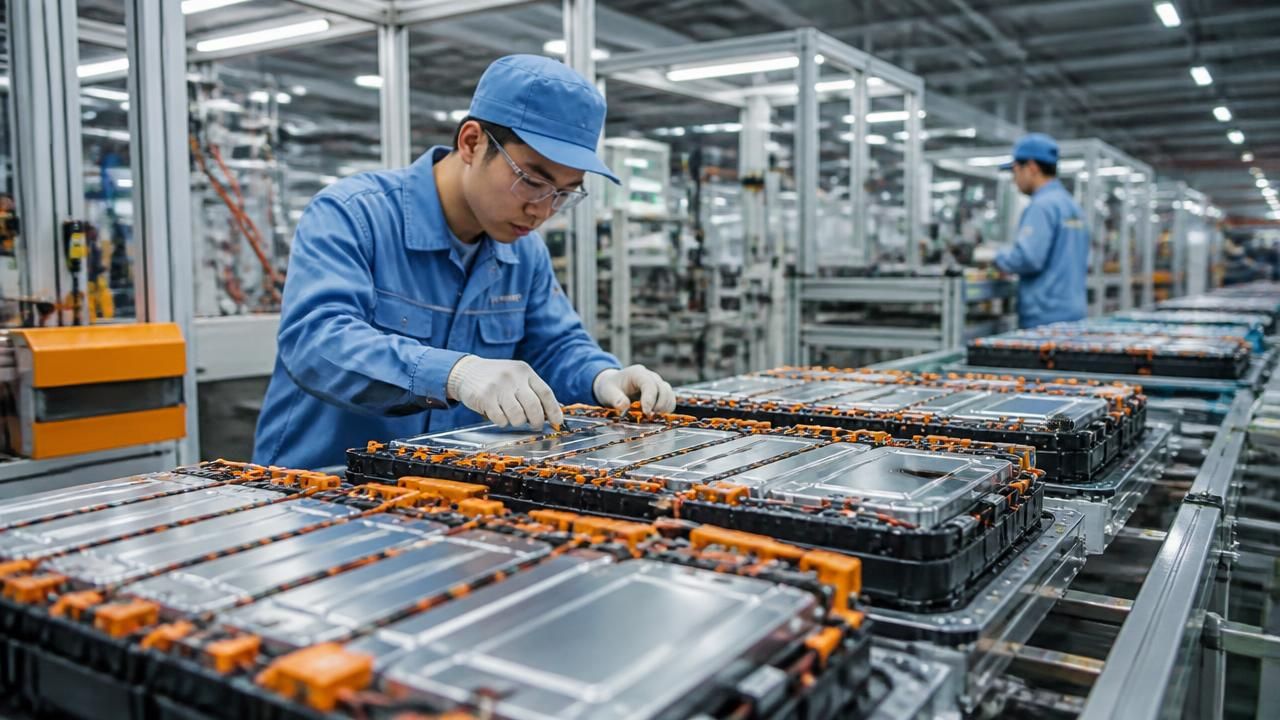
The global push to electrify cars, homes and industry rests on a simple premise: replace fossil-fuel combustion with batteries, and make the electricity that charges them clean. But a new study led by Haiwei Zhou at the University of Melbourne is drawing attention to a less-discussed part of that equation — the emissions created by making the batteries themselves.
According to the research, the greenhouse gases released during lithium-ion battery production currently represent about 0.18 percent of annual global emissions. That figure sounds marginal, and for now it is. The problem is trajectory. As battery demand scales up to serve electric vehicles, grid storage and heating, the researchers estimate those manufacturing emissions could increase by a factor of 10 or more by 2050 under current practices.
“Right now, the researchers estimate that these emissions only account for 0.18 percent of annual greenhouse gas releases, but they could increase by a factor of 10 or more by 2050.”
The hidden footprint of the battery boom
The finding lands at an awkward moment for the energy transition. The first order of business for decarbonization has been electrifying applications like vehicles and heating while ensuring the electricity powering them comes from renewables. As the dominant slices of the emissions pie shrink, however, secondary categories — those with less absolute potential to cut emissions — become proportionally more important. Battery manufacturing is a textbook example.
Unlike a coal plant or a tailpipe, a battery factory's emissions are diffuse and embedded in global supply chains: mining and refining lithium, nickel, cobalt and graphite; processing those materials into cathodes and anodes; assembling cells in energy-intensive facilities. Some chemistries are inherently more energy-hungry to mine and refine than others, which means the emissions intensity of a battery depends heavily on what it is made of and where.
Three levers: materials, manufacturing and recycling
The study points to a set of overlapping solutions rather than a single fix.
- Material choice: Different lithium-ion chemistries carry very different mining and refining burdens. Shifting toward lower-intensity formulations can cut upstream emissions substantially.
- Manufacturing efficiency: Cell production involves many discrete steps, from electrode coating to drying and formation, each with room for energy savings and electrification.
- Recycling: Recovering materials from end-of-life batteries puts metals back into the loop while requiring far less energy than primary mining — arguably the most powerful lever as early generations of packs retire.
- Grid decarbonization: Because factories run on electricity, cleaning up the power supply where batteries are made compounds the gains from efficiency.
How different outlets framed the story
Coverage of the research has diverged in emphasis. Ars Technica, which reported the study in detail, framed it as a technical and systemic challenge — a reminder that the energy transition creates new emissions categories even as it eliminates old ones, and that production processes are not automatically clean just because the end product is. Its account focused on the mechanics of battery manufacturing and the relative energy intensity of different chemistries.
Other outlets, including MSN and Mirage News, distilled the message into a policy-oriented headline: a “wider” or “broader” approach is needed to mitigate rising rechargeable battery emissions. That framing shifts the emphasis from engineering to governance — implying that recycling infrastructure, supply-chain transparency and industrial standards must be built deliberately, rather than left to market forces. The two readings are complementary: the technical findings supply the evidence, while the broader framing supplies the call to action.
The research also arrives amid continuing friction over climate policy at the grassroots level. In Australia, where the study originated, local political forums — such as the recent election debate in Ballarat where candidates sparred over climate — illustrate how national decarbonization debates are increasingly contested at the community level. The question of where and how clean-tech supply chains are built is becoming a local as well as a global issue, particularly in resource-rich regions hoping to capture refining and recycling jobs.
Why it matters
The study's central insight is one of timing. Emissions from battery manufacturing are small today precisely because the battery fleet is still relatively young. Decisions made in the next few years — which chemistries dominate, where cells are made, how quickly recycling capacity comes online — will determine whether those emissions stay a rounding error or become a meaningful line item in the global carbon budget.
That has implications for regulators, manufacturers and investors alike. Stricter battery passports and carbon-intensity disclosure rules in the European Union are already pushing producers to account for embodied emissions. Automakers, meanwhile, face pressure to demonstrate that electric vehicles deliver real lifecycle savings rather than merely shifting pollution upstream.
The researchers' conclusion is not that batteries are a problem, but that they require the same scrutiny as the technologies they replace. Electrification remains the fastest route to cutting transport and heating emissions; the challenge is to ensure the factories that enable it are built on clean power, efficient processes and a genuinely circular materials economy. Without that broader approach, the very technology powering the transition risks carrying a growing share of the emissions it was meant to eliminate.