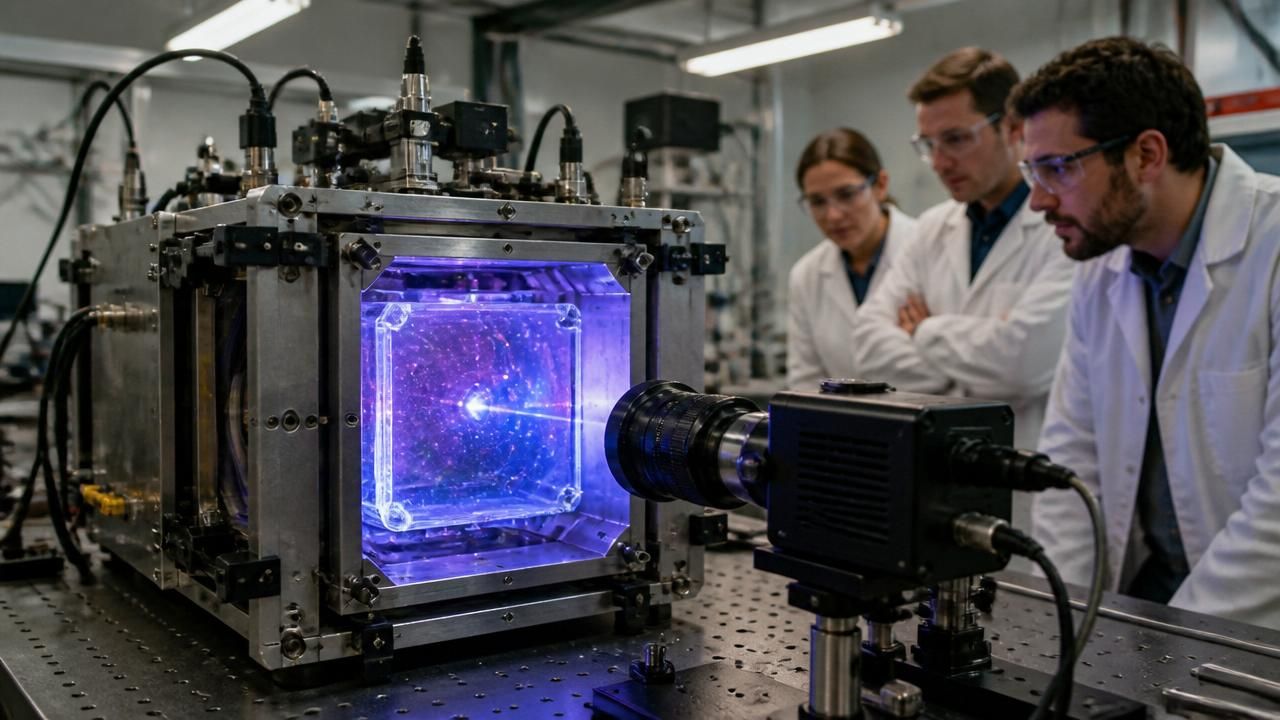
In a breakthrough that could revolutionize particle physics and medical imaging, scientists have built a prototype particle detector called PLATON that tracks invisible particles in 3D using a light-field camera, highly sensitive photon sensors, and artificial intelligence. The device, described in a study from Science Daily, replaces millions of tiny detector components with a single block of light-producing material, making it far easier to scale than current detectors. According to news.osu.edu, the technology also leverages novel quantum entanglement techniques to spy on atomic nuclei, opening new avenues for fundamental physics research.
How PLATON Works
PLATON stands for 'Particle Light-field Tomography.' It uses a block of scintillator material that emits light when particles pass through it. A light-field camera captures the light from multiple angles, and AI algorithms reconstruct the particle's path in 3D. Simulations suggest PLATON can match or even surpass the performance of today's best detectors, such as those used at CERN, while being significantly cheaper and easier to scale. 'This is a paradigm shift in detector design,' said a lead researcher quoted by Science Daily. 'Instead of building complex arrays of thousands of sensors, we use a single crystal and a camera.'
Quantum Entanglement Connection
news.osu.edu reports that the detector also exploits quantum entanglement to spy on atomic nuclei. By entangling photons with nuclear spins, researchers can gain unprecedented insights into nuclear structure. This dual-use capability—tracking particles and probing nuclei—makes PLATON a versatile tool for both high-energy physics and nuclear science.
Medical Imaging Applications
Beyond fundamental physics, PLATON could lead to sharper PET (Positron Emission Tomography) medical scans. Current PET scanners rely on arrays of detectors that are expensive and have limited resolution. PLATON's light-field approach could provide higher resolution and lower cost, making advanced imaging more accessible. 'We're not just building a particle detector; we're building a camera that could see inside the human body with incredible detail,' noted a researcher.
Context and Implications
The development comes amid a push for more efficient detector technology. Traditional detectors like those at the Large Hadron Collider use millions of individual sensors, which are costly and complex to maintain. PLATON's simplicity could enable new experiments in neutrino physics, dark matter searches, and medical diagnostics. While the prototype is still in the simulation phase, the team plans to build a full-scale version within two years.
Expert Views and Skepticism
Some physicists remain cautious. 'Simulations are promising, but real-world performance may differ,' said an independent expert. However, the potential for scalability and cost reduction is undeniable. Meanwhile, the quantum entanglement aspect has drawn interest from the nuclear physics community, which sees it as a new probe for studying exotic nuclei.
What This Means for the Future
If PLATON proves successful, it could democratize particle physics, allowing smaller labs to conduct experiments that currently require massive facilities. In medicine, it could improve cancer detection and treatment monitoring. The fusion of AI, optics, and quantum mechanics in this detector represents a new frontier in instrumentation.
The research was conducted by a team from the University of Ohio and collaborators, with funding from the National Science Foundation. The paper is published in the journal Physical Review Letters.