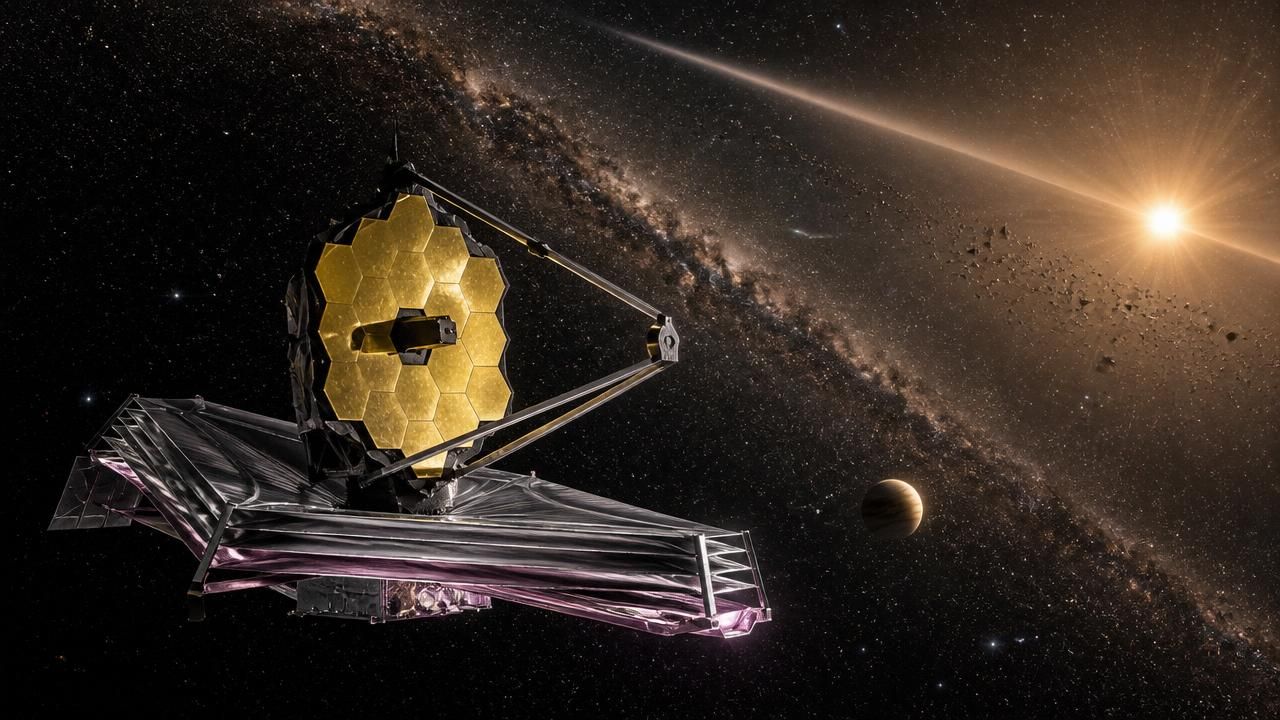
In a landmark discovery, NASA's James Webb Space Telescope (JWST) has uncovered a hidden giant planet in the famous Beta Pictoris star system, located about 63 light-years from Earth. The newly found exoplanet, designated Beta Pictoris d, is a gas giant with a mass several times that of Jupiter and orbits its star at a distance far greater than any of the system's previously known planets. This finding, reported by NASA and multiple observatories, adds to a remarkable year for exoplanet science, with JWST and other telescopes unveiling a menagerie of strange and diverse worlds.
A Decade-Long Hunt Yields Results
The discovery of Beta Pictoris d marks the culmination of over a decade of observations. The planet was first hinted at in data from the European Southern Observatory's Very Large Telescope (VLT) and the Hubble Space Telescope, but its faintness relative to the bright star made confirmation elusive. JWST's powerful infrared instruments, particularly its Near-Infrared Camera (NIRCam), finally captured the planet directly, revealing it as a distinct point of light. 'This is a planet that has been hiding in plain sight for years,' said Dr. Elizabeth Matthews, an astronomer at the Max Planck Institute for Astronomy and lead author of the study. 'Webb's sensitivity allowed us to see it clearly for the first time.'
A System of Giants
Beta Pictoris is already famous for hosting two known exoplanets: Beta Pictoris b and c, both massive worlds that orbit relatively close to the star. The new planet, Beta Pictoris d, is the outermost of the trio, with an orbit that takes hundreds of years to complete. Its discovery completes a picture of a system that resembles a scaled-up version of our own solar system, with giant planets in wide orbits. 'Beta Pictoris is a laboratory for understanding how planetary systems form and evolve,' noted Dr. Christine Chen, an astronomer at the Space Telescope Science Institute. 'Finding a third giant planet suggests that such systems may be more common than we thought.'
Beyond Beta Pictoris: A Year of Exoplanet Surprises
The Beta Pictoris discovery is just one of many exoplanet breakthroughs in 2025. JWST has also detected salt clouds on the 'Pink Planet' (GJ 504 b), a world that glows with a pinkish hue due to its young age and hot atmosphere. The telescope found evidence of sodium chloride (table salt) in its clouds, a surprising composition that challenges models of exoplanet atmospheres. 'We've seen water, methane, and carbon dioxide before, but salt is a new twist,' said Dr. Nikku Madhusudhan of the University of Cambridge.
In another striking find, JWST observed a 'lemon-shaped' exoplanet named WASP-103b, which is tidally distorted by its host star into an elongated shape unlike any known world. 'What the heck is this?' exclaimed Dr. Monika Lendl of the University of Geneva, reflecting the astonishment of the team. The planet's extreme proximity to its star causes it to bulge at the equator, a phenomenon predicted but never before seen so clearly.
Planets in Extreme Environments
JWST has also pushed the boundaries of where planets can form. The telescope discovered a baby 'failed star'—a brown dwarf—with an unusually rich planet-forming disk, suggesting that even these substellar objects can give birth to worlds. Additionally, JWST found planets forming in the harshest environments, such as the Orion Nebula, where intense radiation from massive stars would be expected to destroy protoplanetary disks. 'This shows that planet formation is incredibly resilient,' commented Dr. Mark McCaughrean of the European Space Agency.
Atmospheres and Habitability
One of the most anticipated results from JWST is the detection of atmospheres around rocky exoplanets. The telescope found the strongest evidence yet for an atmosphere on a rocky world, the lava-covered planet 55 Cancri e. 'It's really like a wet lava ball,' said Dr. Renyu Hu of NASA's Jet Propulsion Laboratory, describing the detection of water vapor and other gases. This marks a crucial step toward characterizing potentially habitable worlds.
Meanwhile, the TESS mission continues its haul, discovering Earth-size planets in the habitable zones of their stars. TESS found its first Earth-size world in the habitable zone, a planet orbiting a red dwarf star about 100 light-years away. 'This is not a bad place to hunt for life,' said Dr. Natalia Guerrero of MIT, noting that the planet's moderate temperature could allow liquid water on its surface.
Citizen Scientists and Hidden Worlds
The search for exoplanets has also gone public. Citizen scientists, combing through data from TESS and other surveys, have helped spot a hidden Jupiter-size exoplanet in a binary star system. 'It's amazing what volunteers can find,' said Dr. Jessie Christiansen of the NASA Exoplanet Science Institute. 'They're discovering worlds that automated algorithms missed.'
In total, over 100 new exoplanet candidates have been identified in archival TESS data, thanks to improved machine-learning techniques and human scrutiny. The haul includes a range of sizes, from sub-Earths to super-Jupiters, expanding the census of nearby planetary systems.
Implications and the Road Ahead
The flurry of discoveries underscores the transformative power of JWST and its companions. 'We are in a golden age of exoplanet exploration,' said Dr. John Mather, Nobel laureate and JWST project scientist. 'Every new observation challenges our theories and opens new questions.'
For the Beta Pictoris system, future observations will aim to characterize the atmospheres of its three giant planets and search for smaller, rocky worlds closer to the star. The discovery of Beta Pictoris d also raises the possibility of even more distant planets lurking in the system's outer reaches.
As JWST continues its mission, astronomers anticipate many more surprises. 'The universe is full of worlds we never imagined,' concluded Dr. Chen. 'And we've only just begun to see them.'