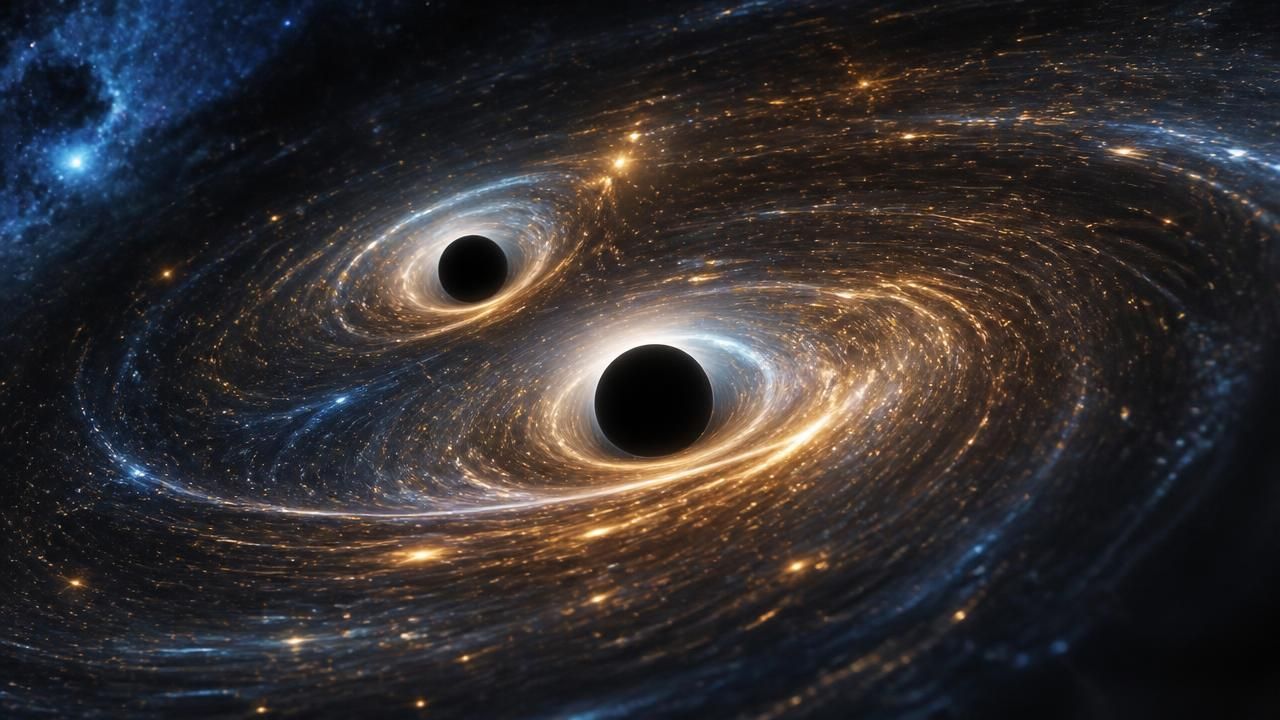
Massive stars may be vanishing without a trace. A new analysis of 257 black hole mergers detected by the world's gravitational-wave observatories has revealed a surprising pattern in the masses of the colliding objects — one that researchers say points to a hidden population of black holes born not in spectacular supernova explosions, but in silent, wholesale collapse.
The findings, reported across a wave of science coverage this week, offer a possible answer to a question that has nagged astrophysicists for decades: what happens to the most massive stars when they reach the end of their lives, and why do so many of them seem to disappear?
Listening to the universe's heaviest collisions
The evidence comes from gravitational waves — ripples in spacetime produced when two black holes spiral into each other and merge. Since 2015, the LIGO detectors in the United States, joined later by Virgo in Europe and KAGRA in Japan, have catalogued dozens of these cataclysmic events, building up the largest census of black hole masses ever assembled.
When researchers plotted the masses of the objects involved in 257 mergers, they found something unexpected: a distinct deficit, a gap in the distribution where black holes should have appeared but largely did not. According to reports from Science Daily and Space.com, that gap is the fingerprint of a formation channel that standard stellar physics struggles to explain.
Why a missing mass range matters
Conventional wisdom holds that black holes are the leftovers of massive stars that exhaust their nuclear fuel and detonate as core-collapse supernovae. The explosion blows away the star's outer layers, leaving a compact remnant behind. But theory also predicts that for stars in a certain mass range — roughly between 50 and 120 times the mass of the sun — the explosion is so energetic, driven by runaway thermonuclear burning in the core, that the star is obliterated entirely. Nothing survives. No black hole.
That prediction creates what astrophysicists call a "pair-instability gap," a forbidden zone in the black hole mass spectrum. The new analysis suggests the observed deficit aligns with that zone — but with an important twist. If some massive stars never explode at all, they would skip the destruction entirely and collapse straight into black holes, filling in regions of the mass spectrum that supernova models say should be empty.
The pattern in the merger data suggests that a substantial share of the black holes now being weighed by gravitational-wave detectors may never have produced a supernova at all — they simply folded in on themselves.
Direct collapse: the quiet death of a giant star
This process, known as direct collapse or a "failed supernova," occurs when a star's core implodes faster than the outgoing shock can tear the star apart. From the outside, nothing dramatic happens: no brilliant flash, no months-long brightening visible across the cosmos. The star is simply there, and then it is not.
Such events are extraordinarily difficult to observe, which is precisely why gravitational-wave astronomy has become essential. Where telescopes see nothing, the mergers of the black holes left behind send out ripples that detectors can register billions of light-years away. Coverage from Newsbytes emphasized that the LIGO–Virgo–KAGRA network is now delivering the first direct evidence for this population.
The implications are substantial. If direct collapse is common, it could account for a large fraction of the black holes in the universe — a hidden majority that formed without the fireworks scientists have long assumed were obligatory.
How different outlets framed the story
- Science Daily led with the mystery: a strange gap that implies stars are "quietly collapsing" rather than exploding, and framed the result as an explanation for a large population of black holes.
- Space.com emphasized the rarity and novelty of the objects, describing the discovery of black holes that formed when stars failed to go supernova.
- Newsbytes focused on the instruments, highlighting the LIGO, Virgo and KAGRA collaboration as the source of the direct-collapse evidence.
- SciTechDaily and Mirage News foregrounded the gap itself, treating the mass deficit as the central clue in a stellar forensic puzzle.
The differences in framing reflect a broader shift in the field: gravitational-wave catalogs are no longer merely confirming Einstein's predictions but are becoming a tool for population studies — a kind of demography of invisible objects.
Related puzzle: an ancient cosmic hum
The result arrives amid a broader rethinking of the universe's dark and early history. Separate research highlighted by ScienceDaily suggests that a mysterious cosmic hum — a faint background of gravitational waves — may originate from 13-billion-year-old "dark stars," hypothetical objects powered by annihilating dark matter rather than nuclear fusion. While distinct from the direct-collapse finding, both lines of work point in the same direction: phenomena that were once purely theoretical are now being probed with data.
What comes next
Confirmation will require more mergers, better mass measurements and — crucially — direct observational evidence of a star vanishing. A handful of candidates have been reported over the past decade, stars that dimmed and disappeared without a supernova, but the sample remains tiny.
Upgrades to LIGO, Virgo and KAGRA, along with next-generation detectors planned for the 2030s, are expected to multiply the catalog of mergers by orders of magnitude. With that statistical power, astronomers hope to determine whether direct collapse is a rare curiosity or a dominant pathway — and whether the universe's black holes were, for the most part, born in silence.