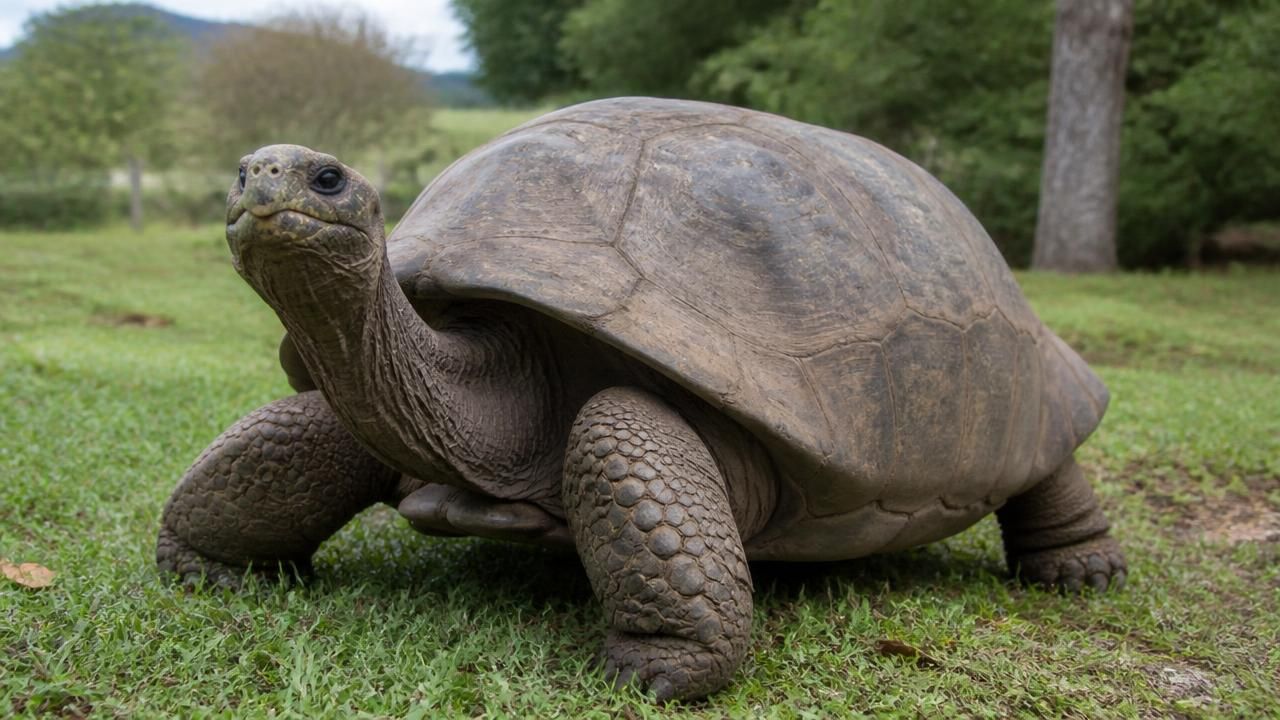
Jonathan is not an ordinary tortoise. Estimated to have hatched around 1832, the Seychelles giant tortoise has lived at Plantation House, the official residence of the governor of St Helena, since 1882. At roughly 194 years old, he is widely recognized as the world’s oldest living land animal. Now, a newly reported genetic and epigenetic analysis suggests his exceptional longevity is not simply a matter of slow metabolism or good luck. Researchers have identified 287 unique genetic variants linked to DNA repair, inflammation control, insulin regulation and cancer suppression—biological systems that, in humans and other animals, are closely tied to how quickly the body deteriorates with age.
The findings, reported by Science Daily, Reuters, CNN, PBS News, Phys.org, BioTechniques, WWNO and other outlets, combine genomic and epigenetic approaches. The genome is the full set of DNA instructions; epigenetics refers to chemical marks that can switch genes on or off without changing the underlying code. According to Phys.org, Jonathan’s analysis revealed stable gene switches that may help resist aging. BioTechniques described the work as uncovering epigenetic secrets of extreme longevity. In plain terms, Jonathan’s molecular machinery appears to keep some protective programs running more reliably than expected for an animal his age.
What the study found
The headline number is 287: unique genetic variants associated with processes that help repair damaged DNA, tamp down inflammation, regulate insulin and suppress cancer. These are not random biological footnotes. DNA repair protects cells from mutations; chronic inflammation is a hallmark of many age-related diseases; insulin regulation influences metabolism and growth; and cancer suppression helps prevent uncontrolled cell growth. Together, the variants suggest a multi-layered defense system rather than a single longevity gene.
Some popular coverage translated the findings into the eye-catching claim that Jonathan has “the cells of a 5-year-old,” as Yahoo put it. That phrase is shorthand, not a literal description. The more precise claim is that certain molecular markers and gene-regulatory patterns remained unusually stable or youthful-looking compared with what scientists might expect in an aged animal. WWNO captured the surprise with the phrase “aging more slowly than you would expect.”
“Aging more slowly than you would expect.” — the characterization of Jonathan’s molecular profile that runs through coverage of the study
Why Jonathan matters
Giant tortoises are already known for long lives, but Jonathan is an extreme outlier. His age makes him a natural experiment in how a vertebrate can avoid or delay the accumulated damage that usually accompanies aging. The fact that he has survived nearly two centuries—through changes in empire, technology and climate—gives scientists a rare window into biological resilience.
Yet the study’s power is also its limitation. Jonathan is one animal. A single exceptional individual cannot prove that any particular variant causes longevity, nor can it establish how much of his health is genetic versus environmental. Researchers will need to compare his genome with those of other giant tortoises, shorter-lived reptiles and possibly mammals. Functional experiments would be needed to show whether the 287 variants actually alter DNA repair, inflammation or cancer risk in living cells.
From tortoise to human health
The human allure is obvious. CNN framed the story as a 194-year-old tortoise who could help humans live longer; PBS and ConsumerAffairs focused on what Jonathan could teach us about healthy aging. That translation is reasonable because the pathways highlighted—DNA repair, inflammation, insulin signaling and tumor suppression—are conserved across many species and are central to geroscience, the study of aging itself.
But the jump from a tortoise’s genome to a human longevity treatment is neither short nor direct. A variant that helps a slow-metabolizing reptile may behave differently in a warm-blooded mammal with a very different life history. The findings could inform drug targets or biomarkers, but they are not a prescription for human immortality. As Reuters put it, the world’s oldest land animal may hold clues to longer life—clues, not a cure.
How outlets framed it
- Science Daily and EurekAlert emphasized the genetic analysis and the 287 variants tied to DNA repair, inflammation, insulin and cancer suppression.
- Phys.org and BioTechniques highlighted epigenetic stability—the idea that Jonathan’s gene switches remain unusually well regulated with age.
- CNN, PBS and ConsumerAffairs stressed the translational angle: what a tortoise could teach humans about healthy aging.
- Yahoo and MSN leaned into the viral framing, including the memorable but imprecise “cells of a 5-year-old” idea.
- Reuters kept the wire-service focus on Jonathan’s status as the world’s oldest land animal and the possibility of clues to longer life.
What comes next
The next step is replication. Scientists will want to know whether the same variants or epigenetic patterns appear in other long-lived tortoises and whether they are enriched in species that age unusually slowly. They will also need to disentangle genetics from environment: diet, temperature, pathogens, social conditions and veterinary care all shape aging. For Jonathan himself, the study is a reminder that conservation and gerontology can intersect. He is not just a curiosity or a symbol; he is a living archive of biological strategies for survival.
The bottom line is that Jonathan’s secret appears to be a suite of protective systems—stable gene regulation, enhanced DNA repair, controlled inflammation, metabolic regulation and cancer suppression—rather than a single switch. That is scientifically richer than a fountain-of-youth headline, and more useful. If researchers can learn how those systems interact, the world’s oldest tortoise may indeed help illuminate why some bodies age more slowly than others—and perhaps how human aging might someday be made more resilient.