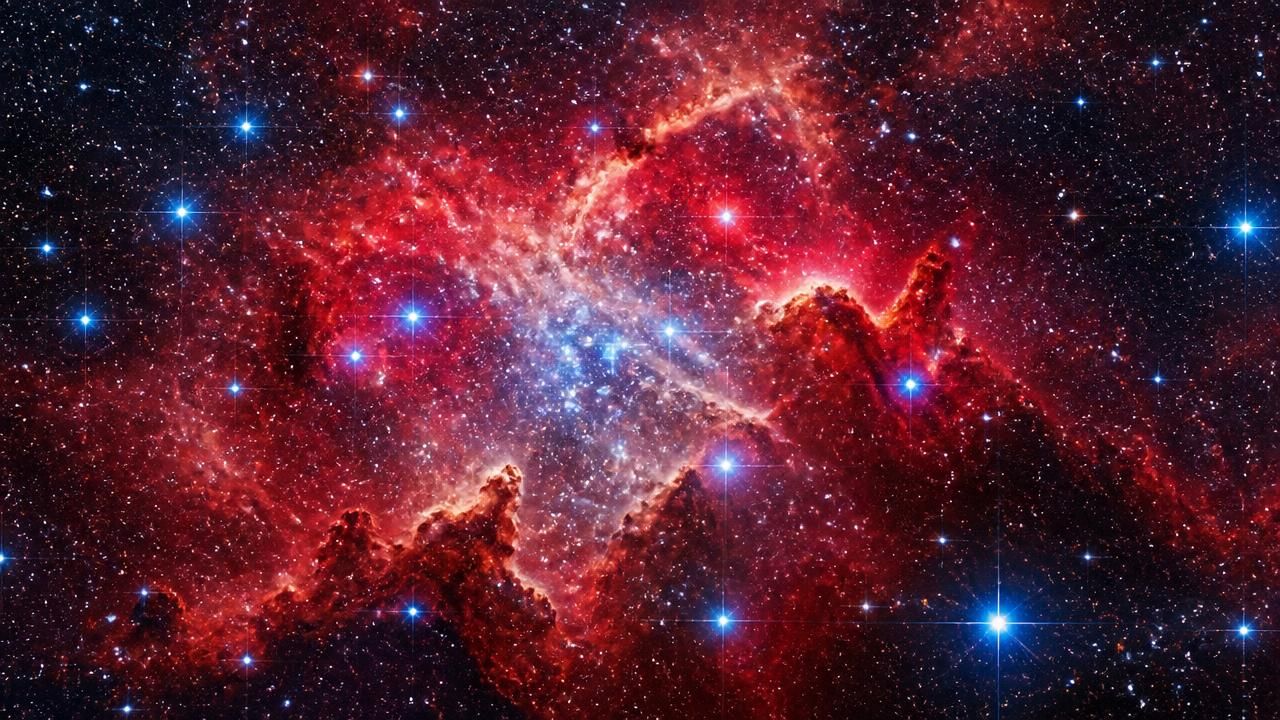
In a breathtaking display of cosmic artistry, NASA's Hubble Space Telescope has captured a new image of the stellar nursery LH 95 in the Large Magellanic Cloud (LMC), a dwarf galaxy orbiting the Milky Way. Released on July 3, 2026, the image shows a vibrant landscape of crimson gas and dust, illuminated and heated by a thriving population of young stars. The scene is punctuated by brilliant blue and white stars, creating a striking red, white, and blue tableau that has captivated astronomers and the public alike.
The image, processed by Gladys Kober at NASA's Catholic University of America, was created from data collected by Hubble's Wide Field Camera 3. It showcases LH 95 as a stellar association—a loose grouping of stars that includes both low-mass infant stars and massive blue giant stars. This region is one of many such associations in the LMC, which is a hotbed of star formation due to its rich reservoirs of gas and dust.
What is LH 95?
LH 95 is a star-forming region located in the Large Magellanic Cloud, approximately 160,000 light-years from Earth. The region is a stellar nursery where new stars are born from collapsing clouds of gas and dust. The crimson glow visible in the image comes from ionized hydrogen gas, which is heated by the intense ultraviolet radiation from young, massive stars. The blue and white stars are mostly massive, hot stars that shine brightly and live relatively short lives compared to lower-mass stars like our Sun.
According to NASA, the image reveals a "glowing landscape of gas and dust" that is home to a diverse population of stars. The low-mass infant stars, still in their formative stages, coexist with massive blue giants, which are already burning through their nuclear fuel at a prodigious rate. This mix of stellar types provides astronomers with a unique laboratory to study how stars of different masses form and evolve.
Significance of the Image
The Hubble image of LH 95 is not just a pretty picture; it holds significant scientific value. By studying regions like LH 95, astronomers can better understand the process of star formation and the role of stellar associations in galaxy evolution. The Large Magellanic Cloud, being relatively close and less cluttered by dust than our own galaxy, offers an excellent vantage point for observing star formation in detail.
Dr. N. Da Rio of the University of Virginia, a co-investigator on the project, noted that the image captures a "snapshot of a dynamic and evolving region." The data will help refine models of how young stars interact with their environment and how their radiation shapes the surrounding gas and dust.
Various media outlets have highlighted different aspects of the discovery. MSN emphasized the "spectacular red, white and blue" color palette, while Space.com called it a "photo of the day" and focused on the baby stars. Sci.News described it as a "star-forming cloud in a nearby dwarf galaxy," and ScienceDaily echoed NASA's description of a "crimson stellar nursery." The consistent theme across sources is the awe-inspiring beauty and the scientific importance of the region.
Context and Broader Implications
The LH 95 image is part of Hubble's ongoing legacy of observing star-forming regions. Since its launch in 1990, Hubble has revolutionized our understanding of stellar birth and death. This latest image adds to a rich archive that includes the iconic Pillars of Creation and the Orion Nebula. Unlike those regions in our own galaxy, LH 95 offers a view of star formation in a different galactic environment, which can reveal how metallicity and other factors influence the process.
The Large Magellanic Cloud is a dwarf galaxy that is currently interacting with the Milky Way, and its star formation is being triggered by tidal forces. Understanding how star formation proceeds in such a galaxy helps astronomers piece together the history of galaxy evolution and the formation of stellar populations.
Experts point out that the image also demonstrates the continued excellence of Hubble, even as the James Webb Space Telescope (JWST) takes over some of its duties. While JWST excels at observing the infrared universe, Hubble's optical and ultraviolet capabilities remain unmatched. The combination of both telescopes provides a comprehensive view of the cosmos.
Reactions and Different Perspectives
The release of the image has generated widespread interest. Space enthusiasts and amateur astronomers have praised the image for its aesthetic beauty, while scientists have focused on the data. Some sources, like Big Think, initially displayed a different story about a dying Sun-like star, but the primary narrative remains the LH 95 nursery. A few other sources, such as those covering Betelgeuse or exoplanets, were unrelated to this specific story but reflect the breadth of Hubble's work.
The image has also been shared widely on social media, with many users commenting on the patriotic color scheme of red, white, and blue, particularly around the Fourth of July in the United States. This cultural resonance has helped amplify the story beyond scientific circles.
What's Next?
Further observations of LH 95 are planned using both Hubble and ground-based telescopes. Astronomers aim to measure the masses and ages of the stars in the association to build a more complete picture of how star formation proceeds in the LMC. Additionally, the data will be used to study the feedback from massive stars—how their radiation and stellar winds affect the surrounding gas and trigger or suppress further star formation.
For now, the image stands as a testament to the beauty and complexity of the universe, and a reminder of the power of space telescopes to unveil the wonders of the cosmos.
"This image exemplifies the kind of detailed, multi-wavelength view that Hubble provides, allowing us to dissect the processes of star formation in a nearby galaxy," said Dr. G. De Marchi of the European Space Agency.