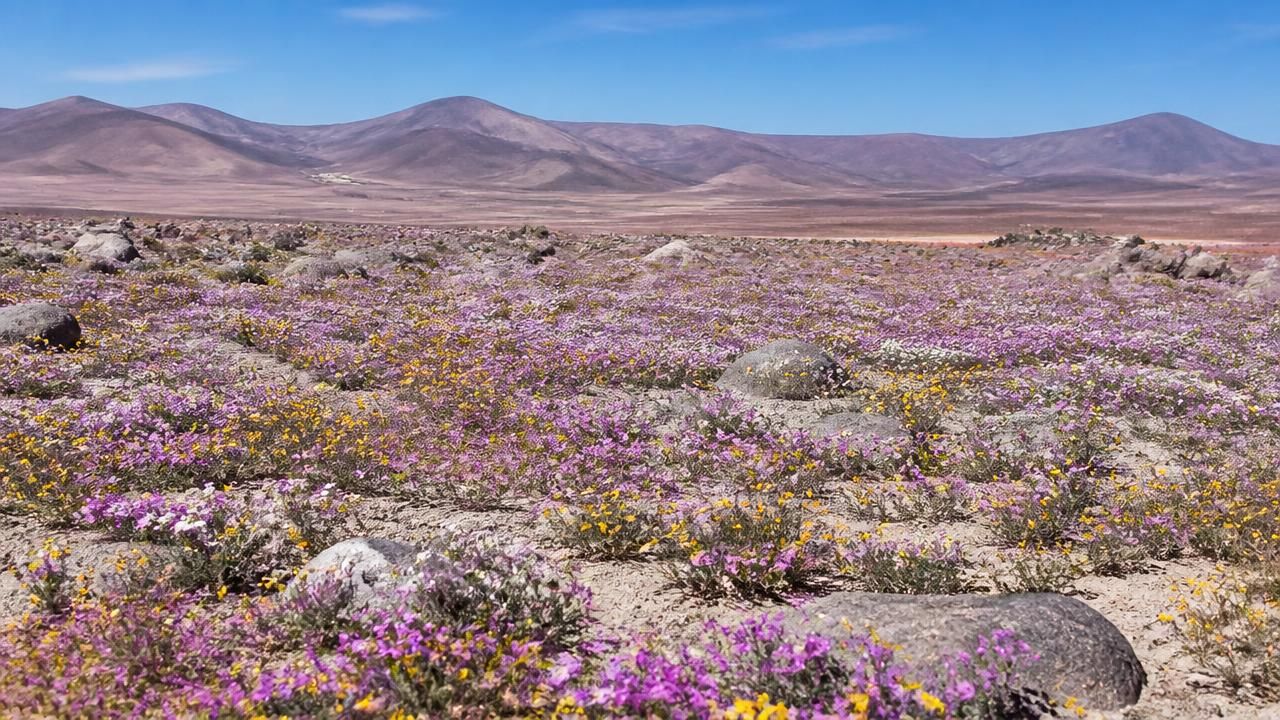
One of the most lifeless landscapes on the planet has turned against type. Chile's Atacama Desert — a stony, salt-crusted expanse where some weather stations have never recorded a drop of rain — has erupted into a sea of violet, gold and scarlet, in what observers describe as its most spectacular floral display in decades.
The transformation, reported this week by NPR, MSN, SFGATE and Newsday, among others, follows a season of rare El Niño-driven rains across northern Chile. The downpour has awakened what ecologists call the desierto florido — the flowering desert — a fleeting ecosystem that lies dormant in the soil for years, waiting for moisture that almost never comes.
A desert defined by absence
The Atacama stretches roughly 1,600 kilometres along Chile's northern spine, wedged between the Pacific and the Andes. It is conventionally described as the driest nonpolar desert on Earth: average rainfall in its hyper-arid core is measured in fractions of a millimetre per year, and some sections are thought to have gone centuries without a significant storm. NASA and Chilean researchers have long used it as an analogue for Mars.
That aridity is precisely what makes the current display so striking. The region's plants survive as bulbs, corms, rhizomes and hardy seeds buried in soil that bakes by day and freezes at night. When rainfall crosses a threshold — generally around 15 millimetres, timed to the cooler months — the dormancy breaks, and germination proceeds with startling speed.
"Earth's driest desert is covered in wildflowers right now." — headline from coverage by SFGATE and Newsday
Photographs distributed by NPR, shot by Tamara Merino, show hillsides washed in pink and purple where only gravel was visible months earlier. The agency's reporting described the scene as "a spectacular sea of color, awakening a fleeting ecosystem of flowers and wildlife."
Why the rains came
The mechanism is El Niño, the periodic warming of the equatorial Pacific that reshuffles weather patterns across the Americas. During El Niño years, the usually stubborn high-pressure system over the subtropical Pacific weakens, allowing moisture-laden air from the Amazon basin and the Pacific to push into northern Chile. The result is the rare frontal storms that seed the desert.
The pattern is irregular. Botanists have documented major bloom years in 1983, 1997, 2015 and 2017, with smaller events in between — typically appearing from September to November in the Southern Hemisphere spring. The 2015 El Niño produced one of the most photographed blooms on record; the 2017 rains were so intense they also triggered damaging floods and landslides, a reminder that the same weather system that brings flowers can bring catastrophe.
Aggregated reporting this week pointed to forecasts of a bloom potentially covering some 17,000 square kilometres — an area larger than Connecticut — involving more than 200 plant species. Such figures are projections rather than censuses, and the true extent will depend on how temperatures and follow-up rainfall evolve. Coverage has varied accordingly: NPR emphasised the ecological awakening and the human encounter with it, while aggregators on MSN and Yahoo foregrounded scale and spectacle, and outlets such as SFGATE and Newsday framed the event around the superlative — a flowering of the driest place on Earth.
An ecosystem, not just a photo opportunity
The flowers are the visible layer of a much larger biological surge. Endemic species such as the añañuca, the lirio del campo, pata de guanaco and various alstroemeria relatives unfurl in succession, followed by a pulse of insects, bees and butterflies. Lizards, rodents and birds move in to feed; foxes, guanacos and vicuñas follow. Even the salt flats stir, with brine shrimp emerging in ephemeral lagoons.
Chilean authorities have moved in recent years to formalise protection, establishing a national park devoted to the flowering desert in the Atacama region and promoting the phenomenon as a seasonal draw for domestic tourism. But conservationists warn that the bloom is uniquely vulnerable to its own popularity.
A spectacle under pressure
- Trampling: Off-road driving and foot traffic crush bulbs that may take years to recover, and soil scars persist for decades in a landscape with almost no microbial turnover.
- Poaching: Bulbs and corms of valued species are dug up and sold illegally, a practice Chilean authorities have repeatedly prosecuted.
- Climate volatility: Warmer oceans and shifting precipitation patterns make the timing and intensity of El Niño events less predictable, raising questions about whether the bloom's rhythm will hold.
- Tourism economics: Local communities benefit from the surge of visitors, but infrastructure in the region is thin and emergency services are stretched.
For now, the desert is doing what it has done for millennia: waiting, then blooming at once. The window is short — a matter of weeks before the flowers set seed, the bulbs retreat underground and the Atacama returns to its familiar silence. Those who study it say that is the point: the display is not an anomaly but a system, calibrated to the rarest of rains and utterly dependent on them.