Archaeologists working in Siberia have uncovered what they describe as the oldest directly dated archaeological evidence of psychoactive cannabis use, a finding that pushes the documented history of the plant's intoxicating properties back roughly 2,800 years and strengthens a long-debated account left to us by the Greek historian Herodotus.
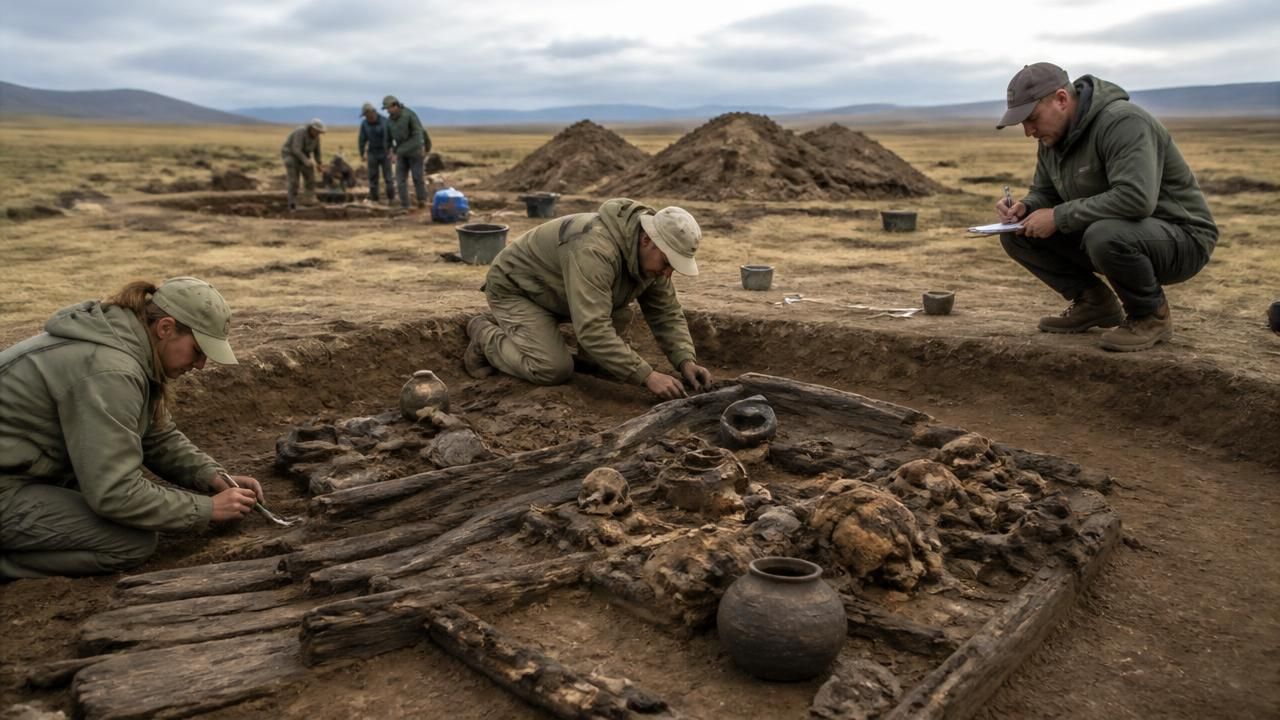
The discovery, first reported by Science Daily and quickly carried by aggregators including Yahoo and MSN under headlines trumpeting the “earliest evidence of cannabis use,” centres on a richly furnished tomb containing approximately 1,000 cannabis seeds, traces of elaborate burial ritual, and the remains of sacrificed animals. European coverage, including a report from Around Prague, highlighted an especially intimate detail: braided hair recovered from the burial that appears to carry chemical signatures consistent with cannabis exposure.
A tomb that kept its secrets for nearly three millennia
The burial belongs to the world of the Scythians, the nomadic pastoralists who dominated the Eurasian steppe from roughly the 9th century BCE through the first centuries of the common era. Their tombs — called kurgans, mounds raised over wooden chambers — have long been a rich source of archaeological surprises, from goldwork and horse harnesses to tattoos preserved by permafrost.
What distinguishes this find is not the presence of cannabis itself. Hemp seeds have turned up in Eurasian archaeological contexts before, and the plant was cultivated for fibre and oil across the ancient world. The significance lies in the combination of evidence: a seed cache of unusual scale, residues indicating burning, and hair that appears to record exposure at a biochemical level — a package that points toward deliberate intoxication rather than incidental contact.
“This is the oldest directly dated archaeological evidence of psychoactive cannabis use,” the study's authors said, according to Science Daily — a claim that rests less on the seeds than on the chemistry surrounding them.
Why the chemistry matters more than the seeds
Cannabis seeds themselves are not intoxicating; they contain negligible amounts of THC, the principal psychoactive compound. Archaeologists have therefore grown wary of inferring “drug use” from seed caches alone, a caution that has fuelled decades of scholarly argument over how ancient Eurasians actually consumed the plant.
What shifts the balance here is the presence of chemical evidence — residues consistent with the plant having been burned or otherwise processed — recovered alongside the seeds and within a burial context marked by ritual sacrifice. Researchers now routinely use gas chromatography and mass spectrometry to identify cannabinoid markers in charred material, a technique that has transformed the field in the past decade.
The braided hair adds a second, independent line of evidence. Hair is a biomolecular archive: compounds circulating in the bloodstream are incorporated into the keratin of growing hair and can remain detectable for millennia under favourable conditions. Where hair survives, it can speak to what a person actually absorbed, not merely what was placed in a grave.
What the different outlets emphasised
- Science Daily foregrounded the scale of the find — about 1,000 seeds — and the surrounding funerary spectacle, including animal sacrifice.
- Yahoo and MSN framed the story around priority: the earliest evidence yet of cannabis used as an intoxicant.
- Around Prague led with the braided hair, treating the human remains as the headline artefact rather than the seeds.
The divergence is telling. Science journalists tend to anchor such stories in either the object (the seeds) or the person (the hair), and each framing carries a different implicit argument about what constitutes proof.
Herodotus, vindicated again
The fifth-century BCE historian Herodotus described Scythians throwing hemp seeds onto red-hot stones inside small tents and inhaling the vapour, “howling with pleasure.” His account was long treated with scepticism, but archaeology has steadily moved in his direction.
In 2019, researchers analysing residue inside a wooden brazier from a cemetery in the Pamir Mountains of Tajikistan found chemical traces of cannabis with elevated THC levels, dating to roughly 2,500 years ago — evidence of burning at high altitude that suggested deliberate selection of more potent plants. Similar braziers have been recovered from Scythian burials in the Altai. The new Siberian find sits comfortably within that emerging picture, adding hair analysis and a substantially larger seed assemblage.
What the discovery does not prove
Caveats remain. A burial is a curated context, not a living room: objects placed with the dead may have been chosen for symbolic reasons rather than reflecting daily habit. Nor can residues easily distinguish recreational use from medicinal, ritual or mortuary practice — categories that ancient societies may not have separated at all.
Researchers also stress that direct dating of the seeds and associated material is what earns the phrase “oldest directly dated.” Many comparable finds have been dated only by association with surrounding strata, leaving room for error of centuries.
Still, the implications stretch beyond one tomb. If nomadic steppe societies were selecting, burning and inhaling cannabis nearly three millennia ago, then the plant's psychoactive properties were understood and exploited far earlier — and across a far wider geography — than the conventional narrative of a south Asian origin for recreational cannabis suggests. The find also underscores how much the Eurasian steppe, long treated as a corridor between “real” civilisations, contributed to humanity's early pharmacopoeia.
For now, the tomb's occupant — buried with seeds, braided hair and sacrificed animals — offers the clearest window yet onto an ancient ritual we had, until recently, only read about in the margins of a Greek history book.