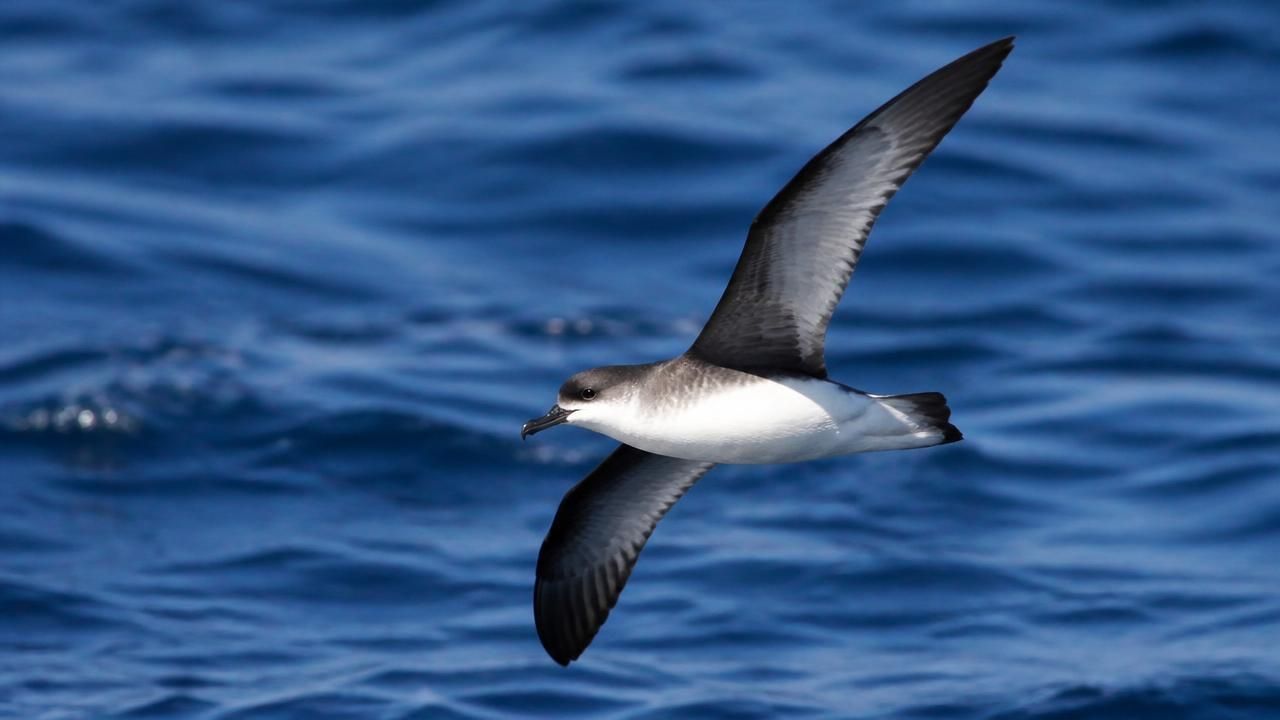
Jet lag has long been treated as a distinctly modern human complaint — the price of red-eye flights, shift work, and crossing oceans faster than the body can reset. A new study published in the journal Science suggests humans are not alone in suffering it. Manx shearwaters, small seabirds that range hundreds of kilometers a day across the North Atlantic, appear to jet-lag themselves during their foraging trips — and because they navigate by the Sun, that internal misalignment measurably bends their sense of direction.
Who, What, and Where
The research was led by Patrick Lewin, a behavioral and sensory ecologist at the University of Oxford. Speaking about the species, Lewin described the birds in disarmingly ordinary terms:
“Manx shearwaters are medium-sized birds, about the same size as a pigeon,” Lewin said. “They are white underneath and black on top, but they have very long wings, and they are closely related to albatross.”The birds nest in burrows on coastal islands ringing the North Atlantic, with the bulk of the breeding population concentrated in the UK and Ireland — roughly half of it in Wales.
The findings were picked up quickly across outlets, from Ars Technica's detailed treatment of the study's mechanics to shorter wire-style reports at MSN and regional broadcasters like NBC Right Now and NPR Illinois. The breadth of pickup reflects a story with obvious popular appeal: a familiar human annoyance discovered in a wild animal, with a twist that makes it scientifically useful rather than merely charming.
How Jet Lag Becomes a Navigation Error
Most coverage converged on the same core mechanism. Shearwaters, like many animals, calibrate an internal compass against the position of the Sun. That system only works if the bird also knows what time it is — a solar bearing is meaningless without a clock to interpret it. Cross several time zones in a single flight, and the body's circadian rhythm lags behind local solar time. The result is a consistent, predictable error in orientation rather than random confusion.
In effect, the birds carry their home time zone with them. A shearwater that has flown west will still be operating on the clock it left behind, so when it consults the Sun it reads the sky as if it were somewhere else entirely. Researchers can exploit that error: by tracking how birds misorient after long flights, they gain a window into the underlying chronobiology, and by extension into the sensory machinery that makes long-distance migration possible.
A Natural Experiment
What makes the finding notable is that it was not induced in a laboratory. The shearwaters were doing what they ordinarily do — commuting across open ocean in search of food, then racing home to burrows where chicks or partners wait. Their own lifestyle supplies the time-zone shift. For scientists, that offers something cleaner than artificial clock-shifting, a standard technique in animal navigation research that can stress subjects and complicate interpretation.
Why It Matters
The study sits at the intersection of two fields: chronobiology, the study of biological clocks, and sensory ecology, which asks how animals perceive and act on information in the real world. Migratory birds are among the most celebrated navigators on Earth, capable of returning to the same burrow after journeys spanning hemispheres. Understanding how robust that system is — and where it can be thrown off — matters for predicting how species respond to environmental change.
Climate change is altering the timing of seasons, prey abundance, and oceanic conditions across the North Atlantic. Species whose behavior is tightly coupled to internal clocks and solar cues may be especially exposed to mismatches between when their bodies say it is time to breed and when the environment says the same. A bird that can misplace itself by a few degrees of bearing after a long commute, the research implies, is running on a system with far less margin than it appears.
- Species: Manx shearwater, a pigeon-sized, long-winged seabird related to albatrosses.
- Key finding: Long ocean crossings desynchronize the birds' circadian clocks, skewing a Sun-based compass.
- Lead author: Patrick Lewin, University of Oxford.
- Published in: Science.
- Breeding range: Coastal islands of the North Atlantic; roughly half the population in the UK and Ireland, much of it in Wales.
How the Story Was Reported
The way the story traveled is itself instructive. Ars Technica gave it the fuller treatment, walking readers through the sensory mechanics and quoting the researcher directly. Aggregators and local broadcasters carried leaner versions of the same announcement, some under service-friendly headlines such as “Can birds get jet lag? New study reveals answer.” That difference in framing is familiar: the science desk reads the finding as a window into animal navigation, while the wider feed reads it as a curiosity about wildlife behaving like tired travelers. Both are legitimate reads of the same paper, and neither is wrong — the shearwater result is at once a technical advance and a genuinely delightful fact.
What remains unanswered is how much this matters in practice. Does the skew cost the birds time, energy, or navigational accuracy on real foraging trips? Does it resolve quickly once they settle at the colony, or persist long enough to affect provisioning of chicks? The paper's contribution is to demonstrate that the phenomenon exists and can be measured in wild birds. The follow-up work — whether self-inflicted jet lag carries an ecological cost — is where the story goes next.
For now, one conclusion seems secure: the restless, disoriented feeling of arriving somewhere your body has not yet caught up with is not a human invention. It is billions of years old, and the shearwaters have been living with it all along.