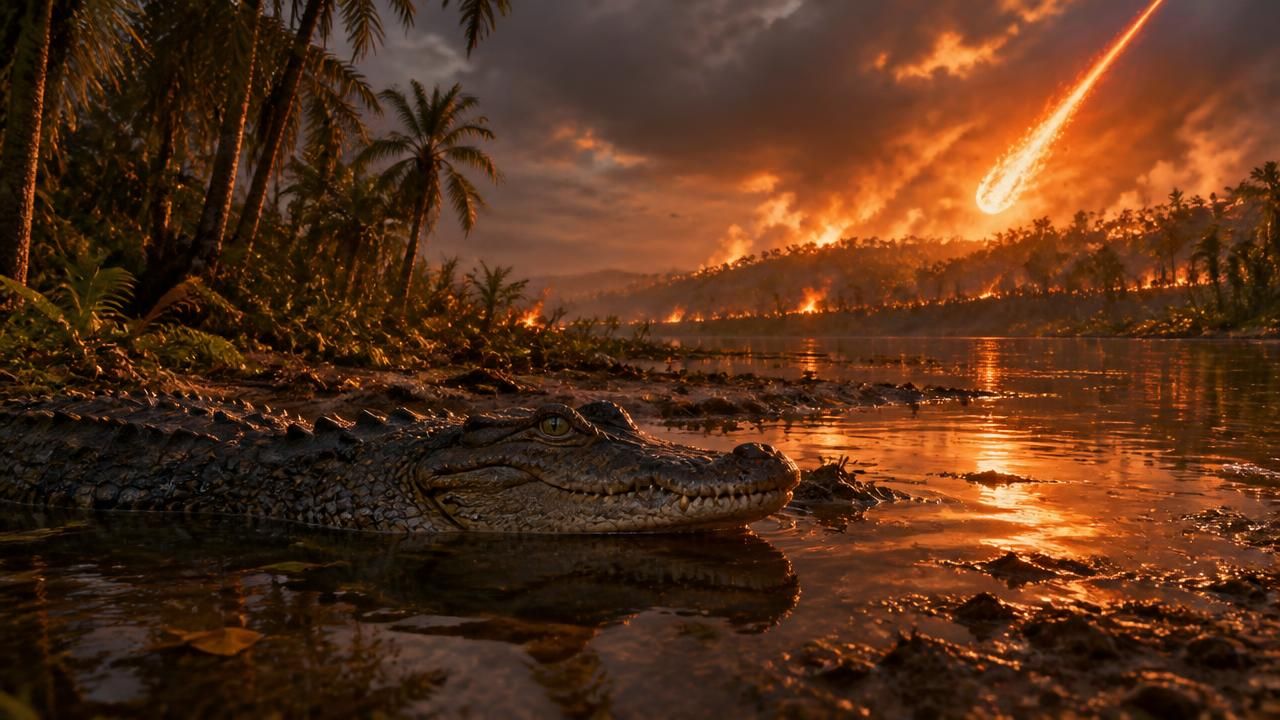
Sixty-six million years ago, an asteroid roughly ten kilometers wide slammed into what is now Mexico's Yucatán Peninsula, igniting wildfires, triggering tsunamis and kicking up a global veil of dust and soot that blotted out the sun. The aftermath wiped out an estimated three-quarters of Earth's species, including every non-avian dinosaur. Yet crocodilians — large, cold-blooded, semi-aquatic predators that by most ecological logic should have been early casualties — swam on.
Now, a sweeping new analysis of roughly 7,000 fossils, paired with reconstructions of ancient climates, offers an explanation for one of paleontology's most durable puzzles: the crocodiles survived because they stayed warm. Their long-standing preference for tropical and subtropical environments, the research suggests, left them clustered in equatorial refuges that remained habitable even as the rest of the planet turned lethal.
A 66-million-year-old mystery
The end-Cretaceous extinction is the most famous mass die-off in Earth's history, but it was also among the most selective. Plankton, ammonites, marine reptiles and the great dinosaur dynasties vanished. Turtles, small mammals, birds, certain fishes, ants and crocodilians pulled through. Explaining that split has never been simple.
The new work, reported by Science Daily, The Economic Times, RealClearScience and MSN, argues that geography mattered as much as physiology. Crocodilians are ectotherms — they rely on external heat to regulate body temperature — which ties them tightly to warm water and warm land. When the impact winter set in and temperatures plunged worldwide, the tropics retained comparatively more heat and moisture, and freshwater systems buffered their inhabitants against the worst swings. For crocodilians already adapted to those conditions, the refuge was familiar territory.
Their physiology added a second layer of insurance. Modern crocodilians can drop their metabolic rate dramatically, go months without eating, and shelter in burrows or mud during harsh conditions — behaviors that likely helped survivors ride out the darkness.
“Their preference for warm environments placed them in tropical refuges that remained habitable even after the catastrophic impact,” the researchers conclude, according to the published analysis.
250 million years of chasing the heat
Sci.News frames the finding in a longer arc: crocodile kin have been pursuing warm climates for some 250 million years. The lineage's tropical habits are not a quirk of the Cretaceous but a deep evolutionary strategy stretching back to the Triassic, when crocodile-line archosaurs were far more diverse than the handful of species alive today. That framing turns the survival story from a lucky break into the payoff of a very old bet — one placed long before the asteroid ever appeared on the horizon.
The distinction matters. If warm-climate specialization was inherited rather than improvised, it suggests crocodilians survived not by adapting in the disaster's immediate aftermath but by already occupying the places where conditions stayed survivable. Other lineages that had diversified into cooler or more specialized niches had no such fallback.
Charbroiled: competing visions of the kill mechanism
Not every account of the impact emphasizes cold. Eurasia Review highlights research suggesting the dinosaur-killing asteroid also generated a dust cloud that insulated Earth, trapping heat and effectively “charbroiling” Cretaceous creatures — a thermal pulse rather than a prolonged freeze. The two pictures are not mutually exclusive. Scientists increasingly describe a chaotic sequence: an initial blast of heat and firestorms, then an impact winter of darkness and cold, followed by a greenhouse-style warming as suspended particles and gases reshuffled the climate.
How an organism died therefore depended heavily on where it stood and when. Crocodilians, with low food requirements, the ability to shelter and a tolerance for fluctuating temperatures in warm waters, appear to have threaded that sequence in the tropics while more demanding species perished.
The asteroid's other winners
Crocodiles were not the only beneficiaries. Reporting from ScienceDaily notes that the same impact may have helped ants conquer the world, with the collapse of dinosaur-dominated ecosystems opening ecological space for the insects to radiate. Meanwhile, WRAL reports that a fragment of the asteroid itself may have been found — a rare physical trace of the object that set this whole chain of events in motion.
Taken together, the threads describe an extinction that was less a single event than a planetary reset: catastrophic for some, opportunistic for others, and legible today mostly through fossils, sediments and chemistry.
Why it still matters
The study's implications extend beyond paleontology. Crocodilians are among the most threatened large vertebrates on Earth, with many species restricted to tropical freshwater habitats now squeezed by development, pollution and climate change. Their ancient strategy — stay warm, stay put, endure hardship — worked for 66 million years, but it depends on stable tropical ecosystems that are themselves under pressure.
- What happened: An asteroid struck off Mexico 66 million years ago, extinguishing non-avian dinosaurs and roughly 75% of species.
- What's new: An analysis of about 7,000 fossils links crocodilian survival to warm-climate refuge in the tropics.
- Deeper context: Crocodile kin have tracked warm climates for some 250 million years.
- The wider pattern: Ants diversified after the impact, and a possible asteroid fragment has been reported.
- The caveat: Researchers still debate whether cold, heat, or a combination of both drove the extinctions.
As coverage across outlets shows, the story resists a tidy moral. Science Daily and RealClearScience emphasize the refuge hypothesis; Eurasia Review stresses the heat and dust; Sci.News stretches the timeline back hundreds of millions of years. What they agree on is the central insight: in a catastrophe that reshaped the planet, the survivors were often those already living in the right place, doing what they had always done.