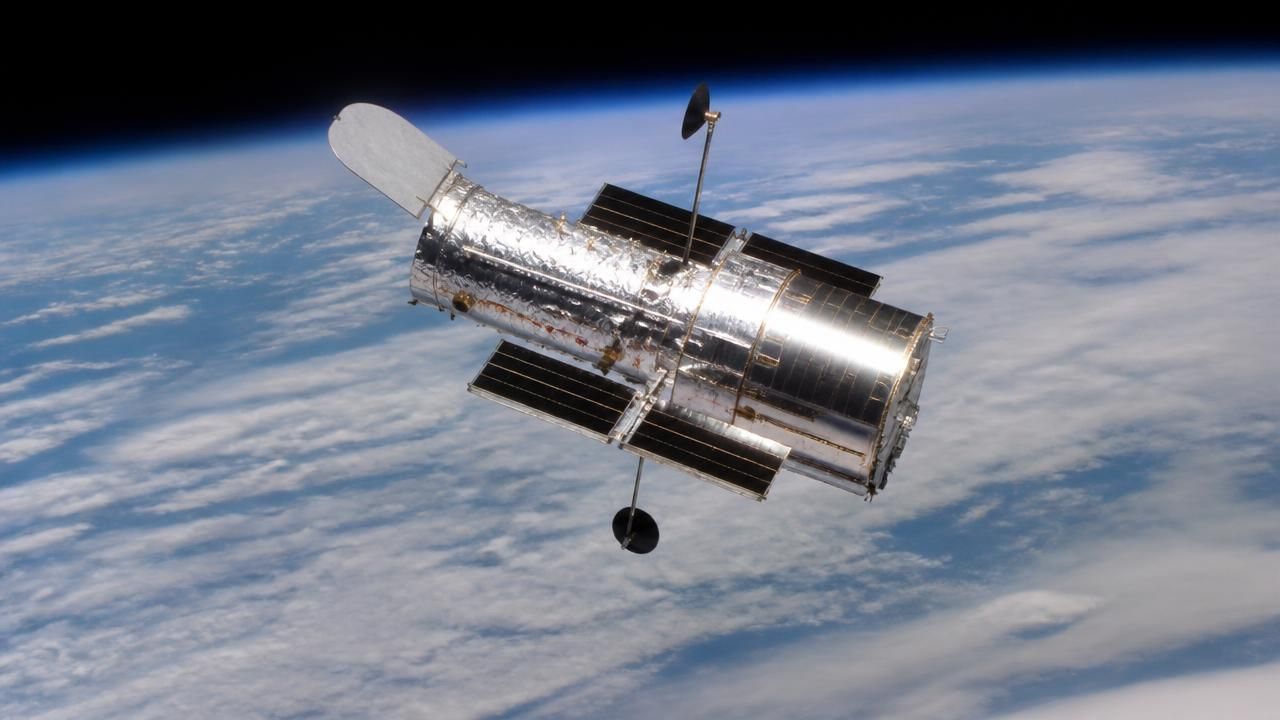
NASA is formally asking the commercial space industry to help it decide what to do with the Hubble Space Telescope — an asset that has reshaped astronomy for more than three decades but is, quite literally, drifting toward the end of its life. The agency issued a Request for Information (RFI) on Oct. 29 seeking industry input on how — or whether — to intervene.
The question is not whether Hubble is still productive. It is whether anyone can reach it, grab it, and either lift it higher or squeeze more capability out of it before atmospheric drag drags it to a fiery end.
Three Paths for a Fading Icon
The RFI lays out three broad categories of commercial interest NASA wants to hear about:
- Reboost: A mission to raise Hubble to a higher altitude, slowing orbital decay and extending its scientific lifetime.
- Servicing: On-orbit work to enhance or refurbish the telescope's capabilities — something no spacecraft has attempted on Hubble since the Space Shuttle era.
- Disposal: A safe, controlled re-entry into Earth's atmosphere or a controlled orbital disposal at the end of the mission.
That third option is the one nobody at NASA wants to lead with, but it is the reality of orbital mechanics. Hubble orbits at roughly 525 kilometers, well below where it flew after its final shuttle servicing mission in 2009. Residual atmosphere at that altitude exerts a steady drag, and the telescope has no propulsion of its own. Without intervention, engineers have long estimated Hubble would re-enter sometime in the mid-2030s — a timeline that depends on solar activity, which expands the upper atmosphere and accelerates the decay.
Isaacman: 'Every Reasonable Opportunity'
NASA Administrator Jared Isaacman framed the RFI as fiscal responsibility as much as scientific ambition.
"Hubble still has important science ahead of it, and we should be looking at every reasonable opportunity to keep it delivering for as long as possible," Isaacman said. "If there are innovative and cost-effective ways to extend the life of an asset already on orbit, we owe it to the American taxpayer and the scientific community to explore them. Extending Hubble's life would mean more discoveries, more science, and more opportunities to expand our understanding of the universe."
Nicky Fox, associate administrator of NASA's Science Mission Directorate, emphasized both Hubble's legacy and the maturation of the private sector.
"Hubble is a national icon that has fundamentally changed how humanity views our universe for more than 35 years," Fox said. "Commercial industry has rapidly evolved in recent years to offer new capabilities for in-space satellite capture and servicing."
Not the First Attempt
The RFI is, as Ars Technica bluntly put it, another round of NASA "asking for ideas to rescue Hubble from certain death." The framing is telling: this is not a novel problem, and the agency has been here before.
In 2022, NASA signed an unfunded Space Act Agreement with SpaceX to study whether a Crew Dragon capsule — flying a privately funded mission with the Polaris Program — could rendezvous with Hubble and boost its orbit. The study concluded such a mission was technically plausible but carried meaningful risk to a telescope that was never designed to be visited by anything but the shuttle. NASA ultimately declined to proceed at the time, citing the risk/benefit tradeoff and the lack of a clear funding path.
Prior to that, the agency abandoned a robotic servicing mission in the mid-2000s after the Columbia accident, a decision later reversed in favor of a final shuttle servicing flight in 2009 that installed new instruments and batteries but left Hubble without a means of maintaining its own altitude.
How the Story Is Being Framed
The coverage splits along predictable lines. NASA's own announcement reads as an open door — an invitation to industry, emphasizing innovation and cost-effectiveness. Outlets aggregating the news leaned into the dramatic: "Hubble is slowly falling, and NASA asks companies how to save it," read one headline; "NASA moves to preserve Hubble with ambitious orbital rescue mission," read another. Ars Technica's framing — "once again" — captured the cyclical nature of the effort and a measure of skepticism that any of these studies will produce a funded mission.
The gap between the framings matters. NASA's language is deliberately conditional: the RFI seeks "potential" commercial interest and asks what capabilities exist. It commits to nothing. Headlines promising a "rescue mission" are ahead of where the agency actually is.
What's Actually at Stake
Hubble's scientific case remains strong despite its age. The telescope has produced more than 1.6 million observations and underpins a substantial share of modern astrophysics, from measuring the expansion of the universe to characterizing exoplanet atmospheres. It is also the rare Great Observatory still operating: the Compton Gamma Ray Observatory was deliberately deorbited in 2000, and the Spitzer Space Telescope was retired in 2020.
But the telescope is degraded. Gyroscope failures forced NASA to shift Hubble to a single-gyro operating mode in 2024, reducing pointing flexibility and cutting into observing efficiency. Instruments have aged. Any servicing mission ambitious enough to replace hardware would be far harder than a simple boost — and far riskier, given that a capture gone wrong could end the mission outright.
There is also the question of money and priorities. NASA's astrophysics budget is under pressure from JWST operations, the Nancy Grace Roman Space Telescope, and the far larger costs of human spaceflight. A commercial servicing mission would need a customer willing to pay, and the RFI explicitly probes whether industry sees a business case rather than simply a science case.
What Happens Next
NASA will use the responses to gauge whether a commercial mission is worth pursuing and, if so, in what form. The agency has stressed that any path forward must balance scientific return against cost and risk — including the risk of doing nothing and letting Hubble come down on its own.
For now, the telescope keeps observing, circling Earth every 95 minutes and losing a little altitude with each pass. The RFI is NASA's acknowledgment that the clock is running — and that the next chapter of Hubble's story may be written by a private spacecraft rather than a shuttle crew.