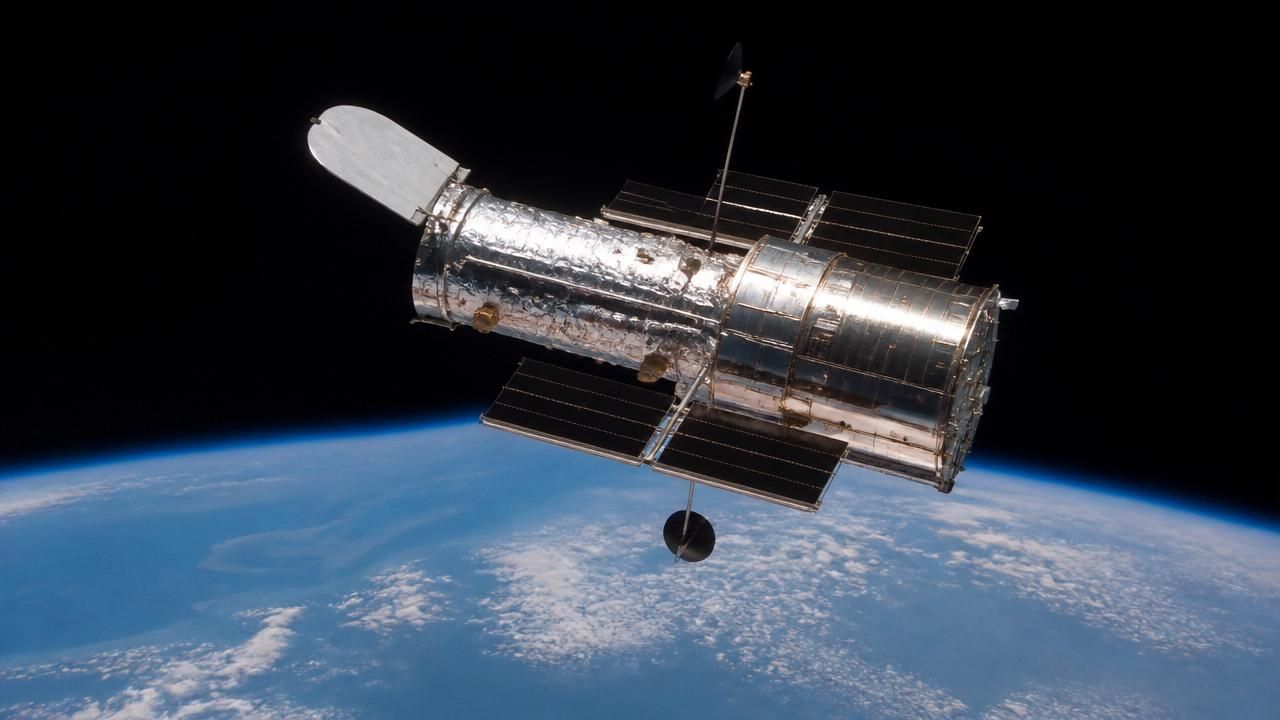
In a landmark discovery that has electrified the astronomical community, NASA's Hubble Space Telescope has provided compelling evidence for an intermediate-mass black hole (IMBH) lurking at the heart of the globular cluster Omega Centauri. This finding, reported by multiple sources including NASA, ESA, and leading science outlets, fills a critical missing link in our understanding of black hole evolution, bridging the gap between stellar-mass black holes and the supermassive behemoths that anchor galaxies.
A Cosmic Puzzle Solved
Omega Centauri, a dazzling collection of about 10 million stars visible from Earth's southern hemisphere, has long puzzled astronomers. For decades, models predicted that such a dense cluster should be teeming with black holes, yet direct evidence remained elusive. Now, a team led by Maximilian Häberle from the Max Planck Institute for Astronomy has used Hubble's sharp vision to identify a population of seven fast-moving stars in the cluster's core, whose motions betray the presence of an invisible, massive object. According to ESA/Hubble, these stars are moving at speeds that can only be explained by the gravitational pull of an object roughly 8,200 times the mass of our Sun—a classic signature of an IMBH.
“We were not looking for the gap, but we found it,” remarked one team member, describing how the stars' unusual velocities led them to the black hole's location.
The discovery, published in Nature, has been hailed as the strongest evidence yet for an intermediate-mass black hole. As Space.com notes, this object represents a new class of cosmic entity that astronomers have long sought. Big Think describes it as the “strongest missing link in black hole physics discovered at last,” while BBC News calls it a “cosmic missing link.”
Why Intermediate-Mass Black Holes Matter
Black holes come in two well-known varieties: stellar-mass black holes, which form from collapsed stars and weigh up to a few tens of solar masses, and supermassive black holes, which reside at galaxy centers and can be millions to billions of times the Sun's mass. But how supermassive black holes grow so large has been a mystery. IMBHs, with masses between 100 and 100,000 solar masses, are the hypothesized seeds that could grow into supermassive giants. Until now, only a handful of candidate IMBHs had been found, and none as convincing as this one.
“This is a big deal,” said Dr. Elena Rossi of the University of Leiden, commenting on the discovery for Sky at Night Magazine. “It confirms that globular clusters can host IMBHs, and that these black holes may be the building blocks of supermassive black holes.”
How Hubble Made the Discovery
Hubble's unique capabilities were key. Over several years, the telescope snapped high-resolution images of Omega Centauri, allowing astronomers to track the motions of individual stars with extraordinary precision. They identified seven stars racing at speeds up to 500,000 miles per hour—far faster than their neighbors. By analyzing these motions, the team pinpointed the black hole's location and mass. The discovery was serendipitous: the team was initially studying the cluster's stellar population, not specifically searching for a black hole. As one researcher told Space.com, “We were not looking for the gap, but we found it.”
This finding aligns with other recent IMBH detections. In a separate study, scientists reported an IMBH in the galaxy NGC 6099, caught in the act of tearing apart and devouring a star—a so-called “tidal disruption event.” That black hole, weighing about 50,000 solar masses, was observed by multiple observatories, including NASA's Chandra X-ray Observatory. As Sci.News reports, this event provides another glimpse into the feeding habits of intermediate-mass black holes.
Broader Implications for Astrophysics
The Omega Centauri black hole is not just a curiosity; it has far-reaching implications. For one, it supports the idea that globular clusters—ancient, dense star groupings—are prime hunting grounds for IMBHs. This could mean that many such clusters harbor hidden black holes, waiting to be found. Moreover, the discovery sheds light on the evolution of galaxies. Supermassive black holes are known to influence galaxy formation, but their origins remain unclear. If IMBHs are indeed the seeds, then understanding their formation and growth is crucial.
“This is a missing piece in the puzzle of how black holes grow from small to supermassive,” said Dr. Häberle in a NASA press release. “We now have a clear target to study further with future telescopes like the James Webb Space Telescope.”
Indeed, the James Webb Space Telescope (JWST) is already following up. Recent JWST observations have revealed mysterious “little red dots” in the early universe, which some astronomers suspect are IMBHs or even “black hole stars”—hypothetical objects powered by black hole accretion. As Space.com reports, these tiny, red objects could be the seeds of the supermassive black holes seen in the early cosmos.
Different Perspectives, One Story
The discovery has been covered widely, with each outlet adding its own spin. NASA's official release emphasizes the technical achievement and the role of Hubble's longevity. ESA/Hubble highlights the international collaboration. Space.com focuses on the “new type of cosmic object” and the excitement among astronomers, while Big Think frames it as a vindication of theoretical predictions. BBC News calls it a “hungry black hole” that may be the cosmic missing link, and Sky at Night Magazine places it in the context of other IMBH candidates. The common thread is unanimous excitement: this is the strongest evidence yet for an intermediate-mass black hole.
Some sources, like Digital Camera World, even note that this is the closest black hole to Earth ever found in a globular cluster—though not the closest overall. The black hole in Omega Centauri is about 17,000 light-years away, making it a relatively nearby laboratory for studying black hole physics.
What's Next?
Astronomers are already planning follow-up observations. Hubble's successor, JWST, will probe the black hole's environment in infrared light, potentially revealing gas swirling into the black hole or jets of material being ejected. Meanwhile, ground-based telescopes like the Very Large Telescope in Chile will search for more fast-moving stars to refine the mass estimate. The discovery also raises questions: Are there more IMBHs in Omega Centauri? Do other globular clusters harbor similar monsters? And how do these black holes influence the clusters themselves?
For now, the astronomical community is celebrating a breakthrough that has been decades in the making. As one researcher put it, “We've been looking for this for so long. It's like finding a needle in a haystack—but we finally did it.” The missing link in black hole evolution has been found, and the universe just got a little more connected.