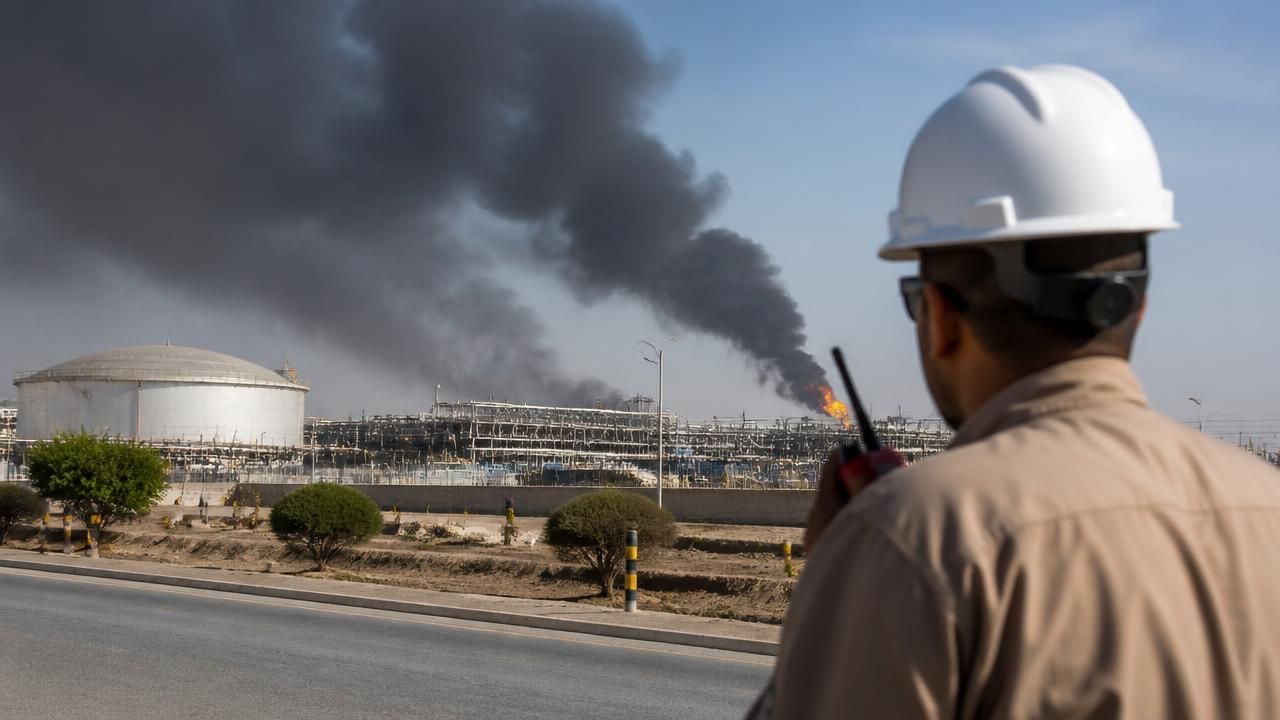
Oil prices surged past $105 a barrel and Brent crude briefly topped $107 on Thursday as Iran-backed Houthi rebels in Yemen escalated a wave of drone and missile attacks on Saudi Arabia, forcing Saudi Aramco to evacuate its headquarters and prompting the U.S. State Department to order non-emergency personnel out of the kingdom. The strikes — including deadly hits on Saudi airports — mark one of the most dangerous escalations in the six-year Yemen war and are drawing the kingdom deeper into a direct confrontation with Iran.
The financial and diplomatic fallout spread quickly across markets and capitals. Energy traders, already jittery over tight global inventories, treated the attacks as a direct threat to the world's most important oil-exporting infrastructure. Inflation-watchers in Washington and Frankfurt took notice. And Saudi Arabia's allies began publicly lining up behind Riyadh, even as questions mounted about why the kingdom's formidable air defenses could not stop the assaults.
A widening war, a vulnerable kingdom
According to multiple reports, Houthi forces claimed responsibility for attacks on Saudi oil facilities and airports. CNN reported that an attack on a Saudi airport killed three people, while Yahoo News, citing Saudi officials, said three had died in airport attacks claimed by the Houthis. The rebels warned of a long conflict. Separately, UPI reported that the Houthis claimed an attack on Saudi oil facilities — a striking echo of the September 2019 strikes on Abqaiq and Khurais that briefly knocked out roughly half of Saudi crude output and rattled global markets.
Bloomberg Markets reported that Aramco was forced to evacuate its headquarters and that the kingdom is on alert for further strikes, with oil prices spiking. "Oil prices are spiking," Bloomberg's Tyler Kendall reported, capturing the immediate market reaction as traders confronted the prospect of sustained disruption to Saudi export capacity.
The market reaction: inflation fears return
The price action told the story. Seeking Alpha reported that oil topped $105 as Houthi attacks raised inflation fears — a framing echoed across trading desks worried that a renewed energy shock could complicate central banks' efforts to ease monetary policy. Gulf News put Brent above $107 and described a broader regional escalation, reporting that Iranian strikes had hit U.S. aircraft in Jordan, that Houthi forces had seized the port city of Mocha, and that vessels had been attacked near Oman's Khasab. Those claims could not be immediately and independently verified, but the headline alone underscores how quickly the conflict is being reframed from a Yemeni civil war into a regional confrontation.
The rally was not one-directional. MSN reported that oil prices edged lower after Iran said it was open to diplomacy to end the war, and Seeking Alpha reported a subsequent pullback as G7 nations pledged to release diesel stocks, with reports that the Saudis were planning a retaliatory attack on the Houthis. The whipsaw price action reflects a market caught between supply fear and the hope that back-channel talks could de-escalate the crisis.
The limits of friendship
MSN's framing — "As attacks choke off Saudi oil, kingdom confronts limits of Trump's friendship" — captures a central political tension. Riyadh has cultivated an unusually close relationship with Washington, but the current wave of attacks exposes how little that relationship can do to shield Saudi infrastructure from relatively cheap asymmetric warfare. The State Department's decision to order non-emergency personnel home is a signal that U.S. officials see real risk of further strikes, not merely a diplomatic gesture.
At the same time, Saudi Arabia's allies are rallying. Al Jazeera reported that Saudi allies were lining up support as Houthi attacks mounted, and MSN carried similar reporting that allies were uniting behind the kingdom. The Journal-News framed the escalation as drawing the kingdom deeper into the Iran conflict — a dynamic that risks turning a costly stalemate into a multi-front war.
"The Houthis vs Saudi Arabia — the new lords of the Red Sea." — The Hindu
That framing from The Hindu is apt: the Houthis' growing ability to threaten Red Sea shipping lanes and Saudi oil infrastructure has given the rebel group leverage far beyond its territorial footprint in northern Yemen.
Context: a war that won't end
The Houthis seized Yemen's capital, Sanaa, in 2014, prompting a Saudi-led coalition intervention in 2015. Years of stalemate have devastated Yemen, produced one of the world's worst humanitarian crises, and left the Houthis with an increasingly sophisticated arsenal of drones and ballistic missiles — largely, Western officials say, supplied or enabled by Iran.
The attacks on Saudi airports and oil facilities demonstrate that the rebels' capacity to strike deep into the kingdom has not been degraded despite years of coalition bombing. That is a strategic problem for Riyadh, which has spent billions on air defenses and sought to reposition itself as a stable, investment-friendly economy under Crown Prince Mohammed bin Salman's Vision 2030 agenda. Foreign investors, already wary, are now watching whether the kingdom can guarantee the security of the very assets it is asking them to finance.
What to watch
- Oil price volatility: Whether Brent holds above $105 or retreats on diplomacy will set the tone for global inflation expectations.
- G7 emergency measures: A coordinated release of diesel stocks would signal that major economies see supply risk as severe.
- Saudi retaliation: Reports that Riyadh is planning strikes on Houthi targets raise the risk of a wider escalation.
- Iran's posture: Tehran's stated openness to diplomacy is the main brake on further escalation — and the markets know it.
- Red Sea shipping: Attacks on vessels near Oman's Khasab, if confirmed, would threaten a chokepoint carrying a substantial share of global trade.
The coming days will determine whether this is another volatile episode in a long, grinding conflict or the beginning of a broader regional war. For markets, the message is already clear: geopolitical risk is back on the agenda, and the price of oil is once again a measure of Middle East instability.