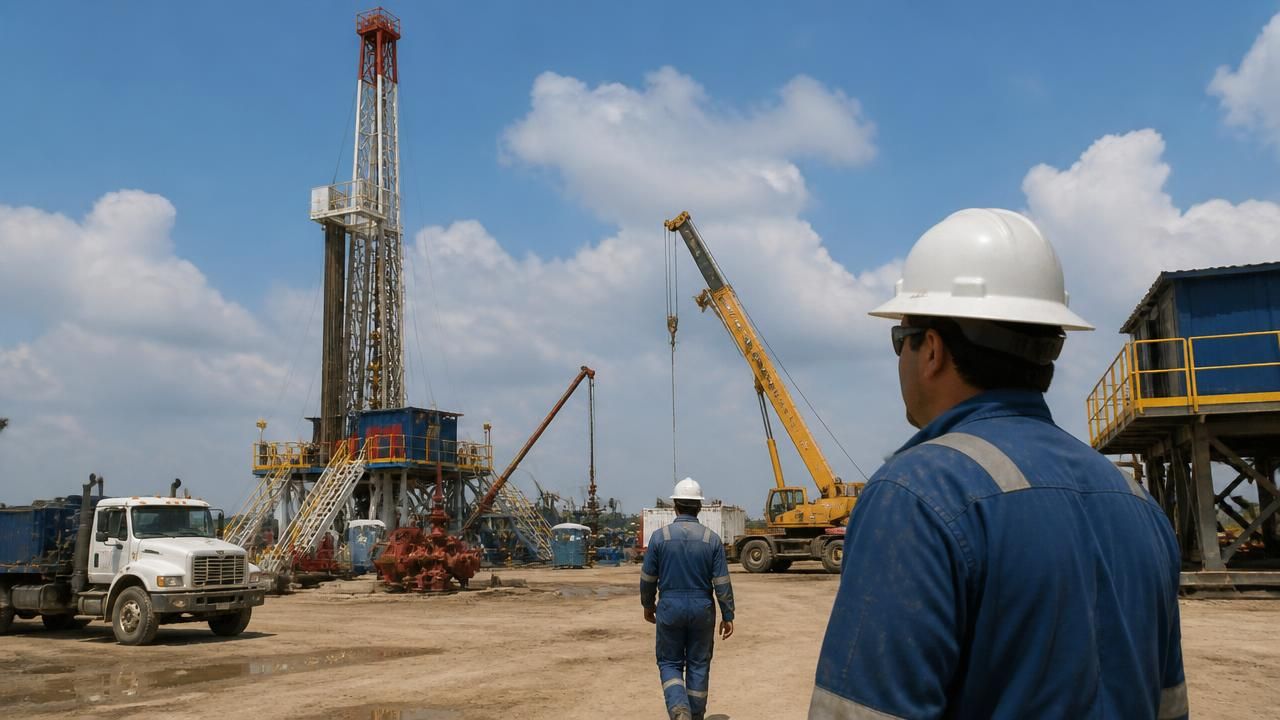
North American Blue Energy Partners Inc., the little-known Texas-based firm developing Venezuelan oil fields under an agreement with the U.S. government, is accelerating its expansion in the South American country, adding a sixth drilling rig and deploying 11 workover rigs as it pursues an ambitious production target of 1 million barrels per day, according to people familiar with the company's operations and reports from industry trade publications.
The buildout, first reported by Bloomberg and subsequently covered by World Oil and Energy-pedia, marks one of the fastest operational ramps by a foreign company in Venezuela in more than a decade — and positions NABEP as a potential challenger to Chevron, long the dominant Western oil producer in the country.
What the numbers show
NABEP's rig count has climbed steadily in recent months. The company is now deploying a sixth drilling rig, capable of sinking new wells into mature fields, alongside 11 workover rigs used to rehabilitate existing wells that have fallen into disrepair after years of underinvestment at state oil company PDVSA. Industry outlets framed the arrivals as evidence that "Venezuela's oil recovery gains momentum" — a notable shift in a country whose output collapsed from roughly 3 million barrels a day in the late 1990s to under 1 million barrels a day in recent years.
The 1 million barrel-per-day goal, if achieved, would represent a transformation not just for NABEP but for Venezuela's national export picture. For context, Chevron — which has operated in Venezuela for a century and retained a narrow sanctions license through successive rounds of U.S. restrictions — has been producing on the order of 200,000 to 250,000 barrels a day in recent years, according to estimates from analysts and company disclosures.
A new model: state capitalism, American-style
The arrangement behind NABEP is highly unusual. Rather than a conventional private investment or a sanctions waiver granted to an established major, the company's Venezuelan operations are being developed in partnership with the U.S. government — specifically with the Department of Defense playing a coordinating role. CNBC characterized the structure bluntly in a headline that has circulated widely among energy analysts: Trump's state capitalism comes to the oil industry with his unprecedented Venezuela deal.
The deal represents an unprecedented fusion of U.S. foreign policy, military strategy and commercial oil production — a model with few precedents in American history.
Supporters argue the structure gives Washington a direct stake in Venezuela's energy recovery and creates leverage over Caracas at a moment of political transition. Critics — including some within the oil industry — contend it blurs the line between corporate strategy and statecraft, and raises questions about how contracts, revenue splits and environmental liabilities will be governed.
Senate Democrats push back
The political scrutiny has already begun. Senate Democrats are challenging the Pentagon's role in the Venezuela oil deal, according to reports from Yahoo News, questioning the legal authority under which the Defense Department is partnering with a private energy firm and demanding transparency on the terms. The objections add a partisan dimension to a project that had, until recently, been framed largely as an operational story.
Key questions raised by lawmakers include:
- What statutory authority permits the Pentagon to structure a commercial oil partnership?
- How are profits, royalties and Venezuelan state obligations divided?
- What oversight exists over sanctions compliance and contracting?
- Whether the arrangement sets a precedent for military involvement in commodity production.
Why it matters
Venezuela holds the world's largest proven crude reserves, but its fields have been starved of capital, equipment and technical expertise. Restoring production requires exactly what NABEP is deploying: workover rigs to revive shut-in wells and drilling rigs to tap new formations. Even modest success would alter global supply math, adding barrels to a market where OPEC+ policy and geopolitical risk already set the tone.
The timing is also significant. With Washington seeking to reduce reliance on rival producers and to shape outcomes in Latin America, Venezuela has re-emerged as a strategic prize. The NABEP experiment tests whether a state-backed corporate vehicle can do what sanctions and diplomacy have not: restart a collapsed oil sector.
The road ahead
Analysts caution that rig counts are an early indicator, not a verdict. Venezuela's infrastructure, power supply, workforce and export logistics all remain constrained, and the 1 million barrel-per-day target is widely viewed as a multi-year — possibly decade-long — ambition rather than a near-term forecast. Congressional hearings, contract disclosures and quarterly production data will be the benchmarks to watch.
For now, NABEP's expanding fleet signals intent. Whether that intent survives Washington's political weather is a different question — and one that may determine the fate of Venezuela's oil recovery as much as geology does.