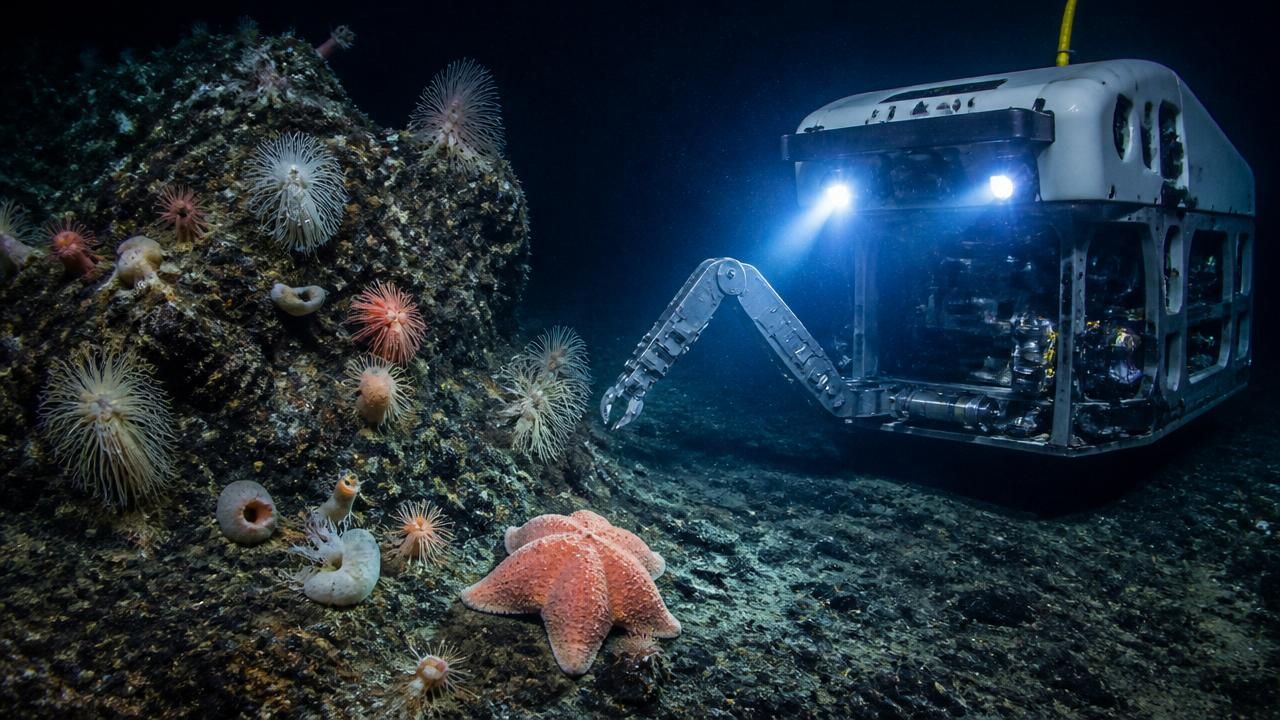
The deep ocean, Earth's final frontier, is yielding its secrets at an unprecedented pace. A wave of recent discoveries—spanning from the Mariana Trench to the Antarctic seafloor—has unveiled hidden ecosystems, bizarre new species, and even a secret food source that could reshape our understanding of life in the abyss. These findings, reported by dozens of scientific outlets, collectively paint a picture of a world far more dynamic and interconnected than previously imagined.
A Hidden Food Web: Pressure-Cooked Nutrients
One of the most surprising revelations comes from a study featured in Science Daily, which found that extreme deep-sea pressure squeezes valuable nutrients out of sinking organic particles. This process provides an unexpected food source for ocean microbes, potentially rewriting our understanding of deep-ocean ecosystems and carbon storage. As Phys.org noted in a related field survey, this is the first big-picture view of deep-sea food webs, showing that life in the depths is not as nutrient-starved as once thought.
New Species Galore: From 'Big-Butt Starfish' to Golden Orbs
Expeditions around the globe have turned up a menagerie of never-before-seen life. Live Science reported on dozens of new species off Argentina, including a 'big-butt starfish' and a 'little sweet potato.' Meanwhile, Science Daily announced 24 new deep-sea species, including a rare new branch of life, and a separate find in the Great Salt Lake revealed a creature unlike any seen before. The mystery of a 'golden orb' found off Alaska—initially baffling researchers—has now been solved, though details remain under wraps. Even the world's 'oldest octopus' turned out to be something else entirely, highlighting how much we still have to learn.
Giant Animals and Elusive Whales
Deep-sea explorers have also captured footage of massive animals drifting through the darkness. Discover Wildlife reported on a gigantic animal appearing after scientists sank a cow 1,629 meters into the South China Sea, and another sighting in the South Atlantic. The BBC has been documenting the sounds of the world's most elusive whales, while Popular Mechanics described a 'voice no creature should have'—the ocean's longest-running mystery. Meanwhile, the question of whether megalodon still lives persists, though the Natural History Museum confirms it is extinct.
Ancient Mysteries Solved: From Mass Extinctions to Reptile Armor
Not all deep-sea news is about living creatures. Science Daily reported that scientists have finally solved the mystery of Earth's greatest mass extinction, as well as a 320-million-year-old puzzle about reptile bone armor. A 160-million-year fossil mystery was also cracked, with one researcher exclaiming, 'I've never seen anything like it.' Even King Charles' diamonds have revealed Earth's deep secrets, according to the BBC.
Unexplored Worlds: Caribbean, Pacific, and Beyond
The BBC revealed unexplored deep-water worlds in the Caribbean for the first time, while Science Daily reported hundreds of new species found in a hidden world beneath the Pacific. When a colossal iceberg broke free from Antarctica, scientists found something staggering beneath it, as Discover Wildlife covered. The deepest 'sea sinkhole' ever found—1,380 feet and still not bottomed—was reported by The Sun. And off the South Carolina coast, a 'lost' deep-sea mining site holds unknown secrets, according to the Post and Courier.
Implications for Climate and Life
These discoveries have profound implications. The pressure-nutrient mechanism could change models of carbon sequestration, as the deep ocean is a major carbon sink. New species expand our understanding of biodiversity and evolution. And the 'immortal jellyfish'—featured by the Natural History Museum—offers insights into aging. As Discover Magazine noted, 99.999 percent of the deep ocean remains unexplored, meaning countless more secrets await.
Conclusion
The deep sea is no longer a silent, empty abyss. It is a vibrant, interconnected world that influences our planet's climate, harbors unknown life, and holds keys to Earth's past. With each expedition, scientists are piecing together a new picture of the ocean's depths—one that is more complex and wondrous than ever imagined.