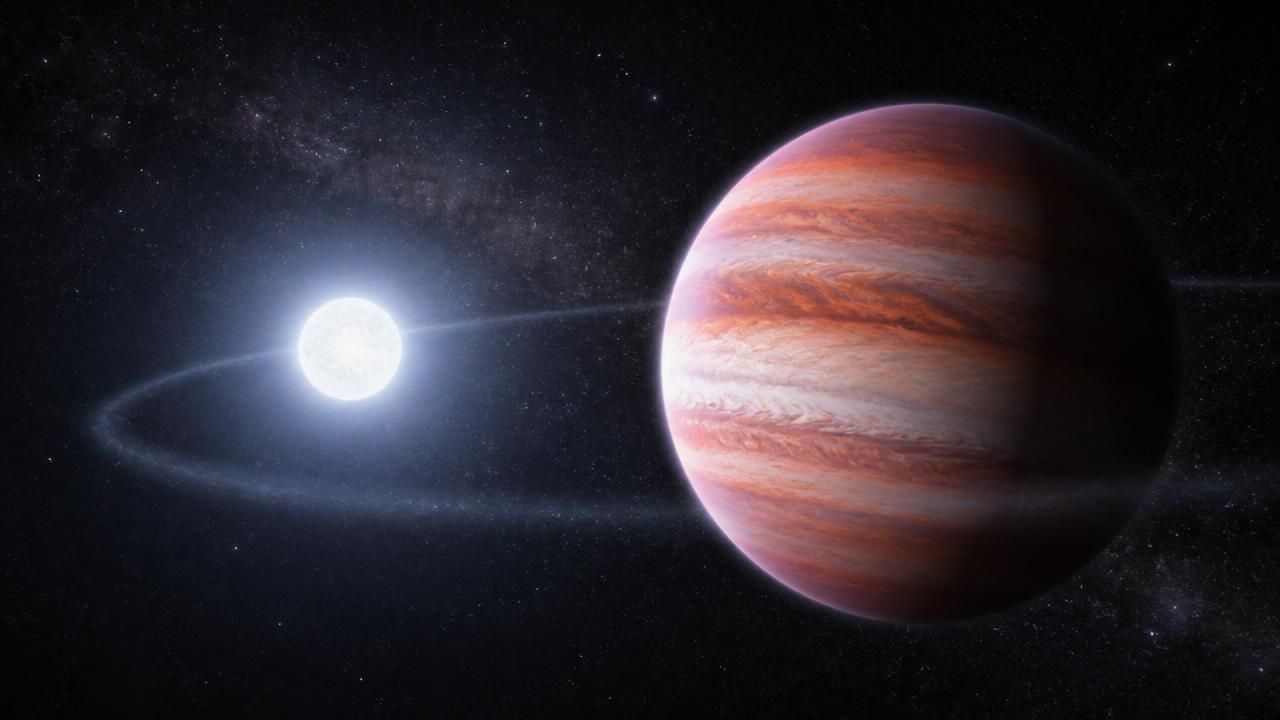
In a cosmic tale of survival against the odds, astronomers have used the James Webb Space Telescope (JWST) to scrutinize a Jupiter-size planet that somehow endured the violent death of its Sun-like star. The planet, designated WD 1856 b, orbits a white dwarf—the burned-out remnant of a star that once resembled our Sun. First discovered accidentally in 2020 by NASA's TESS observatory, this gas giant has now been studied in unprecedented detail, revealing a world that not only survived but appears to have become hotter after its star's demise.
A Strange Discovery from the Start
WD 1856 b was an accidental find. TESS was originally scanning a sample of roughly 2,000 white dwarfs, searching for small objects like comets or asteroids that might transit across these dead stars. Instead, it spotted a massive planet. “As soon as they looked at it, they said, okay, that’s weird,” said Christopher O’Connor, a theoretical astrophysicist at Cornell University and co-author of the recent study published in Nature. The planet’s existence alone was puzzling: white dwarfs are the remnants of stars that have gone through a red-giant phase, swelling to hundreds of times their original size before shedding their outer layers. Any planet originally close to such a star would typically be engulfed and destroyed. Yet WD 1856 b remains, orbiting its white dwarf every 34 hours at a distance of just 0.02 astronomical units—far closer than Mercury is to our Sun.
JWST's Revealing Observations
Using JWST's infrared capabilities, the team led by researchers from the University of Wisconsin-Madison and Cornell University obtained the first detailed spectrum of the planet. The data, published in Nature on [date], showed that the planet retains a substantial atmosphere, rich in carbon and oxygen, and surprisingly, it is hotter than expected. “This planet is an oddball,” said O’Connor. “It’s not just surviving; it’s actually hotter now than it was before its star died.” The heating likely results from tidal forces and leftover gravitational energy from the star’s death throes. The planet’s atmosphere appears to be composed mainly of hydrogen and helium, similar to Jupiter, but with traces of water vapor and carbon monoxide.
Implications for Earth's Future
The survival of WD 1856 b offers a tantalizing glimpse into the far future of our own solar system. In about 5 billion years, the Sun will exhaust its hydrogen fuel, swell into a red giant, and eventually shrink into a white dwarf. Mercury, Venus, and likely Earth will be engulfed. But what about the outer planets? “If a Jupiter-size planet can survive and even thrive around a white dwarf, it raises the possibility that gas giants like Jupiter and Saturn might endure,” said Dr. Lisa Kaltenegger, an astrophysicist at Cornell not involved in the study. However, the planet’s current orbit is extremely close to the white dwarf, suggesting it migrated inward after the star’s death—possibly through interactions with other planets or debris. “The system must have undergone dramatic gravitational reshuffling,” O’Connor noted.
Differing Perspectives from the Sources
The story has been covered by multiple outlets, each emphasizing different angles. Ars Technica focused on the technical details of the discovery and the “feeding frenzy” of scientific interest. Mashable highlighted the planet’s unexpected heating, titling its piece “A giant planet beat the odds and actually got hotter after its star died.” Yahoo News and MSN emphasized the implications for Earth’s fate, with headlines like “A planet survived its star's death. What does it mean for Earth?” while Phys.org and Labroots encountered access issues but their intended content likely mirrored the scientific findings. The consistent message across all sources is that WD 1856 b challenges existing theories of planetary survival and white dwarf systems.
Data Points and Expert Views
Key data from the JWST observations include a measured temperature of about 150 Kelvin (−123°C) for the planet, which is warmer than theoretical models predicted for a world that should have cooled after its star’s death. The planet’s mass is estimated at roughly 1.5 times that of Jupiter, and its radius is similar. The white dwarf itself, WD 1856+534, is about 80 light-years away in the constellation Draco. “This system is a natural laboratory for understanding the end stages of planetary systems,” said Dr. Andrew Vanderburg, an astronomer at MIT and co-author of the study. “We’re seeing a snapshot of what may happen to many exoplanets in the universe.”
Conclusion: A New Window into Planetary Afterlife
WD 1856 b remains the only confirmed planet orbiting a white dwarf, but astronomers expect more discoveries as JWST continues its mission. The findings not only shed light on the resilience of gas giants but also raise questions about the potential for life on moons of such planets. “If a planet can hold onto its atmosphere for billions of years after its star dies, its moons might have conditions for habitability,” Kaltenegger speculated. For now, this “oddball” planet stands as a testament to the universe’s capacity for surprise, offering a preview of the cosmic drama that awaits our own solar system.