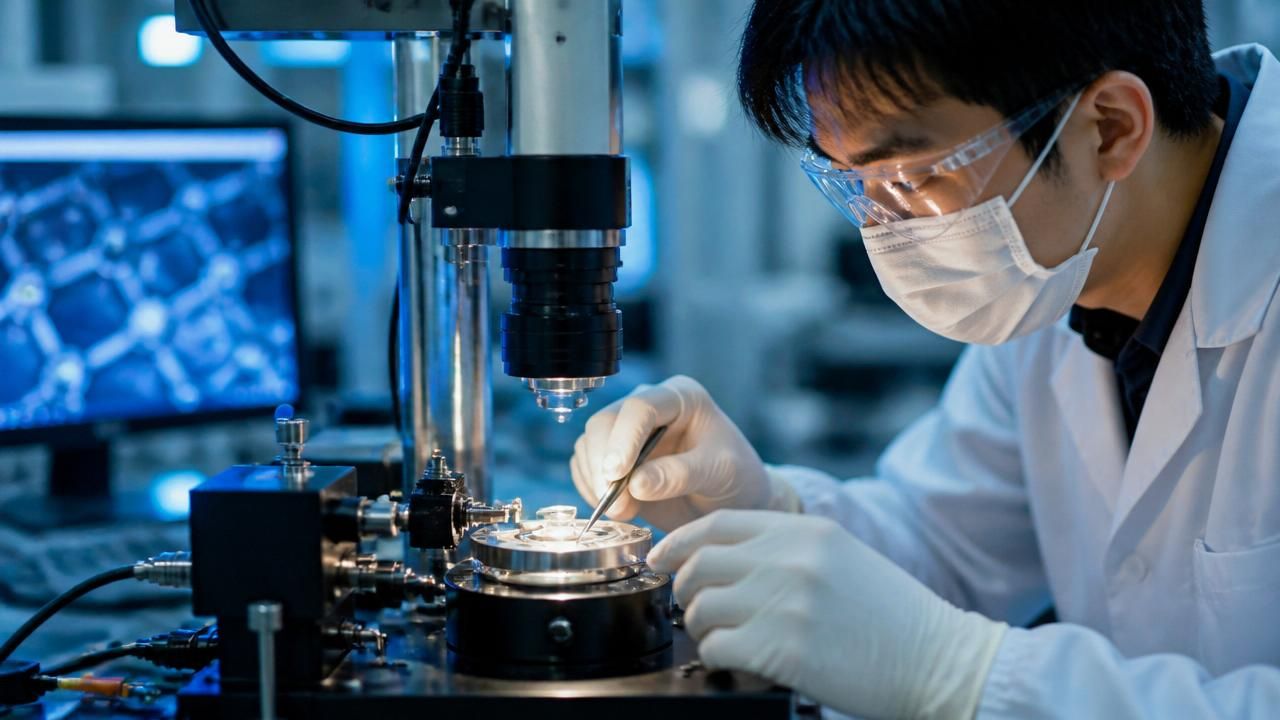
In a breakthrough that has been more than a decade in the making, physicists have successfully created a long-sought two-dimensional quantum material and confirmed its unusual conducting edge states. The achievement, reported by multiple research groups, marks a significant milestone in quantum materials science and could pave the way for room-temperature quantum electronics.
The Material and Its Properties
The new material is a two-dimensional crystal that exhibits quantum spin liquid behavior—a state of matter where electron spins remain in a constant state of fluctuation, never settling into a fixed pattern. This phenomenon, first predicted 50 years ago, has been notoriously difficult to observe in real materials. The breakthrough, detailed in Science Daily and New Scientist, shows that the material's edge states—conducting channels along its boundaries—can be controlled by applying mechanical strain. This tunability is crucial for practical applications in quantum computing and spintronics.
“The ability to control these states through strain could make the material a promising platform for future room-temperature quantum electronics,” said a lead researcher from the team.
The discovery aligns with a broader trend in quantum materials research. In 2025, quantum computers have proven more useful than expected, according to New Scientist. New algorithms have solved previously impossible materials problems in seconds, as reported by Science Daily. These advances are accelerating the search for novel quantum materials.
AI and Quantum Computing Accelerate Discovery
The synthesis of this material was aided by new physics-based machine-learning methods that speed up the search for 2D quantum materials, as highlighted by Phys.org. AI and quantum computers are revolutionizing the discovery process, allowing researchers to predict and design materials with desired properties before stepping into the lab.
However, a cautionary note comes from Understanding AI, where a researcher admitted being fooled by AI-for-science hype, emphasizing that experimental verification remains essential. The field is learning to balance computational predictions with rigorous experimental confirmation.
Broader Implications for Quantum Physics
This achievement is part of a wave of quantum physics breakthroughs in 2025. Scientists have finally measured quantum entanglement in solids for the first time (New Scientist), settled a 100-year quantum debate by proving Einstein wrong (Science Daily), and developed a method to generate truly random numbers (New Scientist). These advances challenge our understanding of reality, as explored by New Scientist's feature on what quantum theory tells us about nature.
Meanwhile, the quest for room-temperature superconductors continues, with Science Daily asking if they are finally within reach. The new 2D quantum material could contribute to this goal, as its edge states might exhibit superconducting properties under certain conditions.
Historical Context and Future Outlook
The prediction of quantum spin liquids dates back to 1973, when physicist Phil Anderson first proposed the concept. For decades, researchers searched for a material that would exhibit this elusive state. Now, with the synthesis of this 2D material, the 50-year quest may finally be over, as New Scientist reports.
The implications extend beyond fundamental physics. Quantum materials are key to next-generation electronics, sensors, and computing. The ability to control edge states with strain offers a new degree of freedom for device design. As one researcher noted, “We are entering an era where we can engineer quantum properties at the atomic scale.”
Differing Perspectives
While Science Daily and New Scientist celebrate the breakthrough, other sources urge caution. The Brighter Side of News notes that a decade-long muon calculation has shrunk hope for a fifth force of nature, reminding us that not all quantum anomalies lead to new physics. Aeon asks when science should finally take 'no' for an answer, questioning the relentless pursuit of certain theories.
Nevertheless, the consensus is clear: the creation of this 2D quantum material is a landmark achievement that validates decades of theoretical work and opens new avenues for technology. As MIT Sloan points out, quantum computing is no longer a distant dream—leaders need to understand its implications now.
Conclusion
The synthesis of this long-sought quantum material represents a triumph of human ingenuity, combining theoretical prediction, advanced synthesis techniques, and computational modeling. As researchers continue to explore its properties, the material may well become the foundation for a new generation of quantum devices that operate at room temperature, bringing quantum technology closer to everyday life.