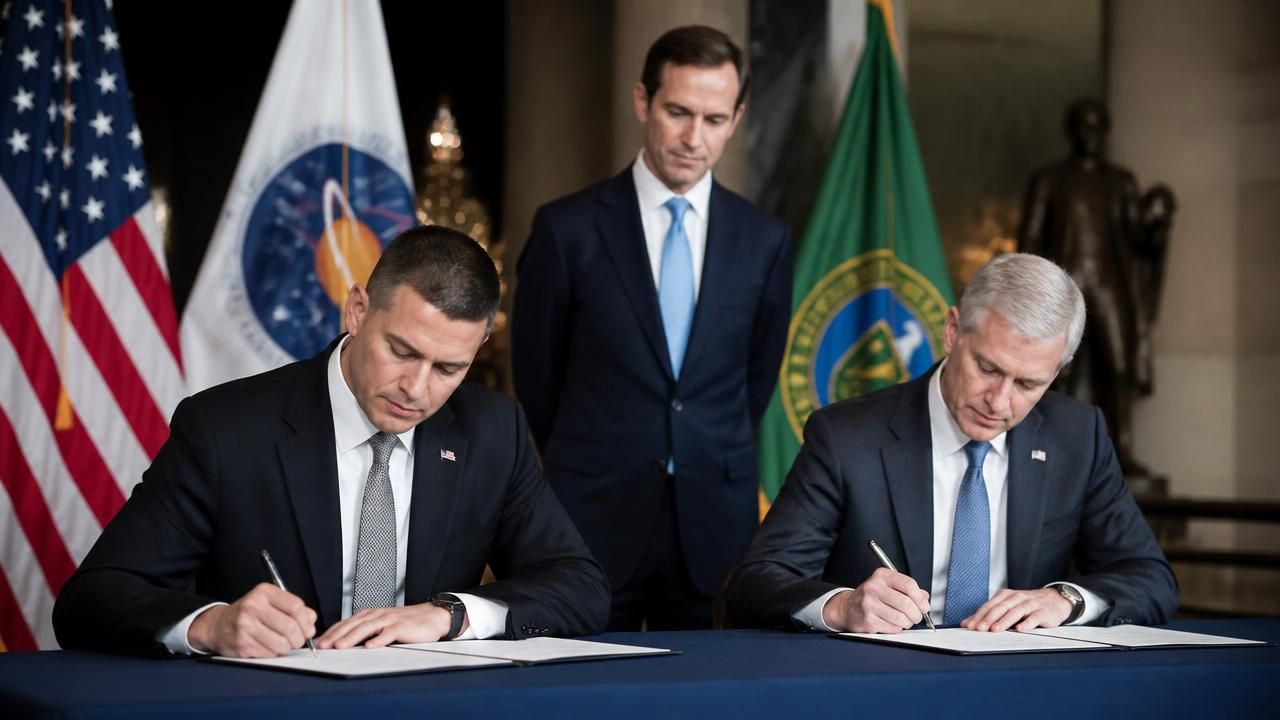
NASA and the U.S. Department of Energy signed a sweeping memorandum of understanding Thursday aimed at accelerating nuclear power and propulsion in space, a partnership officials say will define the next era of exploration — and sharpen a race with other superpowers to establish a nuclear foothold beyond Earth.
The agreement, titled “Accelerating American Leadership in Space Nuclear Power and Propulsion,” was signed at the Golden Age Summit at the Donald J. Trump Institute of Peace in Washington. NASA Administrator Jared Isaacman and Energy Secretary Chris Wright signed the document, with Michael Kratsios, director of the White House Office of Science and Technology Policy, looking on. According to NASA, the MOU “establishes a framework for end-to-end collaboration,” pairing the space agency’s exploration and spacecraft expertise with the Energy Department’s nuclear research enterprise and national laboratory system.
A ‘Nuclear NASA-era’
Isaacman framed the deal in generational terms, casting fission as the enabler of a much more ambitious civil space program — one that no longer depends on solar arrays and the whims of distance from the sun.
“We are entering the ‘Nuclear NASA-era,’ which represents a major transformation for space exploration,” Isaacman said. “Nuclear power will allow us to go farther, operate longer, and field more capable spacecraft and instruments than ever before. The work we’re doing today is laying the foundation for the fission-powered spacecraft of tomorrow and opening an entirely new frontier for exploration and discovery.”
In practical terms, the agreement covers three overlapping technologies: fission surface power, small reactors that could run a lunar or Martian outpost through weeks-long nights and dust storms; nuclear electric propulsion, in which a reactor generates electricity to drive high-efficiency ion thrusters; and nuclear thermal propulsion, which uses a reactor to heat propellant directly for higher thrust. Each has been studied for decades but never flown operationally by the United States.
From the Moon to Mars
Reports citing the agency’s planning say NASA intends to send a nuclear reactor to Mars as early as 2028 — an aggressive timeline that would make fission power a centerpiece of human Mars architecture rather than an afterthought. NASA has separately pursued a lunar fission surface power effort aimed at demonstrating a small reactor on the Moon in the early 2030s, and has worked with the Defense Advanced Research Projects Agency on a nuclear thermal propulsion flight demonstration.
Advocates argue the math is unforgiving without nuclear power. A reactor can generate kilowatts to megawatts continuously, independent of sunlight, and can be throttled or shut down on demand. Solar arrays, by contrast, scale badly with distance from the sun and require enormous surface area and battery mass to survive lunar nights that last roughly 14 Earth days.
The fuel bottleneck
Perhaps the most concrete element of the push involves fuel. World Nuclear News reported that Radiant — a startup developing the Kaleidos microreactor — and NASA were among the recipients of U.S. allocations of high-assay low-enriched uranium, or HALEU, the fuel enriched to between 5% and 20% uranium-235 that most advanced reactor designs require.
HALEU supply has been the sector’s chronic constraint. Domestic commercial enrichment capacity for the material is still being built out, and the Energy Department’s HALEU Availability Program has been the primary mechanism for distributing limited quantities to civilian developers. Awarding allocations to both a commercial startup and a civil space agency signals that Washington now treats space reactors as part of the same industrial base as terrestrial advanced nuclear — not a niche science project.
A race among superpowers
The New York Times framed the moment in explicitly geopolitical terms, describing a contest among major powers to place nuclear reactors on the Moon. That competition is already visible: China and Russia have outlined plans to develop a nuclear power source for their joint International Lunar Research Station in the 2030s, while the United States has leaned on its Artemis program, commercial partners and now the Energy Department’s labs.
The stakes extend beyond bragging rights. Whoever demonstrates reliable fission power first helps set technical standards, shapes safety and regulatory norms, and gains a durable advantage in exploiting lunar resources such as water ice for propellant and life support. Reactors are, in effect, the enabling infrastructure for any long-term presence — and infrastructure tends to determine who stays.
Questions that remain
None of this is frictionless. Launching radioactive material carries inherent risk, and any accident could set the program back years politically. The Outer Space Treaty and United Nations principles on nuclear power sources impose consultation and safety obligations, and critics argue the current framework lacks robust enforcement. Cost, schedule slippage and the sheer difficulty of qualifying hardware for the thermal and radiation environment of space are familiar obstacles — the same ones that stalled earlier U.S. nuclear space efforts.
For now, the two agencies have a signed framework, a stated ambition and a fuel supply path. What they do not yet have is a reactor in flight. The coming years will test whether the “Nuclear NASA-era” is a genuine transformation or another promising diagram — and whether the United States can move faster than its rivals to a finish line that, for the first time, sits on another world.