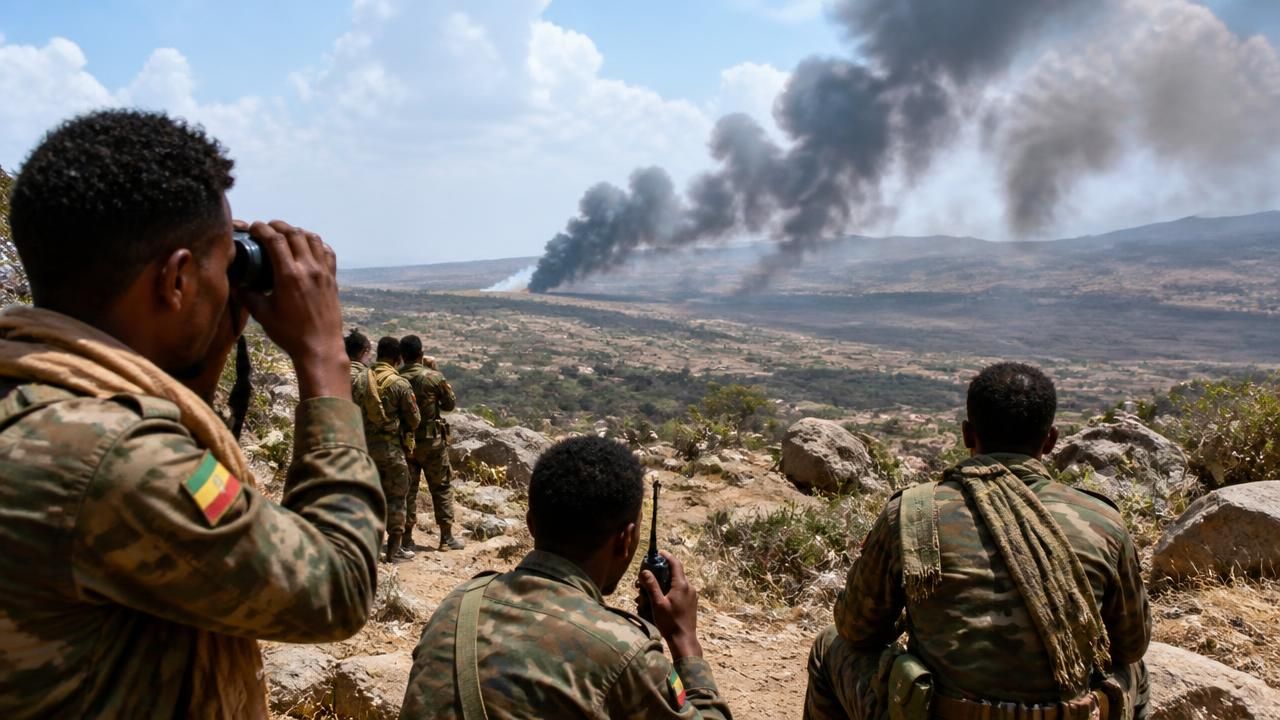
Ethiopian government forces launched a drone attack against Eritrean troops who crossed into Ethiopia's Tigray region this week, according to witnesses, a militia commander and the conflict monitoring group Acled, sharply escalating a confrontation that the European Union now warns could ignite a regional war.
The Eritrean soldiers moved south in military vehicles on Wednesday, crossing Eritrea's southern border and reaching Adigrat, about 25 miles (40km) inside Tigray, the Guardian reported, citing civilian witnesses and the Acled monitoring group. A government-allied commander told Newsday that Eritrean soldiers had entered towns across northern Ethiopia, while MSN and other outlets reported that Eritrean troops were driving through northern Ethiopian towns as fighting intensified.
A rapid military and diplomatic escalation
The incursion drew an immediate response from Ethiopian forces, which used drones to strike the Eritrean units. There were no immediate independent casualty figures, and the full scale of the fighting remained unclear amid the fog of war. But the direction of events was unmistakable: after years of uneasy post-war relations, Ethiopia and Eritrea appeared to be sliding toward direct conflict.
In a further sign of rupture, Ethiopia announced it would close its embassy in Eritrea, accusing Asmara of 'acts of hostility and belligerence' amid the widening war. The move effectively downgrades diplomatic ties and signals that Addis Ababa now views its northern neighbor as an active threat rather than a partner.
The EU warned that the Ethiopia-Eritrea tension risks a regional war, as Eritrean President Isaias Afwerki returned from talks in Alamein, Egypt.
The EU warning, reported by Mereja, underscored international alarm that a bilateral border crisis could pull in outside powers. The Horn of Africa is already fragile, with conflicts in Sudan and Somalia, Red Sea shipping disruptions and rivalries among Gulf states and Egypt. A full war between Ethiopia and Eritrea would compound those risks and could destabilize the wider region.
What witnesses and monitors report
The accounts of the Eritrean incursion came from multiple directions. Civilian witnesses described military vehicles carrying soldiers crossing the border and moving through Adigrat. A militia commander and Acled corroborated the movement, according to the Guardian. Newsday, citing a government-allied commander, reported that Eritrean soldiers had entered northern Ethiopian towns. MSN's coverage focused on the same troop movements and on Ethiopia's decision to close its embassy, while Mereja highlighted the EU's warning and Isaias's diplomatic movements.
Such a range of sourcing does not remove uncertainty. Wartime information is often contested, and neither Ethiopia nor Eritrea has provided a detailed public accounting of the clashes. But the convergence of witness testimony, a government-allied commander and a conflict monitor gives the reports significant weight.
Historical roots of the crisis
Ethiopia and Eritrea fought a devastating border war from 1998 to 2000, which left tens of thousands dead and froze relations for two decades. A surprise peace deal in 2018 between Ethiopian Prime Minister Abiy Ahmed and Isaias Afwerki ended that standoff and even earned Abiy the Nobel Peace Prize. But the rapprochement proved brittle.
When Ethiopia's Tigray war erupted in 2020, Eritrean troops intervened on the side of Ethiopian federal forces against the Tigray People's Liberation Front. The 2022 Pretoria agreement that ended the Tigray conflict called for the withdrawal of foreign forces, but Eritrean troops were widely reported to have remained in parts of Tigray. Their continued presence has been a persistent source of tension, and the latest incursion appears to have turned that friction into open military confrontation.
More broadly, Ethiopia's landlocked status and its search for reliable sea access have unsettled the region. Addis Ababa has signaled that it wants to secure port options, while Eritrea has viewed such ambitions with suspicion. Those strategic anxieties now intersect with the immediate troop movements across the border.
Why it matters beyond the border
The drone attack and embassy closure mark a qualitative shift. A cross-border incursion by Eritrean forces, answered by Ethiopian drones, raises the prospect of a return to interstate war. If the fighting widens, it could draw in regional powers, disrupt Red Sea trade routes and deepen a humanitarian crisis in Tigray, where memories of the 2020-2022 war remain raw.
The EU's warning reflects that broader danger. So does the timing of Isaias's return from Alamein talks: diplomacy is still in motion, but the military facts on the ground are moving faster. The next days will determine whether the drone strike was a limited response or the opening shot in a far larger conflict.
For now, the most urgent question is whether Eritrean units will press deeper into Tigray, whether Ethiopia will expand its aerial campaign, and whether outside mediators can pull both sides back from a war that neither can afford and that the region may not survive intact.