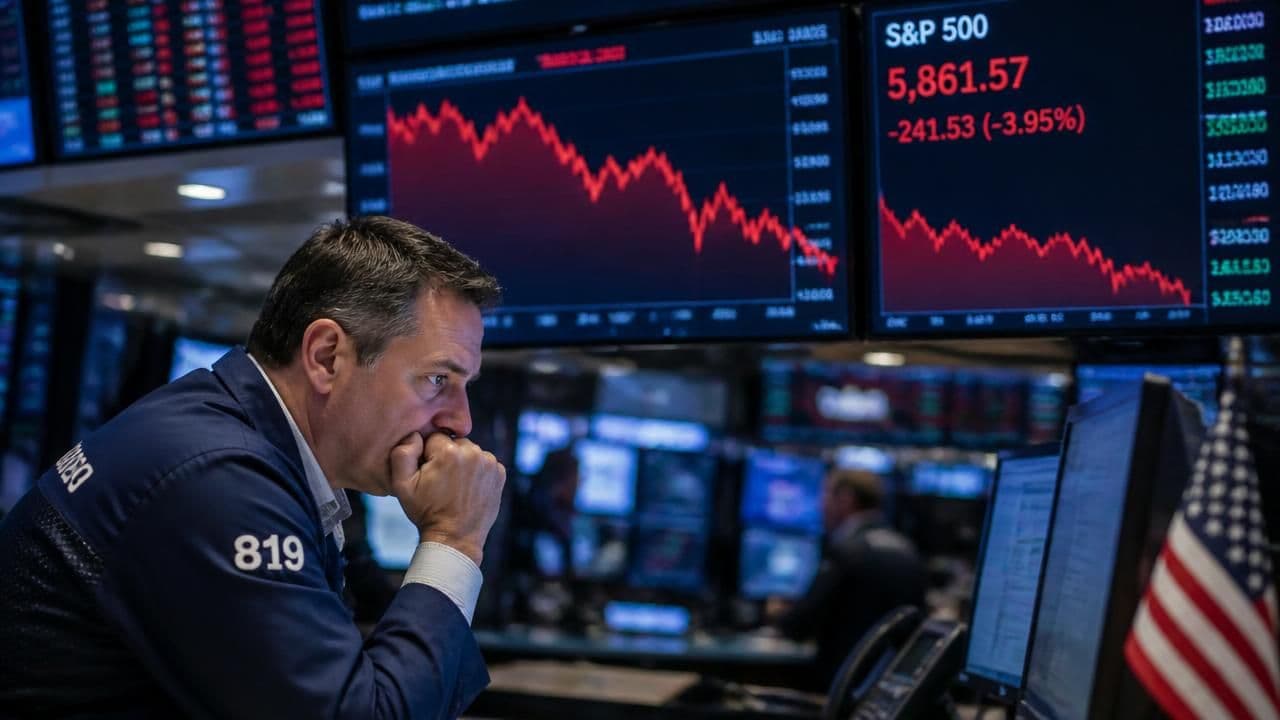
US equity futures rebounded sharply on Monday, climbing nearly 2% in premarket trading as dip buyers re-entered the market following one of the most violent rotations out of technology shares in recent memory. The bounce, which lifted futures tied to the Nasdaq, Dow Jones Industrial Average and S&P 500, offered a measure of calm after a bruising selloff that had raised fresh questions about the durability of the artificial intelligence trade.
According to Bloomberg Markets, the recovery came as "dip buyers stepped in following a steep selloff that saw a violent rotation out of technology shares, in a signal of heightened volatility in the artificial intelligence trade." The phrasing matters: this is not being framed by market watchers as a clean recovery, but rather as evidence that the market's AI enthusiasm has entered a more fragile, volatile phase.
The Anatomy of the Selloff
The turbulence was concentrated in the technology sector, where the enormous valuations of AI-linked companies have driven US indexes to repeated records over the past two years. When investors began rotating away from those names, the selling cascaded across markets. Yahoo Finance described the prior session as a "brutal tech selloff," with futures jumping nearly 2% in the aftermath — a scale of premarket move that typically signals genuine bargain hunting rather than routine noise.
Asian markets bore the brunt of the contagion overnight. MSN reported that "US futures bounce as AI rout rattles Asian stocks," underscoring how a Wall Street narrative trade has become a global risk factor. Tech-heavy indexes in Asia, which have grown increasingly correlated with US AI sentiment through the semiconductor supply chain, slid before the US rebound steadied sentiment.
The rotation out of technology shares was described as "violent," with dip buyers emerging to check the decline — a sequence that signals heightened volatility in the artificial intelligence trade.
Why the AI Trade Is Suddenly Fragile
The selloff reflects a deeper tension that has been building for months. Investors have poured hundreds of billions of dollars into AI infrastructure — data centers, chips, power generation — with the expectation of transformative returns. But as capital expenditure forecasts climb, scrutiny over whether revenues will arrive on schedule has intensified. Any hint of disappointment in earnings guidance or demand signals can trigger outsized moves, precisely because positioning in the sector is so crowded.
Adding to the pressure: a rotation into laggards and value names. Yahoo Finance flagged GameStop (GME), Johnson & Johnson (JNJ), Alnylam Pharmaceuticals (ALNY) and Gap (GAP) as stocks in focus — an eclectic mix that suggests traders are hunting for idiosyncratic catalysts while stepping back from the crowded AI trade.
The Payrolls Test
The rebound is also a bet on macro data. China Tech News noted the bounce came "ahead of payrolls," referring to the upcoming US employment report, which has taken on elevated significance. A resilient labor market could ease recession fears but complicate the case for Federal Reserve rate cuts; a weak print could revive growth worries while strengthening the easing narrative. For a market already whipsawed by AI positioning, the jobs report is a binary catalyst.
Trading desks are also watching whether the dip-buying is broad or narrow. If the rebound is led disproportionately by the same megacap technology names that drove the selloff, it would suggest the rotation was a shakeout rather than a regime change. If, instead, financials, healthcare and industrials participate meaningfully, it would point to a healthier broadening of the rally.
What to Watch
- Breadth of the bounce: Whether gains extend beyond megacap AI names into value and cyclical sectors.
- The payrolls print: Its implications for Fed policy and for the growth-sensitive parts of the AI trade.
- Volatility signals: Elevated implied volatility in tech suggests investors are hedging, not just buying the dip.
- Asian market follow-through: Whether the US rebound stabilizes semiconductor-heavy indexes across the region.
Divergent Framings, One Story
How outlets frame this moment reveals what is genuinely at stake. Bloomberg's coverage emphasizes mechanics — dip buyers, violent rotation, volatility — treating the episode as a market-structure event. Yahoo Finance leans into the headline number and the retail-friendly stock watchlist, reflecting its audience's focus on tradeable names. MSN and regional outlets frame it through the Asian contagion lens, highlighting how US AI sentiment exports risk globally. Each is describing the same underlying phenomenon: a market that has become extraordinarily dependent on a single narrative, and extraordinarily sensitive to any crack in it.
The broader context is a bull market that has been unusually concentrated. The S&P 500's gains over the past two years have been driven disproportionately by a handful of AI-linked giants, leaving indexes vulnerable to sharp reversals when sentiment shifts. The selloff and subsequent bounce are a reminder that concentration cuts both ways.
The Road Ahead
For now, the dip buyers have won the opening round. But the phrase "signal of heightened volatility" is the tell. Markets do not typically transition from euphoria to panic in a single session, nor recover in one either. The coming days — shaped by the payrolls report, upcoming earnings guidance and the flow of AI capital expenditure announcements — will determine whether this was a healthy shakeout that resets positioning, or the first tremor of a deeper repricing of the AI premium.
What is clear is that the era in which AI stocks could rise on narrative alone is being tested. Investors are now demanding evidence: revenue, margins, timelines. Until that evidence arrives, expect the kind of two-way volatility that turns quiet Monday mornings into 2% premarket moves.