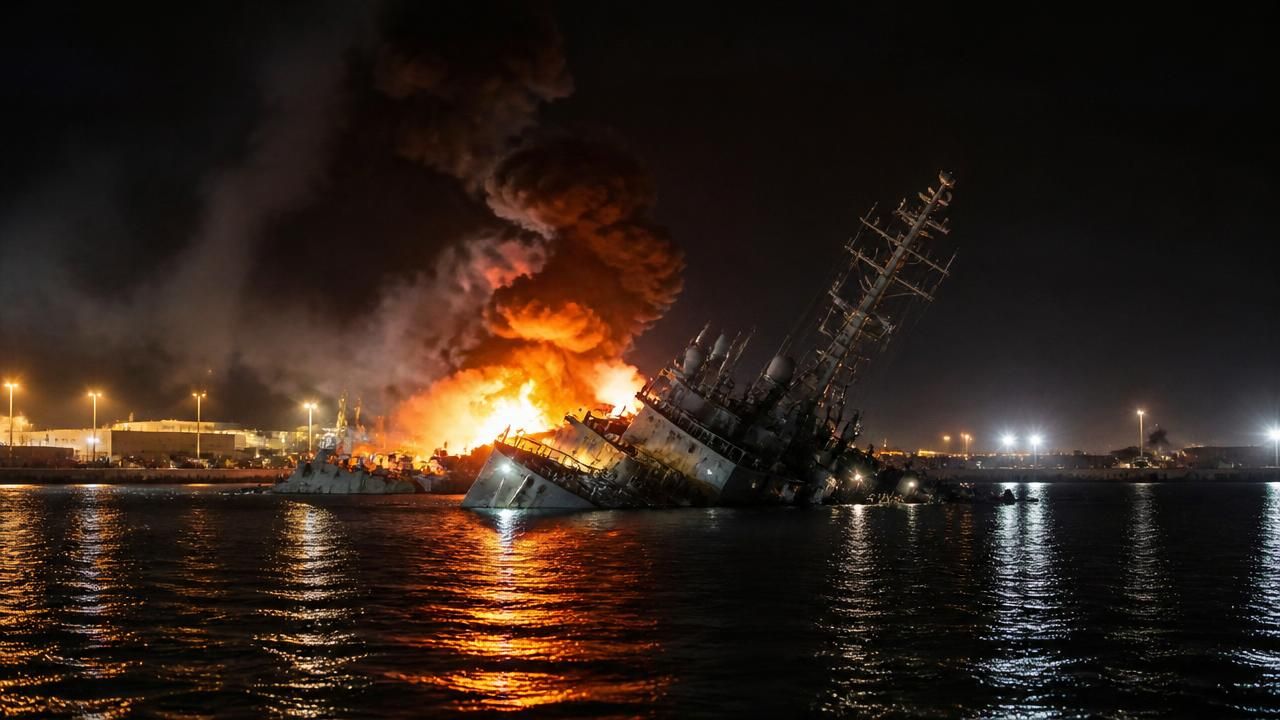
A Russian navy corvette docked at the port of Benghazi in eastern Libya was struck in the early hours of Sunday by what Libyan officials described as sea drones, triggering a massive night-time explosion and sending the vessel — identified as the Merkury — to the bottom of the harbour. No one has claimed responsibility for the attack, but suspicion has fallen swiftly on Ukraine, whose naval drone campaign has repeatedly struck Russia's Black Sea Fleet hundreds of miles from its own coastline.
The strike marks a dramatic widening of the maritime war beyond the Black Sea, placing a Russian warship in the central Mediterranean in the crosshairs for the first time since Moscow's full-scale invasion of Ukraine in February 2022.
What happened in Benghazi
According to officials from Libya's eastern administration, which controls Benghazi and much of the country's east, the Merkury had docked to refuel and take on supplies while en route back to Russia when it was hit. Multiple witnesses reported a fireball rising over the Mediterranean and a series of secondary explosions as the vessel burned.
Accounts of the human toll varied. Some Libyan reports said several people were injured; British tabloid coverage claimed the ship, with a crew of up to 90 sailors aboard, had been "destroyed" in the blast. Those figures could not be independently verified, and Russia's defence ministry has so far said nothing publicly about the incident — a silence consistent with Moscow's past practice when warships are damaged.
By Monday, Libyan media reported a second drone attack targeting ships in the same area, including a Russian vessel, suggesting either a sustained campaign or a follow-up strike on the wreck site. The details of that second episode remain murky, and no authoritative list of damaged vessels has been released.
A widening war and an awkward host
The political fallout in Libya was immediate. The eastern government, which has spent years cultivating ties with Moscow and with the Russian-backed commander Khalifa Haftar, condemned the strike as a "violation of sovereignty" — a striking rhetorical turn for an administration that has hosted Russian military personnel and welcomed Russian naval visits.
"This is a violation of Libyan sovereignty and a dangerous escalation on Libyan territory," officials from the eastern government said, according to reports from the region.
The complaint underscores the uncomfortable position of Libya's divided authorities. The country has been split since 2014 between a UN-recognised government in Tripoli and the eastern administration based in Benghazi, with Russia backing the latter through the Wagner Group and, more recently, formalised defence arrangements. Moscow has looked to eastern Libya as a logistics and naval foothold as its access to Syria's Tartus naval base has come under question following the fall of Bashar al-Assad.
Western officials have watched that courtship with alarm, warning that Benghazi and nearby bases could become a permanent Russian military hub on NATO's southern flank. Sunday's strike will sharpen that debate: a Russian naval presence in Libya is now demonstrably vulnerable, but it also drags Libya directly into the Ukraine war.
Why Ukraine is suspected
Kyiv has not commented on the Benghazi strike, and Ukrainian officials have generally refused to confirm or deny operations outside the Black Sea theatre. But the attack bears the hallmarks of Ukraine's evolving naval drone programme, which has used small, fast, explosives-laden uncrewed surface vessels to sink or cripple Russian ships, including the cruiser Moskva in 2022 and landing ships and patrol vessels in later strikes around Crimea and Novorossiysk.
- Ukrainian sea drones — known as Sea Baby and Magura V5 platforms — have a range of several hundred kilometres, far short of Benghazi's roughly 2,000 km distance from Odesa.
- That gap has led analysts to speculate that any operation would have required a launch from a third country, a covert mother ship, or local operatives working with Ukrainian intelligence.
- Kyiv has previously demonstrated the ability to strike deep behind Russian lines using saboteurs, aerial drones and, increasingly, long-range missile systems supplied by Western partners.
Some analysts caution that the attack could equally have been carried out by local militias or Islamist groups hostile to Haftar's administration, or could have been an accident aboard the vessel. The absence of a claim of responsibility leaves significant uncertainty.
The strategic picture
Whatever its authorship, the sinking carries outsized symbolic weight. Russia's ability to project naval power into the Mediterranean — a key pillar of its claim to great-power status — depends on a shrinking network of friendly ports. Syria's instability has already complicated that picture; losing a resupply stop in Libya would leave Moscow with few reliable anchorages between the Black Sea and the Atlantic.
The incident also illustrates how Ukraine's war has metastasised into a global contest. Drone warfare, once confined to the front lines in Donbas, now reaches ports in North Africa, shipping lanes in the Red Sea and energy infrastructure across Russia. Western capitals have largely welcomed Ukraine's long-range strikes while privately worrying about escalation and about the risk to neutral or fragile states whose territory becomes the battlefield.
For Libya, the immediate question is whether Benghazi's Russian ties will invite further attacks — and whether the country's fragile ceasefire between rival administrations can survive being drawn into someone else's war. For Moscow, it is whether a warship can safely dock anywhere beyond its own harbours. Neither question has an easy answer, and in both cases, Sunday's explosion may prove to be a turning point rather than an isolated incident.