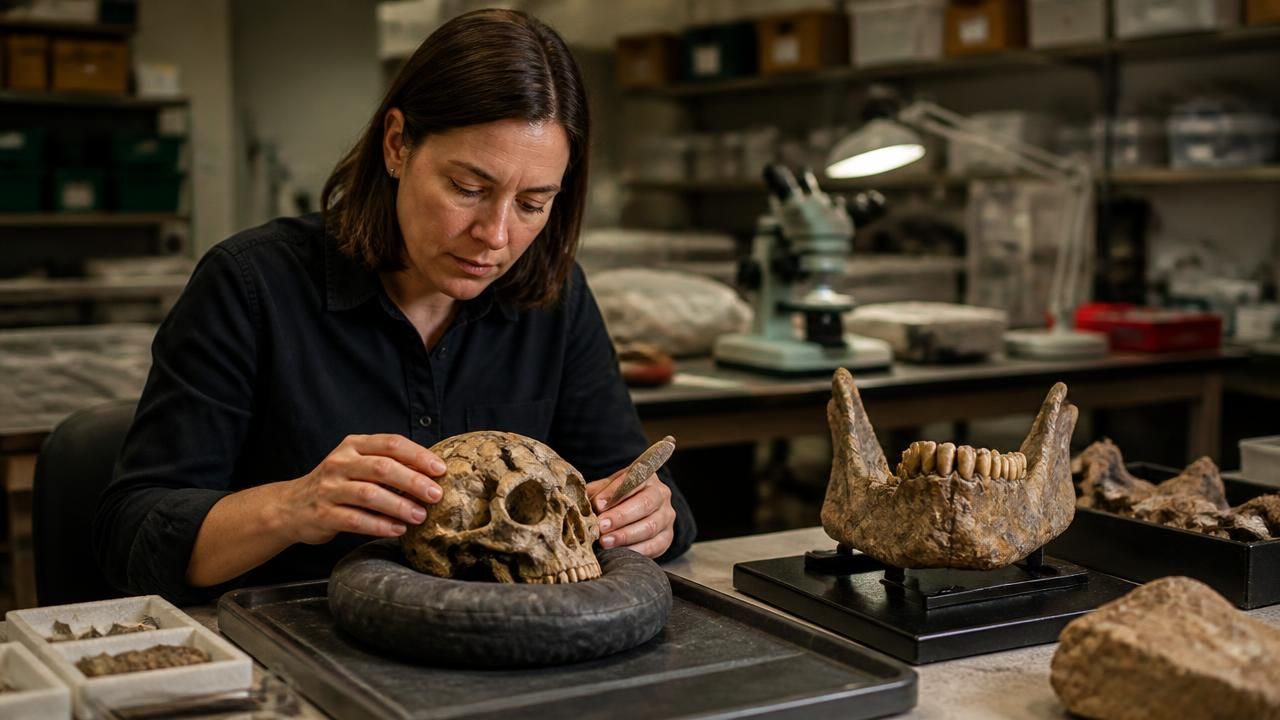
In the fossil-rich limestone caves of South Africa's Cradle of Humankind, a fragment of an adult skull has pushed back the arrival of Homo erectus in southern Africa by roughly 200,000 years. The fossil, recovered from Drimolen Cave, is among 18 hominin specimens described by researchers and dated to about 2 million years ago. The discovery strengthens the case that Homo erectus—a key ancestor of later humans—appeared in southern Africa far earlier than many scientists had assumed, and it places the species alongside a very different evolutionary cousin: Paranthropus robustus, a big-toothed, heavy-jawed hominin that outnumbered Homo erectus by as much as 10 to 1.
The Drimolen finds, reported and analyzed by an international team of palaeoanthropologists, include a partial adult cranium that preserves enough anatomy to identify it as Homo erectus. The fossil dates to between roughly 2.04 and 1.95 million years ago, making it the oldest securely dated Homo erectus evidence in southern Africa. Previously, the earliest known Homo erectus fossils in the region were about 200,000 years younger. The new date narrows the gap between southern and East African fossil records and raises the possibility that the species arose in southern Africa—or at least dispersed across the continent much earlier than a simple east-to-south migration model would suggest.
A Contested Origin Story
For decades, the standard narrative placed the emergence of Homo erectus in East Africa around 1.9 million years ago, with later waves spreading to Asia, Europe, and southern Africa. The Drimolen skull challenges that linear story. Its age overlaps with—and may even predate—some of the earliest East African Homo erectus fossils. That has led researchers to debate whether Homo erectus originated in one region and then spread, or whether multiple populations across Africa were evolving similar traits at the same time. The South African evidence does not settle the debate, but it complicates any tidy family tree.
The find does not merely add a new dot to the map; it redraws the map itself.
Science Daily, which reported the discovery, emphasized two major implications: the earlier appearance of Homo erectus in southern Africa and the simultaneous evolution of Paranthropus robustus. At Drimolen, Paranthropus robustus was not a static side branch. Its teeth were getting larger and its chewing muscles stronger as the climate shifted toward drier, more seasonal conditions. That specialization may have helped it process tough, abrasive plant foods—but it also may have trapped the species in a narrow ecological niche.
Outnumbered 10 to 1
Martin Cid Magazine framed the story around that imbalance: Homo erectus was outnumbered 10 to 1 by its big-toothed cousin. The ratio is a striking reminder that early human evolution was not a solo march toward modernity. For hundreds of thousands of years, multiple hominin species shared the same landscapes, competing for food, water, and shelter. Paranthropus robustus was a robust australopithecine with massive molars and flaring cheekbones, adapted for heavy chewing. Homo erectus, by contrast, had a larger brain, smaller teeth, and a more flexible diet. When the climate changed again, flexibility may have won out. Paranthropus eventually went extinct; Homo erectus survived and spread across Africa and beyond.
MSN and Ancient Origins both highlighted the same core claim: the adult fossil strengthens evidence for Homo erectus in southern Africa 2 million years ago. Their headlines reflect the way the discovery has been received—as a confirmation of something long suspected but poorly dated. The fossil provides a secure anchor point, not just a fragmentary hint. It also adds to the growing picture of Drimolen Cave as a rare window into a multi-species community. The site has yielded remains of Homo erectus, Paranthropus robustus, and early Homo, all within a relatively narrow time slice.
Teeth as Time Capsules
Separately, research on 400,000-year-old teeth has revealed a hidden link in human evolution, according to ScienceDaily. That study, while focused on a much later period, underscores why dental remains are so valuable. Teeth are the hardest parts of the skeleton, and they preserve a record of diet, growth, and ancestry. They can reveal interbreeding between lineages, shifts in developmental timing, and adaptations to changing environments. In the Drimolen story, teeth tell a similar tale: Paranthropus robustus was evolving ever more specialized molars, while Homo erectus kept a more generalized toolkit. The contrast between those dental strategies is one of the clearest signals of how the two species were living differently in the same habitat.
What It Means
The Drimolen skull fragment does not answer every question. Scientists still need more complete fossils, more precise dates, and more comparisons with East African sites. But the discovery shifts the center of gravity in early human evolution. It suggests that southern Africa was not a peripheral backwater but a place where key evolutionary experiments happened early. It also shows that climate change was a powerful filter: as habitats shifted, some hominins specialized and perished, while others generalized and survived.
The story of Homo erectus is now more tangled, more African, and more interesting. A single piece of skull has added 200,000 years to the species' stay in southern Africa and placed it in a crowded, competitive world. That world—of big teeth and bigger challenges—helped shape the ancestors who would eventually spread across the planet.