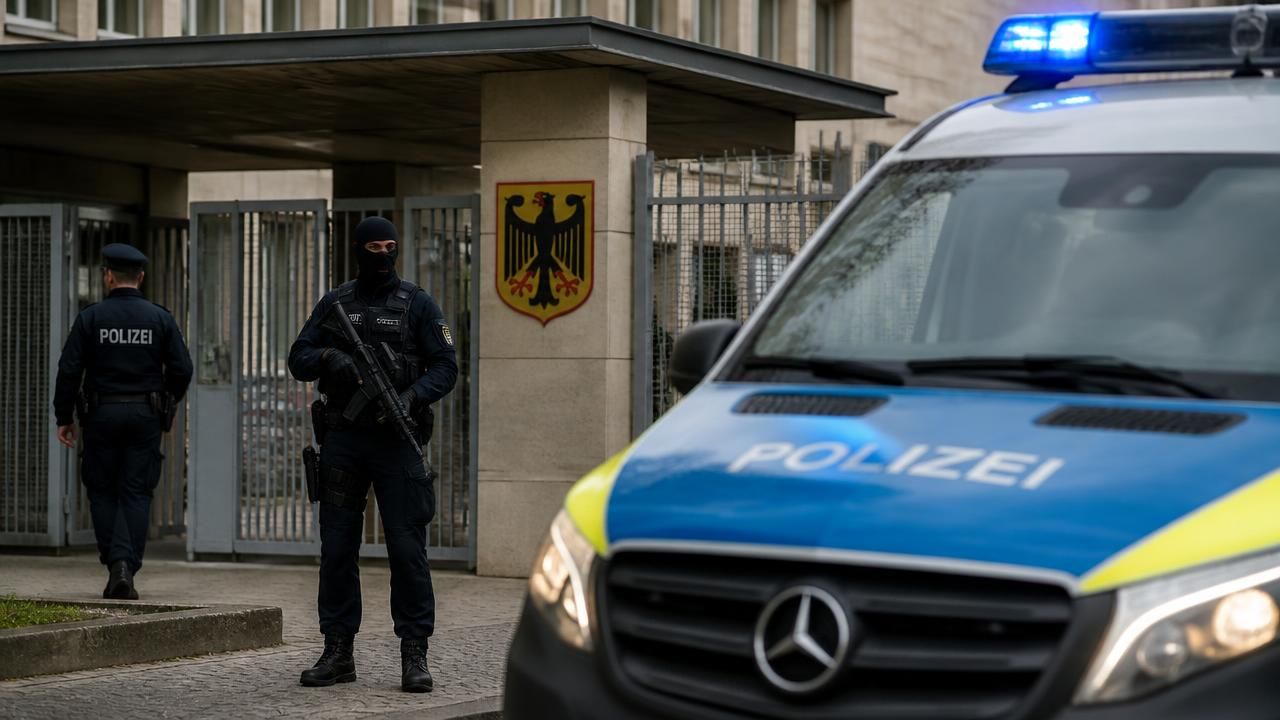
KARLSRUHE, Germany — A former head of Germany's foreign intelligence service has been arrested on suspicion of treason and of passing state secrets to a foreign intelligence service, the country's federal prosecutor's office said, in what threatens to become one of the most damaging espionage investigations in the history of the German security establishment.
The Federal Prosecutor's Office (Generalbundesanwalt), based in the southwestern city of Karlsruhe, confirmed the detention but released few additional details, including the identity of the suspect, the country whose intelligence service was allegedly involved, and the timeline of the suspected handover. The arrest was first reported by the German tabloid Bild before being confirmed by federal authorities and picked up by international broadcasters and wire services.
The former head of Germany's foreign intelligence service was arrested on suspicion that he had passed state secrets to a foreign intelligence service, the federal prosecutor's office said.
A rare and politically explosive case
The suspect, described as a former chief of Germany's foreign intelligence service — the Bundesnachrichtendienst, or BND — would be the most senior figure ever detained in connection with espionage against the Federal Republic. The BND is responsible for foreign intelligence gathering, counterintelligence abroad, and the analysis of overseas threat information for the chancellery, which directly oversees the agency.
Because of that direct reporting line, any former BND president would possess an unusually broad view of Germany's intelligence priorities, its human sources abroad, its technical collection methods, and the political secrets of successive governments. Prosecutors have not said whether the alleged disclosure involved raw intelligence, source identities, internal assessments, or all three.
What German law actually says
Reports have used the terms "espionage" and "treason" somewhat interchangeably, but German law treats them as distinct offenses. Under the Criminal Code, Landesverrat — the classic crime of betraying state secrets to a foreign power — is set out in Sections 94 to 99 and carries a minimum sentence of one year in prison, rising to life imprisonment in especially serious cases, and applies only where the disclosed material is a genuine "state secret" under a definition combining limited circulation, secrecy of content, and a genuine interest in keeping it from a foreign power.
Intelligence officers and former officials who share such material with a foreign agency often find themselves in a different legal category — simply called "intelligence agent activity" — unless prosecutors conclude that the material directly endangered the security of the Federal Republic. The choice of charge will be an early signal of how seriously investigators view the leak, and it will shape the secrecy surrounding the case.
Historical context
Germany's postwar history is scarred by high-profile betrayals that changed governments and prompted sweeping reform of its intelligence apparatus:
- The Guillaume affair (1974): Günter Guillaume, a close aide to Chancellor Willy Brandt, was unmasked as an East German spy. The scandal forced Brandt's resignation and remains the standard by which German espionage crises are measured.
- The BND's Russia problem (2022): A serving BND officer, Carsten Linke, was arrested on suspicion of passing information to Russian intelligence — one of the most serious breaches in the agency's history and a case that triggered a hard review of internal counterintelligence.
- The Taurus call leak (2024): A recording of a sensitive German military discussion about Ukraine was published in Russia, exposing weak operational security and reigniting arguments about how exposed the country's security services are to foreign penetration.
Against that backdrop, the arrest of an individual who once sat at the very top of the BND is qualitatively different from the periodic capture of mid-level moles. It goes to the question of whether the agency has been vulnerable at its senior leadership, not only in its ranks.
How the story is being framed
Coverage has diverged in emphasis. German outlets reporting the initial arrest stressed the espionage angle, describing the detention as a suspected case of spying for a foreign power. International broadcasters such as NPR and aggregators including MSN led instead with the federal prosecutor's office's formal formulation — suspicion of "trading state secrets" and treason — which is more legally precise but leaves open whom the suspect is alleged to have served. Commentators in German media have already begun speculating about whether the alleged recipient was a friendly Western ally or a rival service such as Russia's, a distinction that would drastically alter the diplomatic fallout.
Implications and what comes next
Under German practice, a suspect may be held in pretrial detention while prosecutors build a case that typically relies on classified evidence presented in closed proceedings. That means the public may learn very little for months, and the full outline of the allegations may surface only at trial — if it surfaces at all.
Politically, the arrest lands in a tense moment for Berlin. Germany has spent the past several years hardening its security architecture against Russian and Chinese espionage, tightening vetting at the BND, expanding the domestic service's resources, and pressing allies for better intelligence-sharing safeguards. A case involving a former intelligence chief could test that trust from the outside as well, particularly with partner services that share sensitive material with Berlin on the assumption that its own house is secure.
Officials have so far declined to comment beyond the prosecutor's statement, and the suspect has not been publicly named or charged. If the allegations hold, however, the consequences are likely to reach beyond the courtroom — reshaping the leadership, oversight and internal culture of the agency entrusted with protecting the country's most closely held secrets.