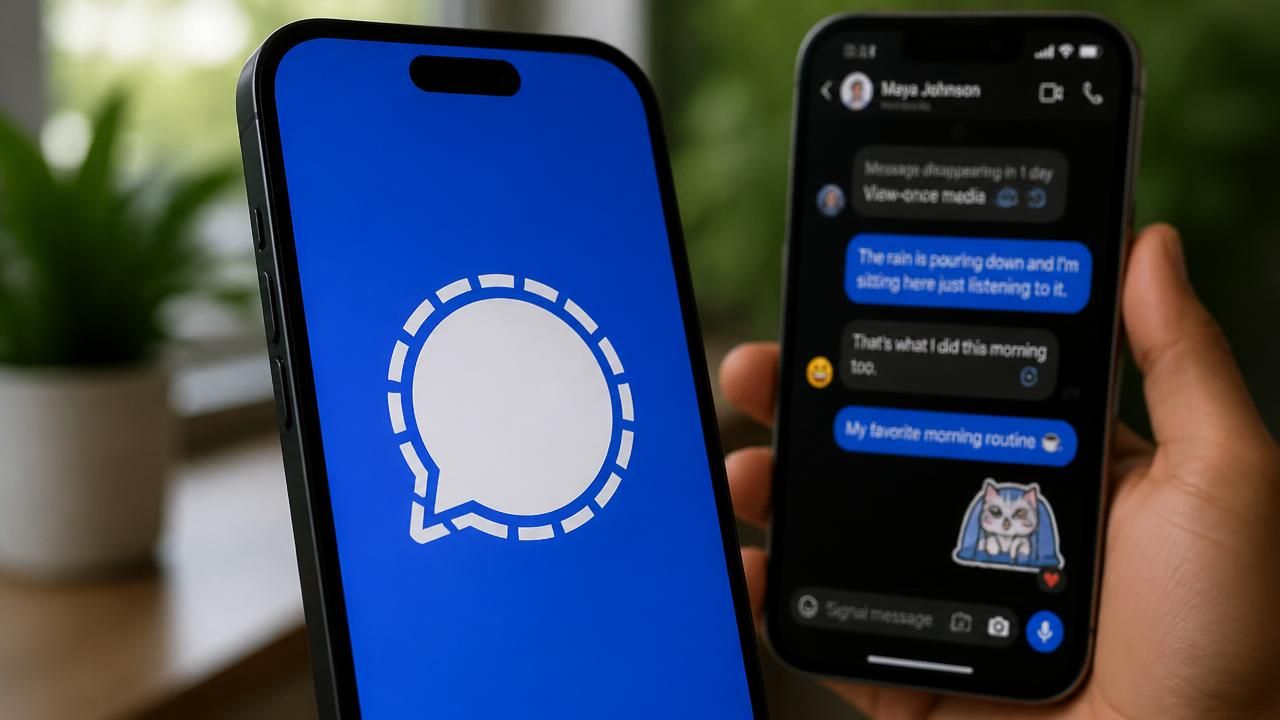
Signal is drawing a line in the sand over on-screen artificial intelligence. The encrypted messaging nonprofit is rolling out new screenshot restrictions on both iOS and Android in an effort to stop operating-system-level AI agents — including Apple's Siri and Google's Gemini — from reading users' private conversations and other on-screen data.
The change, first reported by The Verge, gives iOS users a new toggle that blocks screenshots and prevents Siri AI from scanning on-screen content inside the app. Android users see a comparable restriction. It is a rare, explicit acknowledgment from a major app developer that the agentic AI now baked into phone operating systems has become a privacy threat in its own right.
What Signal is actually changing
At the surface level, the update is about screenshots. But the real target is a newer class of software: AI assistants that can see what is displayed on a phone's screen and use that context to answer questions, summarize content, or take actions on the user's behalf. For a messaging app built on end-to-end encryption, that capability effectively punches a hole in the security model — the message is encrypted in transit, but the pixels on the display are not.
According to The Verge, Signal users on iOS will see an option to toggle blocking screenshots and to prevent Siri AI from scanning on-screen content. On Android, the app is restricting screenshot capture as well. The practical effect is to reduce the number of avenues through which an assistant — or anything with screen-reading permissions — can ingest a private chat.
'Undermining' a privacy guarantee
Signal president Meredith Whittaker framed the move in unusually blunt terms in a blog post, arguing that screen-reading AI agents conflict directly with the promise Signal makes to its users.
“We want to be very clear: it is a serious problem that Signal — and application developers beyond — lack robust tools to prevent AI agents from accessing sensitive user data,” Whittaker wrote, adding that the capabilities are “undermining Signal's ability to independently guarantee privacy.”
Whittaker also called on operating-system providers — principally Apple and Google — to make it easier for app developers to control what data AI agents can access, rather than leaving the burden on individual apps to fight the platform layer one toggle at a time.
The platform problem
The technical difficulty here is asymmetrical. On Android, developers have long had an API — the FLAG_SECURE window flag — that can block screenshots and screen recording. On iOS, Apple has historically offered no equivalent mechanism, which is why Signal's new iOS toggle is notable: it represents an attempt to carve out a protected space on a platform that does not natively provide one.
More fundamentally, an AI agent running at the operating-system level may have access to the display buffer itself, which sits beneath any app's control. That is the crux of Signal's complaint: apps cannot fully defend against a layer of software they do not govern. The restrictions raise the bar, but they are not a wall.
How the story is being framed
Coverage of the announcement has coalesced around a single narrative but with distinct emphases. Reuters, working from wire-service convention, led with the concrete action — Signal restricting screenshots to block AI agents from reading messages. Digital Trends cast it as combat: Signal “fighting back” against AI agents snooping on private chats. Channel NewsAsia's version, syndicated through UA.NEWS, and India's The Hans India both emphasized protection of chats from AI. Unite.AI, writing for a more technical audience, described the move as limiting mobile AI data capture — a framing that treats the update as a data-governance story rather than a product feature.
The convergence is telling. Outlets that rarely agree on technology coverage are describing the same shift: privacy is no longer only about what an app collects, but about what the operating system's AI can see after the app has rendered it.
The assistant war behind the toggle
The timing lands in the middle of an intensifying contest between the two assistants named in Signal's restrictions. Comparative coverage of Siri AI and Google Gemini has become a genre of its own, with outlets such as TechRepublic publishing head-to-head evaluations of which assistant is better in 2026, and Android Authority running pieces arguing that Siri AI beats Gemini “at the thing that matters most.” Whatever the verdict of any single review, the rivalry has pushed both Apple and Google toward more capable, more context-aware, more ambient assistants — precisely the capabilities that make Signal's objections urgent.
What it means for users and the industry
- iPhone users gain a switch, not a guarantee. The new iOS toggle reduces exposure but cannot neutralize OS-level screen access entirely.
- Android users get a familiar, stronger control. Screenshot blocking on Android rests on well-established platform APIs.
- Other messaging apps may follow. Signal has historically set the privacy agenda that rivals later adopt, from sealed sender to minimal metadata retention.
- Regulators have a new test case. Whittaker's call for platform-level tooling gives policymakers a concrete ask: define what an AI agent may see, and who decides.
The deeper question Signal is raising is one the industry has largely avoided: as assistants become the primary interface to the phone, who governs the boundary between an app's content and the AI watching over it? Signal's answer, for now, is a toggle and a public appeal to Apple and Google. Whether the platforms respond with real controls — or simply ship more capable agents — will determine how much of that boundary survives.