For decades, the answer to nearsightedness has come down to a choice between glasses, contact lenses and a laser. Now a team of scientists says it may have found a fourth path: reshaping the cornea with a small electric potential and a specially shaped platinum lens, no cutting and no laser required.
The experimental technique, described as a potential alternative to LASIK and LASEK, temporarily softens the cornea — the clear front surface of the eye — so it can be molded into a new curvature in roughly one minute. If it holds up in human testing, it could offer a cheaper, safer and more accessible form of vision correction than the laser procedures that millions of people undergo every year.
How the technique works
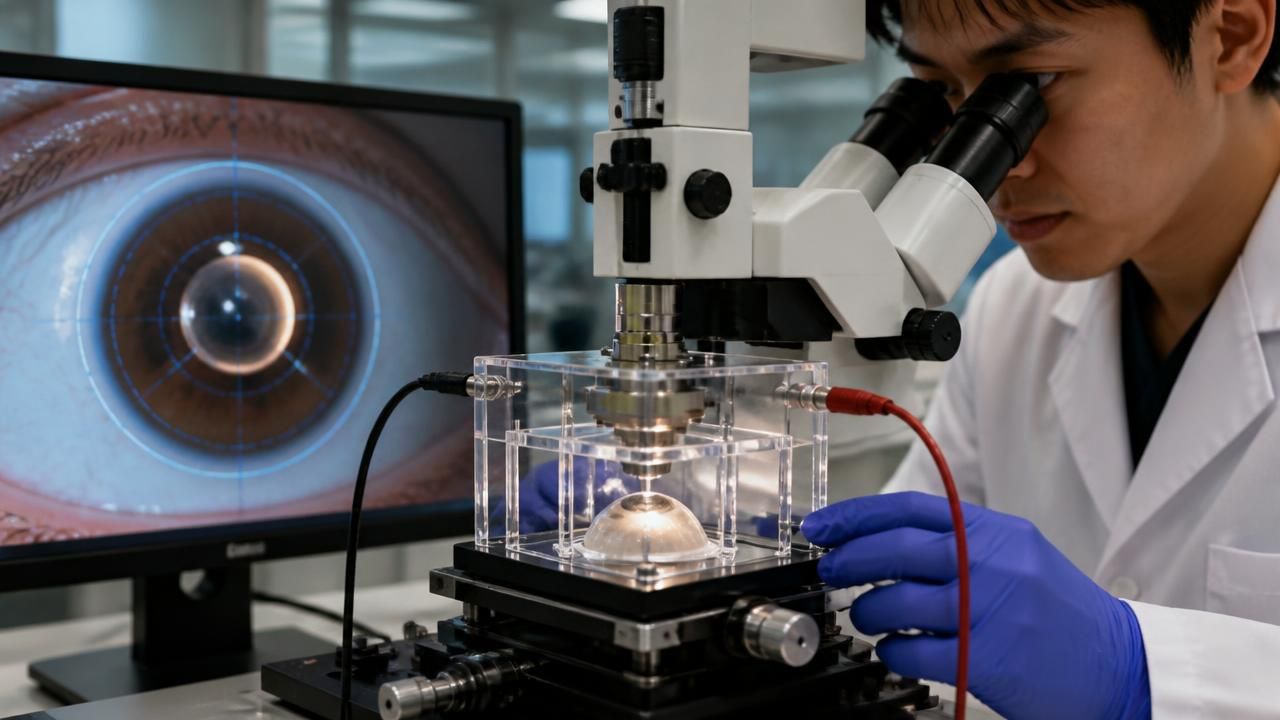
The approach belongs to a family of research known as electromechanical or electrochemical corneal reshaping, which has been explored in laboratories for more than a decade. Instead of removing tissue with an excimer laser, as LASIK does, the method applies a mild electric current through a platinum electrode shaped to match the desired final curvature of the eye.
The current alters the mechanical properties of the cornea's collagen network, making the tissue temporarily pliable. A customized lens is then pressed against the softened surface, and the cornea holds its new shape once the current is switched off and the tissue stiffens again. The entire sequence takes about a minute — a striking contrast to the roughly ten to fifteen minutes typically required for a LASIK procedure, and far shorter than the recovery timeline associated with surface ablation techniques such as PRK.
No incision, no laser, no flap — just a brief electric potential and a molded lens, according to the researchers' description of the method.
Because the procedure does not cut a flap in the cornea or vaporize tissue, it could sidestep some of the most feared complications of laser surgery. It also theoretically leaves the door open to repeat treatments, since no tissue is permanently removed.
The problem it aims to solve
LASIK remains one of the most common elective surgeries in the world, and it is generally safe and effective for appropriately screened patients. But it is not risk-free. Known complications and side effects include:
- Chronic dry eye, caused by disruption of corneal nerves during flap creation
- Flap-related problems, including dislodgement, folds and epithelial ingrowth
- Night vision disturbances such as halos, starbursts and glare
- Rare but serious corneal ectasia, in which the cornea weakens and bulges
- Undercorrection or overcorrection requiring a second procedure
Cost is another barrier. Laser vision correction typically runs into the thousands of dollars per eye in most markets and is rarely covered by insurance, placing it out of reach for many patients. A technique built around a shaped electrode and a controlled current, rather than a multi-hundred-thousand-dollar excimer laser platform, could in principle lower the capital cost for clinics and the price for patients.
How the story was framed
The four outlets covering the research emphasized different angles, reflecting their distinct audiences.
Science Daily led with the contrast that will define the coverage: "Forget LASIK: Safer, cheaper vision correction without lasers or incisions." Its framing was squarely scientific, highlighting the mechanism — a small electric potential and a specially shaped platinum lens that temporarily softens the cornea and molds it in about a minute.
Yahoo's headline leaned into the consumer-friendly image of a "1-minute electric contact lens" that could replace LASIK "without cutting the eye one day," foregrounding speed and the absence of surgery. The phrase "one day" captured the essential caveat that ran through all versions of the story: this is laboratory science, not a procedure available at a clinic near you.
MSN's coverage stressed the same absence of a scalpel and laser, framing the technique as a gentler alternative to the surgical status quo. And the Korean outlet MK opened with the scale of the market itself: every year, millions of modern people around the world file onto LASIK and LASEK operating tables for vision correction. That patient-volume framing underscores why even incremental improvements in safety or cost would matter enormously at a global level.
What still has to be proven
The enthusiasm comes with significant unknowns. The research so far is early-stage, and the jump from laboratory or animal work to human eyes is historically where many promising ophthalmic technologies stumble. Key questions include:
- How long does the reshaped cornea hold its new curvature before drifting back?
- Does repeated electrical exposure damage corneal cells, nerves or the endothelium?
- How does the eye respond over years, not months, to the treatment?
- Can the technique correct astigmatism and higher-order aberrations, not just simple myopia?
- What regulatory pathway would such a device face from agencies such as the FDA?
Ophthalmologists not involved in the work are likely to greet the news with cautious interest, noting that LASIK itself took decades of refinement — and several high-profile safety controversies — before it became a mainstream procedure.
A large prize
The commercial stakes are substantial. Laser vision correction is a multi-billion-dollar global industry, and any credible non-laser alternative would draw immediate attention from device makers, surgical chains and investors. A low-cost, equipment-light procedure could also expand the market into regions where LASIK is currently too expensive to reach most patients.
For now, the technique remains a proof of concept — a promising signal that the cornea can be reshaped with electricity rather than light. If it survives the long road of clinical testing, the next generation of vision correction may involve no laser, no scalpel and no more than a minute under a shaped platinum lens.