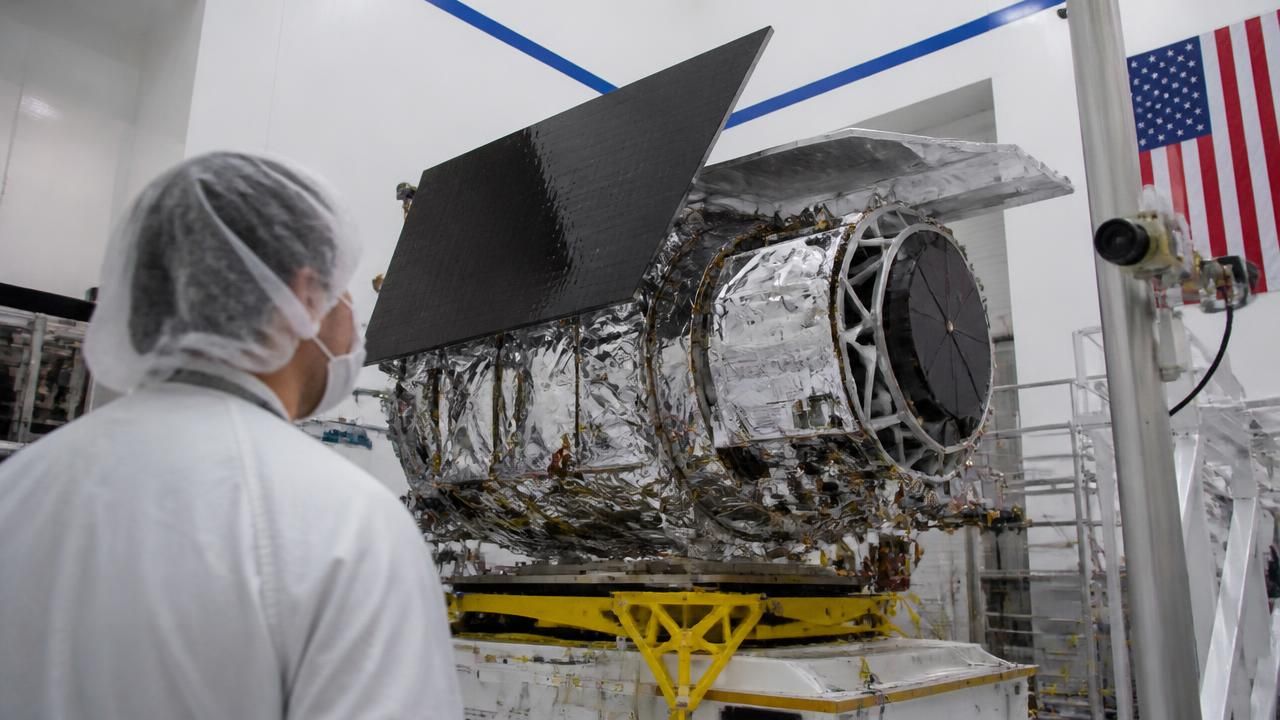
NASA’s Nancy Grace Roman Space Telescope has reached a pivotal stretch in its young mission: it has seen starlight for the first time, is moving through commissioning, and is now set to deliver its first public images. NASA said it will unveil those images during a live stream from the American Geophysical Union Annual Meeting in San Francisco at 3:30 p.m. EST (12:30 p.m. PST) on Monday, Dec. 7. The event will be carried on NASA’s website and at nasa.gov/live, with the images posting simultaneously.
The reveal is more than a photo opportunity. Roman is designed to answer some of the largest questions in astrophysics, including the nature of dark energy and dark matter, the demographics of planets beyond our solar system, and the structure of our own Milky Way. NASA said the first images will showcase the observatory’s unique scientific capabilities and its ability to capture deep, panoramic views of the universe.
The images will showcase the unique scientific capabilities of Roman, which will soon capture deep, panoramic, never-before-seen views of the universe to explore the mysteries of dark energy, dark matter, and worlds outside our solar system. — NASA
A wide-angle eye on dark energy and alien worlds
Roman is not simply a successor to earlier observatories; it is built for breadth as well as depth. Its wide-field instrument is intended to survey large swaths of sky far faster than Hubble, collecting statistical samples of galaxies, supernovae, and stars that would be impractical to assemble one target at a time. That survey power is central to its dark-energy mission, which will map how the expansion of the universe has changed over cosmic time.
The telescope’s exoplanet work has also drawn attention. MSN described a major milestone that could change how scientists search for alien worlds. Roman is expected to use microlensing surveys to find planets that are difficult to detect with other methods, including cold worlds and planets far from their stars. It also carries a coronagraph technology demonstration designed to test ways of blocking starlight so that faint planets can be seen directly. The first images will not settle those questions, but they will show whether the observatory’s systems are working together as planned.
First light, then the next 100 days
Mashable reported that Roman saw starlight for the first time, a classic milestone for any new telescope. Yahoo coverage focused on what comes next, including a look at the mission’s next 100 days. Those reports align with the commissioning phase that follows launch: engineers and scientists must check the spacecraft’s pointing, focus, thermal stability, and instruments before the observatory can begin routine science.
NASA’s Dec. 7 event will include a media preview under embargo at noon Eastern, with registered journalists able to participate remotely or in person. NASA asked media to register with AGU by 8 p.m. Sunday, Dec. 6, and said embargoed interviews would follow the briefing. The agency also said a recording of the media briefing would be available afterward.
In a parallel public-engagement push, NASA invited the public to adopt a Roman camera pixel, offering a personal link to the mission, according to MSN. The campaign turns the telescope’s huge detector into something tangible: each pixel is a tiny piece of the instrument that will collect the mission’s panoramic images. It is a way to connect people to a machine designed to survey the sky on an industrial scale.
Why coverage differs
Not every outlet framed the moment as an immediate photo bonanza. USA Today’s headline warned that although Roman is in space, the public should not expect photos until 2027. That caution points to the distinction between early engineering or first-light images and routine science-ready imagery. NASA’s Dec. 7 release is an early showcase; the observatory’s full survey campaign will come after commissioning, when the instruments are calibrated and the mission begins its formal science program.
Phys.org emphasized how Roman will open a window into the Milky Way. The telescope’s wide field will capture dense star fields and help astronomers study the galaxy’s structure, stellar populations, and hidden planets. Houston Public Media’s Sept. 4, 2026, segment on NASA’s new space telescope reflects how local and regional outlets have followed the mission for audiences beyond the space community. Together, the coverage shows a story with several layers: an engineering milestone, a public-engagement campaign, a timeline for science, and a long-term promise to reshape astronomy.
What the first images will mean
The first images are expected to demonstrate Roman’s ability to combine sharp resolution with a wide field of view. For astronomers, that combination is the mission’s signature. It will allow Roman to survey the sky repeatedly, discovering transient events and building large datasets that other telescopes can follow up in detail. The mission is named for Nancy Grace Roman, NASA’s first chief of astronomy, often called the mother of Hubble, and its science program is meant to extend her legacy of making space-based astronomy a central tool for understanding the cosmos.
For the public, Dec. 7 will be the first real look at what Roman can do. For scientists, it will be an early test of a machine built to survey the universe at a scale that has not been possible before. And for NASA, it will be a chance to show that the telescope’s first starlight was only the beginning.