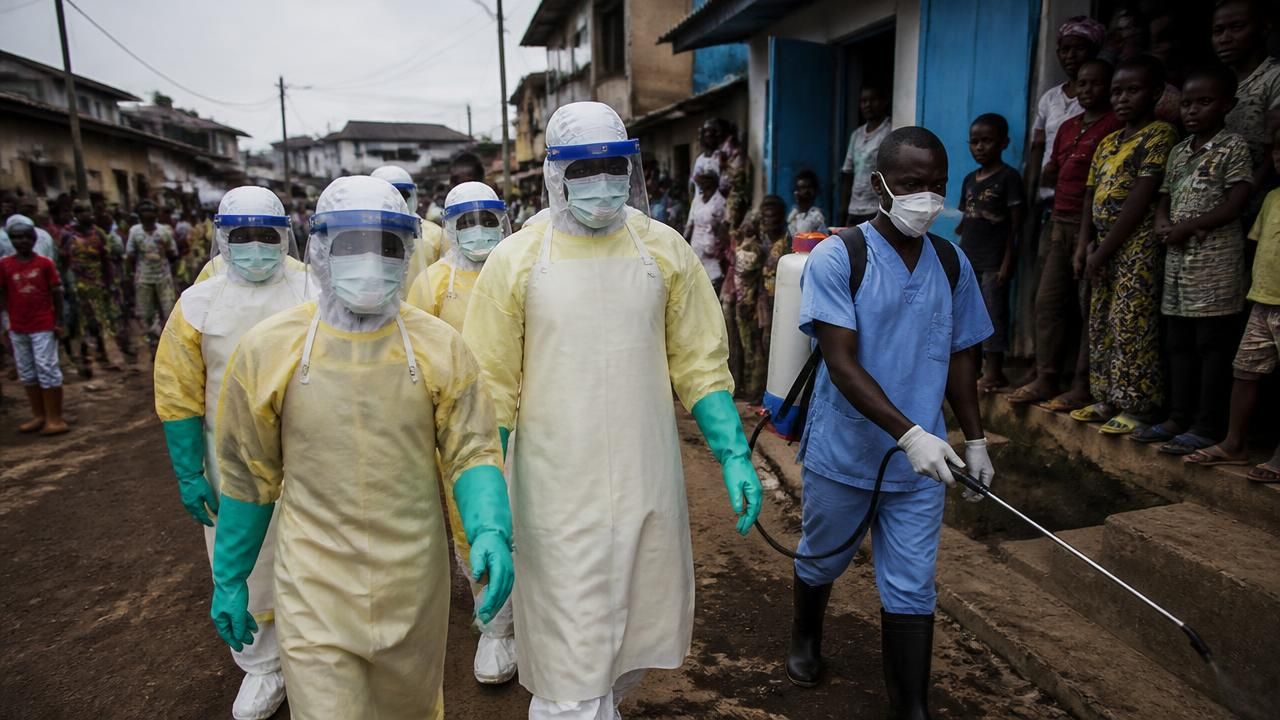
BUTEMBO, Democratic Republic of the Congo — A senior member of the Democratic Republic of the Congo’s ruling party was beaten to death on Sunday after he appeared on a radio program to promote measures to prevent the spread of Ebola, his party said, in a killing that has underscored the dangers facing local officials in an outbreak zone.
Marie-Celestin Karondwa, the acting president of the Union for Democracy and Social Progress (UDPS) federal executive committee in Butembo, was attacked after taking part in the broadcast, the UDPS federation in the city said in a statement reported by Reuters. The party identified him as a local leader of the ruling party in a city that has become a hotspot in the Ebola outbreak.
“Marie-Celestin Karondwa ... was attacked after taking part in a radio show during which he promoted prevention measures for the disease,” the UDPS federation in Butembo said in the statement.
Initial reports did not identify a motive or announce any arrests. The Guardian’s world news coverage described Karondwa as a politician killed after a radio appearance about Ebola. Yahoo News and MSN carried versions of the same Reuters account, with headlines emphasizing that the party said he was beaten to death after urging Ebola prevention on the radio.
The differing framings are subtle but revealing. The Guardian placed the killing in the context of the Ebola outbreak and the public-health message Karondwa had been delivering. The Reuters-derived accounts led with the party’s claim and the radio appearance, adding the cautious attribution “party says.” None of the initial reports included confirmation from police, prosecutors, or the national health ministry, a reminder that the first accounts of violent incidents in eastern DRC often rest on local testimony and political statements.
Why Butembo matters
Butembo is a commercial hub in North Kivu, eastern DRC, and a place where Ebola response teams have faced both logistical obstacles and violent resistance. The city was a major epicenter of the 2018–2020 Ebola outbreak in eastern DRC, the second-largest in history, which infected more than 3,000 people and killed more than 2,000. During that outbreak, treatment centers were attacked, health workers were killed, and community mistrust repeatedly hampered efforts to trace contacts and isolate patients.
Ebola spreads through direct contact with the blood, bodily fluids, or tissues of infected people, and through contaminated surfaces and bedding. Funerals can also be high-risk if mourners touch the body. Prevention campaigns typically urge hand-washing, safe burials, early isolation, and vaccination where available. In parts of North Kivu, however, such messages have sometimes been met with suspicion because of long-standing grievances against the central government, the presence of armed groups, and rumors about the motives of health workers.
That context makes the killing of a local political figure after an Ebola radio broadcast especially sensitive. If communities associate public-health outreach with state authority, then an attack on a ruling-party official could have consequences beyond one city. It could deter volunteers, health communicators, and local leaders from speaking openly about the disease.
Political and security dimensions
The UDPS is the party of President Félix Tshisekedi, who came to power in 2019. Karondwa’s position as acting president of the party’s federal executive committee in Butembo made him a visible local representative of the ruling party in a region where state authority is contested and armed violence is common. Eastern DRC has suffered from decades of conflict involving local militias, foreign armed groups, and Congolese security forces. In such an environment, motives for violence are rarely simple.
The party linked the attack to Karondwa’s radio appearance and his Ebola prevention message. But no independent evidence has yet established that the disease outreach was the reason he was targeted. The killing could also reflect political rivalries, criminal violence, or a combination of local disputes. That uncertainty is central to the story: the party’s account is powerful and specific, but it remains an account from one side, pending an investigation.
“A senior member of the Democratic Republic of the Congo’s ruling party was beaten to death on Sunday after appearing on a radio programme to raise awareness about the Ebola outbreak, a party representative has said,” The Guardian reported.
What it means for the Ebola response
Health agencies and local authorities depend on trusted messengers to persuade communities to adopt prevention measures. In Butembo, those messengers include religious leaders, traditional authorities, journalists, and political figures. When one of them is killed after speaking publicly, the impact can ripple through the entire response. Workers may demand better protection, communities may retreat further from official campaigns, and rumors may fill the vacuum left by fear.
The killing also raises questions about accountability. If no suspects are identified, impunity can deepen distrust. If the investigation points to a specific armed group or local network, it could inflame political tensions. Either way, the case is likely to be watched closely by public-health officials, human-rights monitors, and the Congolese government.
The wider picture
DRC has repeatedly been at the center of Ebola outbreaks, and each one tests the country’s fragile health system and its ability to coordinate with international partners. Butembo’s history shows that defeating Ebola is not only a medical challenge. It is also a security, political, and communication challenge. The virus can be controlled with vaccines, treatment, contact tracing, and safe burials, but those tools only work when communities trust the people delivering them.
For now, the essential facts remain stark: a ruling-party official in Butembo went on the radio to talk about Ebola prevention. Shortly afterward, he was attacked and killed. His party says he died because of that public-health appeal. The full truth will depend on what authorities discover next, and whether they can deliver justice in a region where violence often goes unpunished.