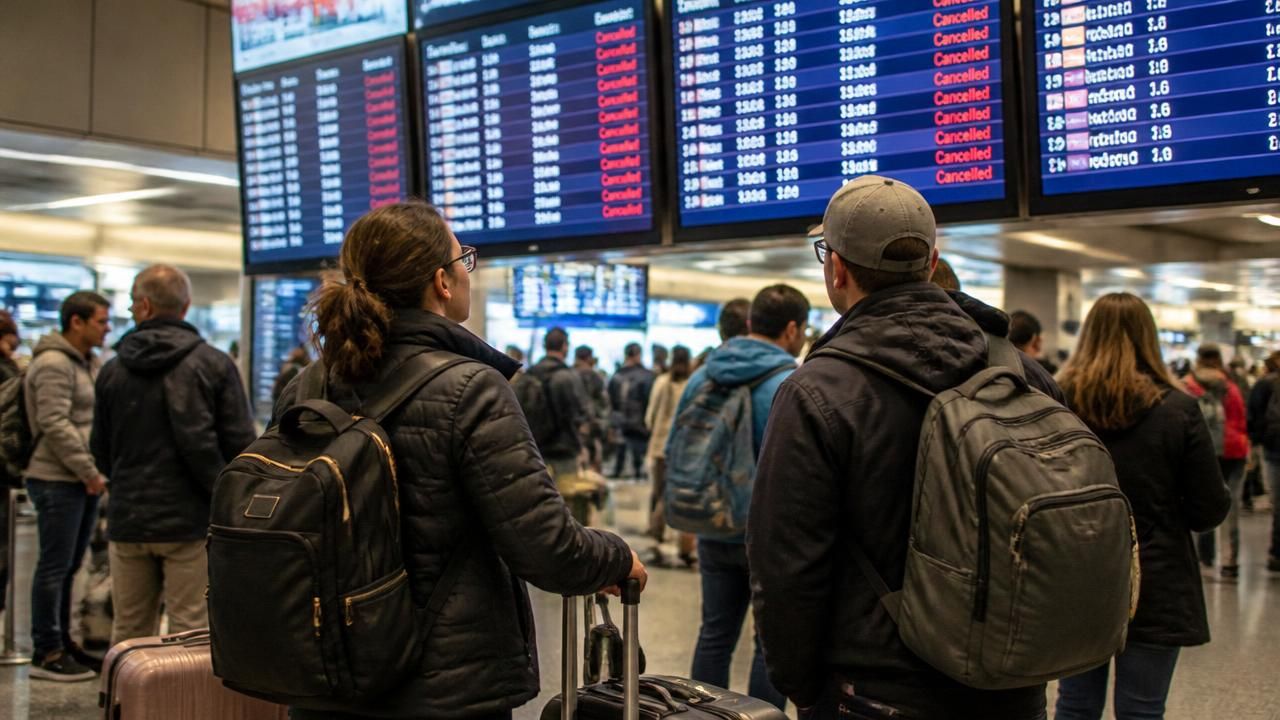
The Federal Aviation Administration ordered a nationwide ground stop for all U.S. airports on Wednesday, halting departing flights from coast to coast after what Transportation Secretary Sean Duffy described as a "communication issue impacting all Air Route Traffic Control Centers." The order, which cascaded through airports from Boston to Houston to Wichita within minutes, left tens of thousands of travelers stranded or scrambling and thrust the nation's aging air traffic control infrastructure back into the spotlight.
The FAA said the pause was ordered for "reasons of safety," with the agency's notice citing "extraordinary circumstances." The Department of Homeland Security said there was no indication the disruption stemmed from an attack, according to the BBC. Details on the root cause remained scarce hours after the order, and neither the FAA nor the Transportation Department immediately provided a timeline for resuming operations.
What Happened
According to NPR, the FAA issued the ground stop after identifying a communication problem affecting the network of Air Route Traffic Control Centers — the regional facilities that manage high-altitude traffic and hand aircraft off between local towers. There are roughly 20 such centers across the continental United States, and they form the backbone of the national airspace system. A failure across that layer of the system is not a local outage but a systemic one, which explains why the order applied uniformly to every airport in the country rather than to a single region.
NBC News reported that the halt was ordered "for reasons of safety," while the Los Angeles Times characterized the FAA's language as invoking "extraordinary circumstances and for reasons of safety" — phrasing that aviation attorneys note is unusual and typically reserved for events beyond routine disruption. The Dallas Morning News, citing officials, tied the stoppage to an equipment issue.
Coast to Coast, Departures Frozen
The practical effect was immediate and highly visible. Local outlets across the country documented the shutdown in real time:
- Boston: Flights at Logan International were affected, according to regional coverage of the order.
- Houston: Departures were paused at both Bush Intercontinental and Hobby airports, the Houston Chronicle reported.
- Texas broadly: KUT reported that all flights at Texas airports were halted.
- Maine: Portland and Bangor airports were impacted, according to News Center Maine.
- Nebraska: Rural radio outlets reported mounting delays at the state's airports.
- Ohio: The Columbus Dispatch reported nearly 100 delays and cancellations at Columbus-area airports tied to the stoppage.
- Kansas: Wichita's airport and others were affected, KMUW reported.
Business travel outlets, including Business Travel News and Travel Market Report, moved quickly to alert corporate travel managers, a sign of how seriously the industry treated a system-wide halt. The ground stop applied to departures; aircraft already airborne were permitted to continue to their destinations, though the ripple effects — diverted crews, displaced aircraft, and missed connections — were expected to persist for days.
How the Story Was Framed
Coverage of the order reflected each outlet's priorities. NPR led with the mechanics of the failure and Duffy's identification of the cause — a communication breakdown across the route centers. The BBC foregrounded the security question, noting that Homeland Security had found no indication of an attack, a detail that mattered enormously in the first minutes of an unexplained nationwide shutdown. Trade publications focused on operational and business-travel consequences. Local newsrooms, meanwhile, translated a Washington directive into the language travelers understand: gate agents, delayed departures, and rebooking lines.
"A communication issue impacting all Air Route Traffic Control Centers." — Transportation Secretary Sean Duffy, describing the cause of the nationwide ground stop
The divergence is not merely stylistic. The federal framing emphasized technical failure; the security framing emphasized the absence of foul play; the local framing emphasized disruption. Together they produced a fuller picture than any single account: a system-wide technical breakdown, apparently not an attack, with consequences measured in thousands of disrupted journeys.
A Familiar Pattern for a Fragile System
Nationwide ground stops are rare but not unprecedented. The most recent comparable event occurred in January 2023, when a failure of the Notice to Air Missions — or NOTAM — system prompted the FAA to halt all domestic departures for several hours, the first nationwide grounding of its kind since the September 11, 2001 attacks. That incident exposed how much of the air traffic system still runs on aging technology, some of it decades old, and prompted renewed calls in Congress to accelerate modernization.
The September 11 ground stop remains the benchmark for the category: an order that cleared the skies entirely and reshaped aviation security for a generation. Wednesday's order did not carry that gravity, but it echoed the same underlying vulnerability — that the U.S. airspace system is a single, tightly coupled network in which a fault in one layer can freeze the whole.
What Remains Unknown
As of publication, several key questions were unresolved: precisely which systems failed and why; how long the communication problems persisted before the ground stop was issued; whether the order would be lifted gradually by region or uniformly; and how many flights and passengers were ultimately affected. The FAA has not said whether a cyberattack has been ruled out, though DHS's assessment that there was no indication of an attack provided early reassurance.
For travelers, the immediate guidance was unambiguous: check with airlines before leaving for the airport, expect cascading delays well beyond the lifting of the order, and anticipate that recovery could take days as aircraft and crews are repositioned. For policymakers, the episode arrives as another data point in a long-running debate over whether the nation's aviation infrastructure — and the funding to modernize it — is adequate to the demands placed upon it.
The FAA said it would provide updates as the situation develops. Until then, the skies over the United States remain, by order, unusually quiet.