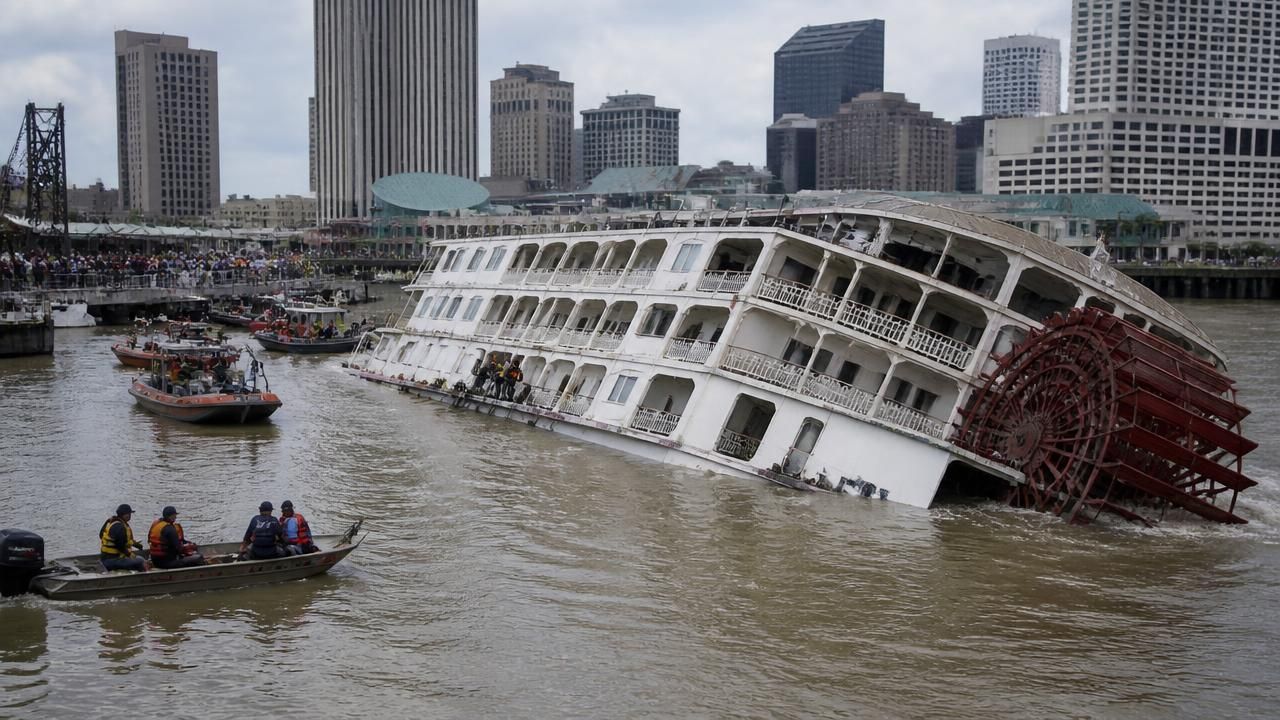
NEW ORLEANS — A 295-foot paddlewheel river cruise ship rolled onto its side and partially capsized in the Mississippi River on Friday after being struck by an asphalt tanker near the Port of New Orleans, triggering a frantic water rescue that officials say ended without a single fatality. All 129 people aboard — passengers and crew — were accounted for, and 32 were taken to hospitals, none of them critically injured, according to Mayor Helena Moreno.
The vessel was identified in multiple reports as the American Heritage, a river cruise ship docked along the New Orleans riverfront when the tanker lost control and slammed into it. Video circulated widely on social media showing the paddlewheeler listing hard to starboard, water washing over its lower decks and passengers clinging to railings and the hull as rescue boats converged.
What happened
Accounts of the sequence vary in detail, but the broad outline is consistent across local, national and international outlets: the tanker, described by the Houston Chronicle as an asphalt carrier, lost control on the river and struck the docked cruise ship, knocking it into a severe list. Emergency crews from the New Orleans Fire Department, the U.S. Coast Guard and harbor patrol units responded within minutes.
Dispatch audio obtained and reported by local media captured the urgency of the first moments. "It's definitely taking on water," one responder is heard saying, according to MSN's review of the recordings — a glimpse into a chaotic scene in which rescuers had to account for well over a hundred people in moving river current.
"All passengers and crew members are accounted for," Mayor Helena Moreno said, adding that 32 people were hospitalized but none were in critical condition.
The numbers, and why they differed
Early reporting was, as is typical in fast-moving disasters, inconsistent. Some outlets reported "more than 130" aboard, others "over 125 passengers," and at least one headline cited a ship carrying 150 people. The figure of 129 total souls on board, reported by NOLA.com and consistent with the mayor's accounting, appears to be the most authoritative.
- Vessel: American Heritage, a 295-foot paddlewheel river cruise ship
- People aboard: 129, all accounted for
- Hospitalized: 32, none critically injured
- Location: Mississippi River near the Port of New Orleans
- Cause: Collision with an asphalt tanker that reportedly lost control
How different outlets framed it
The story's presentation split sharply along outlet type. Wire services and mainstream outlets — Bloomberg, UPI, KHOU — led with official casualty figures and the mayor's statement, emphasizing the absence of critical injuries. Tabloids leaned into spectacle: the Daily Mail ran "horrifying video" of passengers "hanging on for life," while The Sun described an "out-of-control trawler" striking a ship with "over 130 on board."
International coverage framed the outcome as deliverance. India's Times of India called it a "Miracle on Mississippi," and Yahoo's headline used the word "Miracle" outright — a framing echoed in local celebrations of a worst-case scenario narrowly avoided. Trade and business publications took a different angle entirely: WWD and Cruise Industry News focused on the identity of the vessel and the collision's implications for Port NOLA operations, with WWD noting that the impact on port traffic remained unclear.
Local outlet NOLA.com, which ran rolling live updates through the day, provided the most granular reporting, including the dispatch audio that gave readers a sense of the response in real time. Several outlets — ftnnews.com, chron.com, natchezdemocrat.com and express.co.uk — were inaccessible at the time of this reporting, their pages blocked by bot protections or server errors, a reminder of how much early disaster coverage now circulates secondhand.
Why it matters: a river under pressure
The Mississippi at New Orleans is one of the busiest and most economically consequential waterways in North America, carrying grain, petroleum products, asphalt and chemicals between the Gulf and the American interior. It is also the spine of a resurgent overnight river-cruise market that has grown steadily over the past decade, with paddlewheel-style vessels marketed on nostalgia and close-in access to riverfront cities.
The collision puts two of those economies — bulk cargo and leisure tourism — into direct contact. Asphalt, a heated heavy petroleum product, raises specific concerns about spill risk and waterway contamination, though no significant release had been confirmed in initial reports. Marine casualty investigations of this kind typically involve the U.S. Coast Guard and the National Transportation Safety Board, and would examine the tanker's speed, mechanical condition, crew fatigue and pilot communications with harbor traffic control.
The financial exposure is multifaceted: hull and liability claims on both vessels, business-interruption losses for a cruise line mid-season, possible Jones Act considerations for a U.S.-flagged domestic cruise operation, and port disruption costs if berths or channels are closed for inspection or salvage. For a tourism-dependent city still building back its hospitality sector, the images of a listing paddlewheeler on the downtown riverfront carry reputational weight well beyond the insurance ledger.
What comes next
Officials have not publicly assigned fault, and the cause of the tanker's loss of control remains unexplained. Salvage crews face the delicate task of righting or stabilizing the partially submerged vessel without worsening structural damage or releasing fuel. Meanwhile, the question investigators will return to is straightforward and consequential: how does a large commercial tanker lose control in a channel where a docked cruise ship, its crew and 129 people are within striking distance?
For the passengers and crew of the American Heritage, the answer arrived Friday in the form of rescue boats and hospital gurneys — and, by every official account, a great deal of luck.