NASA has named the four astronauts who will fly the agency's SpaceX Crew-14 mission to the International Space Station, pairing a veteran Navy submariner with a first-time pilot and two international mission specialists — an announcement that landed alongside news of a major expansion of SpaceX's commercial crew contract.
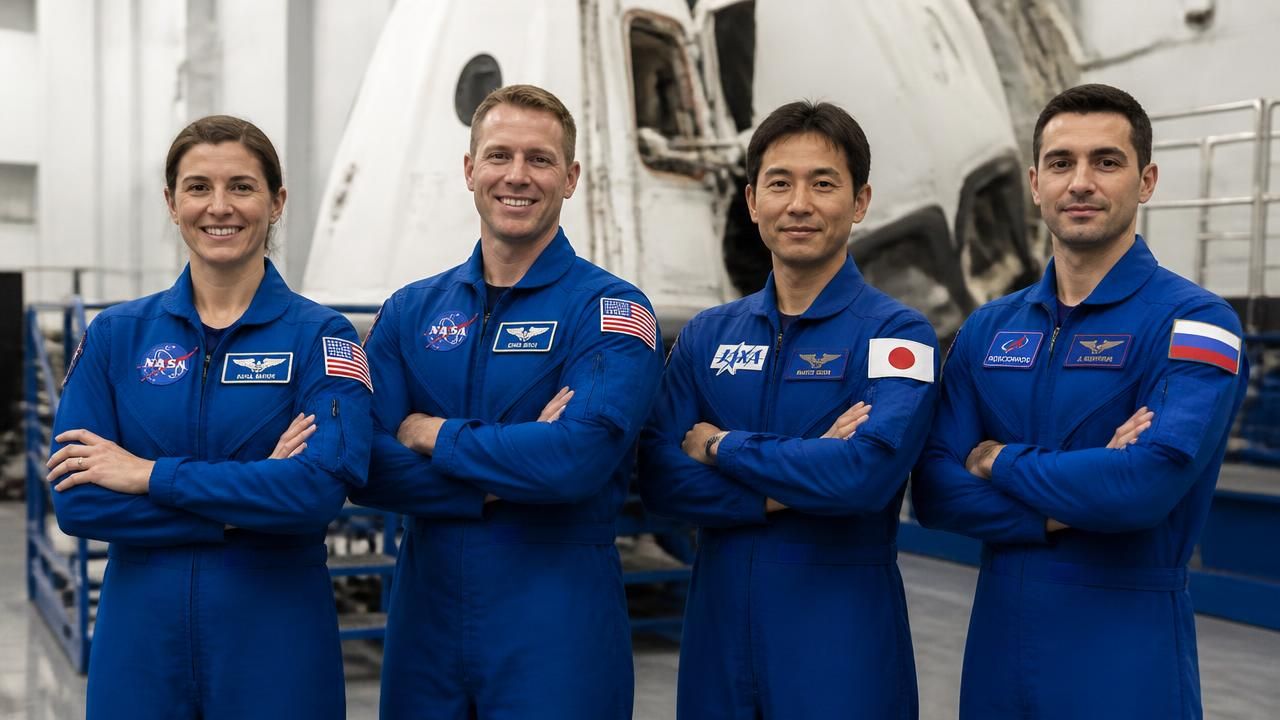
According to NASA's official release, NASA astronauts Kayla Barron and Chris Birch will serve as spacecraft commander and pilot, respectively, with JAXA (Japan Aerospace Exploration Agency) astronaut Makoto Suwa and Roscosmos cosmonaut Arutyun Kiviryan rounding out the crew as mission specialists. The quartet is scheduled to launch no earlier than spring 2027 for a long-duration science expedition, joining the station's Expedition 75/76.
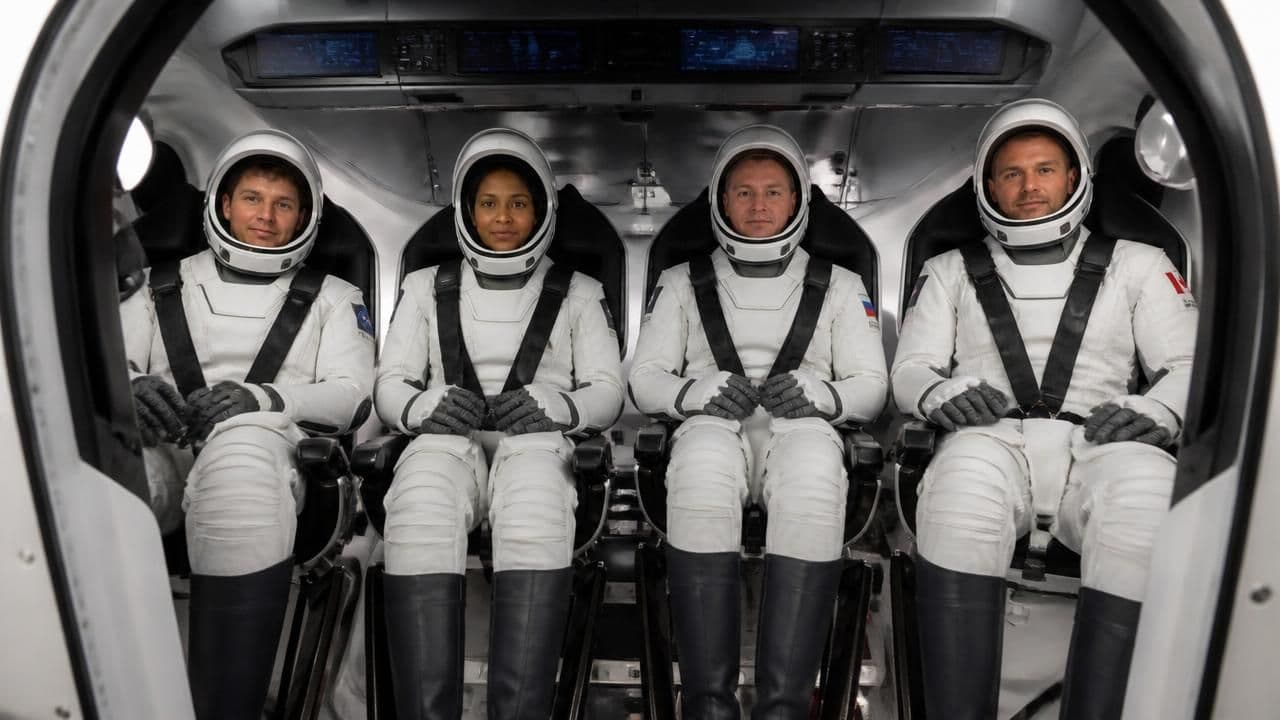
The crew has already begun preflight training at SpaceX's facility in Hawthorne, California, where NASA shared a group photograph of the four fliers in preparation for the mission.
A veteran commander and a 14th rotation
Crew-14 marks the 14th commercial crew rotation flown by SpaceX under NASA's Low Earth Orbit Program, a cadence that has made the Hawthorne-based company the agency's primary taxi service to the orbital outpost since the first operational Crew Dragon flight in 2020.
Barron returns for a second flight
For Barron, the assignment is a return to orbit. Selected as a NASA astronaut in 2017, she holds a bachelor's degree in systems engineering from the U.S. Naval Academy in Annapolis, Maryland, and a master's degree in nuclear engineering from the University of Cambridge in England. A commander in the U.S. Navy, she earned her submarine warfare officer qualification before joining the astronaut corps, and she previously flew to the station as part of SpaceX Crew-3 in 2021.
Birch takes the pilot's seat, while Suwa and Kiviryan represent Japan and Russia under the long-standing international partnership that governs the station. NASA framed the mission around its scientific purpose, noting the crew will conduct investigations and technology demonstrations intended to prepare humans for future exploration missions to the Moon and Mars — and to deliver benefits to people on Earth.
The crew will conduct scientific investigations and technology demonstrations to help prepare humans for future exploration missions to the Moon and Mars and to benefit people on Earth. — NASA mission announcement
The contract behind the crew
While NASA's own release focused on the human story — crew biographies, roles, and training — business and space-trade outlets zoomed in on the money. Reports indicate SpaceX will fly three additional NASA crew missions under a contract modification valued at roughly $946 million, part of an expanded arrangement that financial coverage pegged at $5.92 billion overall.
That divergence in emphasis is telling. For NASA, Crew-14 is a science expedition and a milestone in international cooperation. For the financial press, it is a reminder of how thoroughly SpaceX has entrenched itself as the commercial backbone of America's human spaceflight program — and of the revenue stability that comes with it.
Delays reshape the schedule
The Crew-14 announcement arrives against a backdrop of scheduling turbulence closer to home. Houston Public Media reported that NASA's SpaceX Crew-13 is quarantining at Johnson Space Center in Houston ahead of an Oct. 1 launch window, the standard pre-flight isolation meant to protect the crew and the station's inhabitants from illness.
Meanwhile, WUSF reported that astronauts already aboard the station have had their stay extended because the launch of their relief crew was delayed. The two stories illustrate a structural reality of station operations: rotations are tightly coupled. A slip in one launch cascades forward, stretching crews beyond their planned tours and forcing planners to re-sequence training, cargo and docking slots.
With Crew-14 not slated to fly until 2027, NASA is effectively planning years ahead while managing month-to-month contingencies — a dual horizon that has become routine for the commercial crew program.
Why it matters
- Continuity of access: Crew-14 extends SpaceX's role as the station's principal crew transport, a position solidified across more than a dozen rotations.
- International partnership: A crew drawn from NASA, JAXA and Roscosmos underscores that the station remains one of the few enduring arenas of U.S.-Russian cooperation.
- Commercial reliance: The reported contract expansion reflects NASA's strategy of buying seats rather than owning vehicles, a model that has lowered launch costs but concentrated risk in a single provider.
- Exploration pipeline: The science conducted aboard the station feeds directly into planning for crewed lunar and Martian missions.
The station itself faces a finite future, with NASA planning to retire it around the end of the decade and transition low Earth orbit operations to commercial platforms. Each new rotation, then, is both an operational necessity and a countdown marker — another crew trained, another set of experiments flown, another increment of experience banked for whatever comes next.
For now, the immediate work is prosaic: training in California, quarantine protocols in Texas, and the slow, meticulous choreography that precedes every launch. Barron, Birch, Suwa and Kiviryan have roughly a year and a half of preparation ahead before they ride a Falcon 9 toward the station — assuming the schedule, as it so often does, holds.