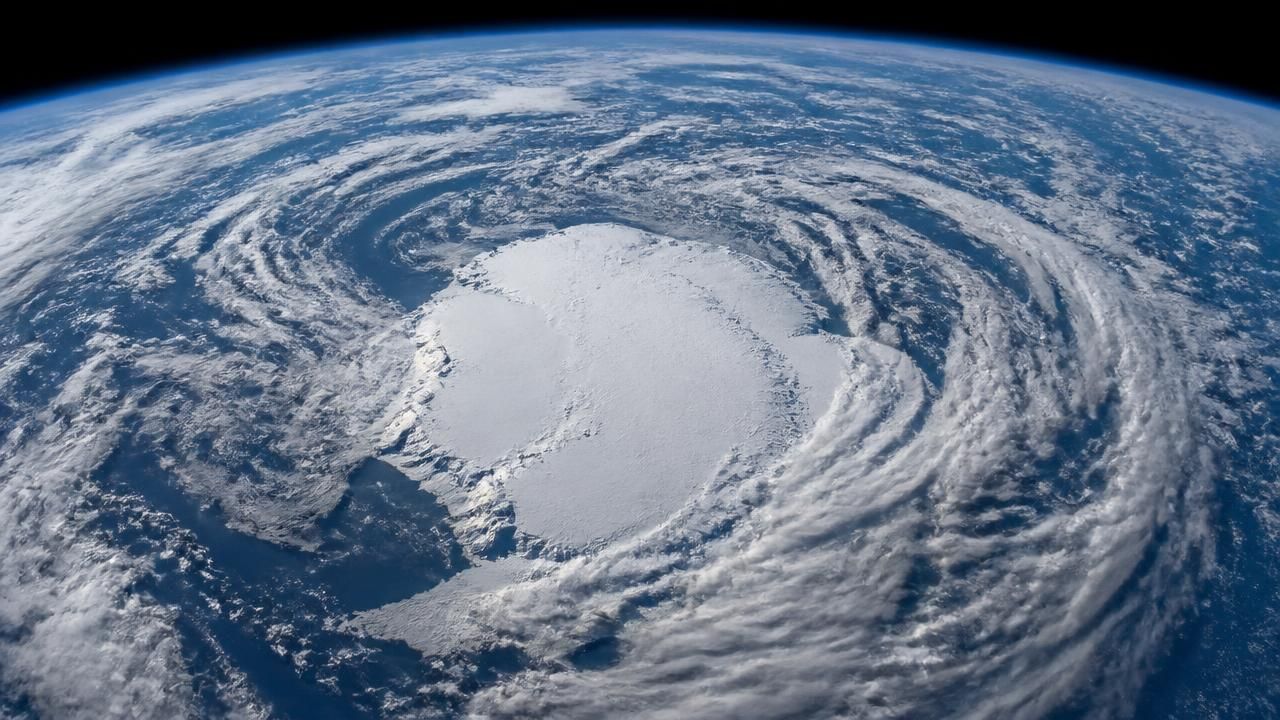
The hole in Earth's protective ozone layer over Antarctica reached its annual maximum on September 18, 2026, closing out a season that scientists at NASA and the National Oceanic and Atmospheric Administration (NOAA) describe as one of the largest in nearly half a century of satellite monitoring — and, at the same time, one that offers no evidence that the ozone layer's long-term recovery has faltered.
NASA's Earth Observatory published a data visualization of the ozone hole's area and shape on the day of peak extent, part of an update to its long-running "World of Change" series documenting how the planet transforms over months, seasons and years. Scientists define the ozone hole as the region where stratospheric ozone concentrations fall below 220 Dobson Units — a threshold never observed before 1979, and one that became a global alarm after the discovery of severe springtime thinning over Antarctica.
How Big, Exactly? It Depends How You Count
Coverage of the 2026 season has produced a cluster of seemingly competing superlatives, each reflecting a slightly different measurement. Reports described the hole as the largest in a decade, as the seventh-largest in 48 years of tracking, and — in Smithsonian Magazine's framing — as September's biggest in 25 years.
The apparent contradictions are largely a matter of metric and moment. Annual rankings typically compare the season's peak single-day area against the satellite record that began in 1979 with NASA's Total Ozone Mapping Spectrometer and continues today through instruments aboard NASA and NOAA spacecraft. The seventh-place ranking reflects that full 48-year record. The "25-year" figure cited for September speaks to the timing and intensity of the peak within the month, when the Antarctic stratosphere is coldest and ozone destruction is most efficient.
What the various measures agree on is the direction: 2026's hole was substantially larger than those of the past decade, a period in which the Antarctic ozone hole has generally trended smaller as chlorine and bromine levels in the stratosphere slowly decline.
A Cold Stratosphere, Not a Policy Failure
The proximate cause, according to NOAA and NASA scientists, was weather — specifically the behavior of the polar vortex, the swirling band of frigid air that isolates the Antarctic stratosphere each winter. A strong, stable and unusually cold vortex keeps temperatures low enough for polar stratospheric clouds to form. Those clouds convert otherwise benign chlorine reservoir compounds into reactive forms that, once sunlight returns in spring, catalytically destroy ozone.
When the vortex is disturbed — by planetary waves propagating upward from the troposphere — it warps, warms or breaks apart early, and the hole stays comparatively small. In 2026, the polar stratosphere stayed cold and undisturbed, and the hole grew accordingly.
"This is meteorology, not a failure of the Montreal Protocol," said one atmospheric scientist familiar with the NOAA-NASA assessment, echoing a point agency researchers have made repeatedly in annual briefings: year-to-year variability in the ozone hole is dominated by stratospheric weather, while the underlying recovery signal unfolds over decades.
Four Decades Since the Alarm
The story began in 1985, when scientists from the British Antarctic Survey, working from ground-based measurements at Halley Research Station, reported that Earth's natural sunscreen was thinning dramatically over Antarctica each austral spring. NASA satellite instruments soon revealed the phenomenon's continental scale, and the world responded with the 1987 Montreal Protocol on Substances that Deplete the Ozone Layer — an agreement later strengthened to phase out chlorofluorocarbons, halons and related compounds.
Atmospheric concentrations of ozone-depleting substances have been declining since the late 1990s, and researchers expect the Antarctic ozone hole to gradually shrink and eventually disappear, with Antarctic springtime ozone projected to return to 1980 levels around mid-century under current policy.
The 2026 result does not contradict that trajectory. A single large year is a perturbation on a long downward curve, and the stratospheric chlorine burden continues to fall. But it is a reminder that recovery is not linear, and that a colder stratosphere — a possible consequence of greenhouse gas-driven climate change — could modulate how quickly the healing becomes visible.
The Counterfactual That Matters
As coverage of the 2026 maximum circulated, commentators revived a thought experiment: what if the world had not acted? Without the Montreal Protocol, models project global ozone depletion of catastrophic proportions by the middle of this century, with severe consequences for human health — rising rates of skin cancer and cataracts — and for agriculture, fisheries and the marine food web, which are acutely vulnerable to ultraviolet radiation.
The 1987 agreement is routinely described as the most successful environmental treaty in history, and it delivered a secondary climate benefit: the CFCs it phased out were also potent greenhouse gases.
What to Watch
- The vortex next spring: Scientists will look to the austral winter of 2027 for whether the cold, stable conditions of 2026 were an anomaly or part of a pattern.
- Stratospheric temperature trends: Continued cooling of the polar stratosphere would complicate the expected recovery timeline.
- The Montreal Protocol's successors: The Kigali Amendment, which targets hydrofluorocarbons, extends the treaty's climate reach.
For now, the message from NASA and NOAA is a nuanced one: the ozone layer is healing, but its annual wound still opens and closes according to the whims of the polar atmosphere — and this year, the atmosphere was unusually unkind.