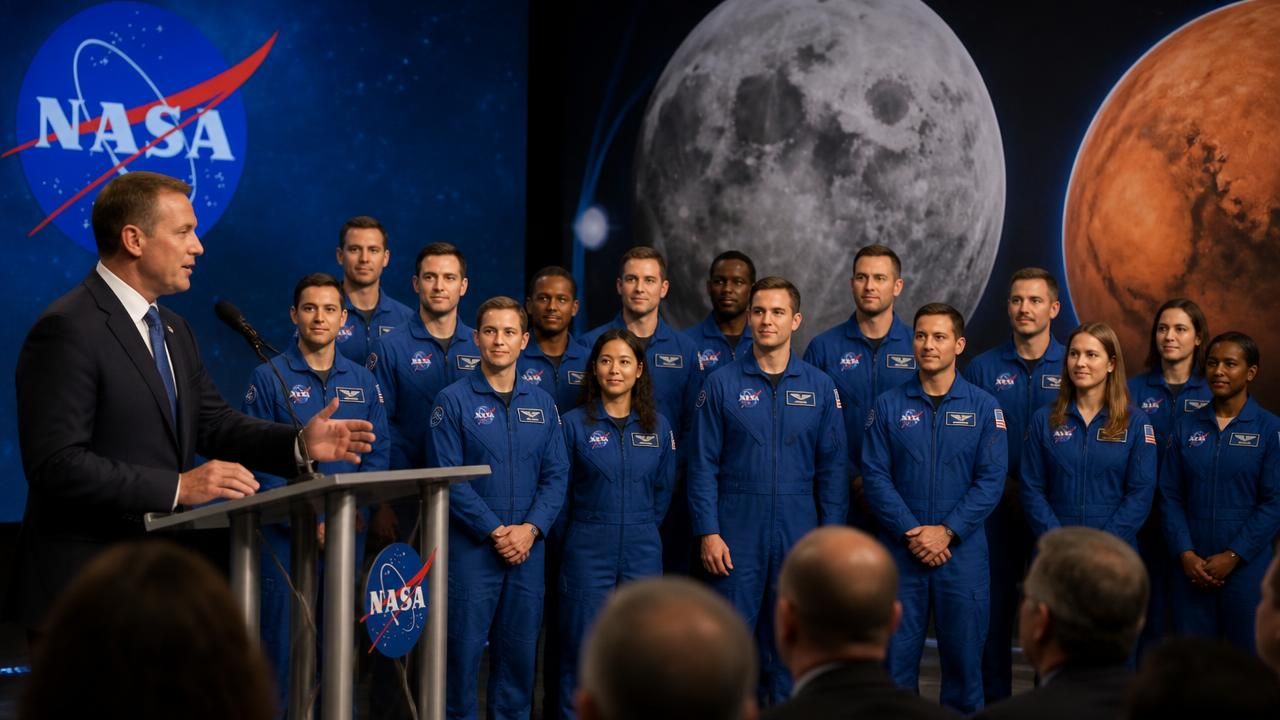
NASA has opened applications for its next class of astronauts, launching a nationwide hunt for the men and women the agency says will fly during America's return to the Moon, the construction of a lunar base and, eventually, the first crewed missions to Mars. U.S. citizens have until 11:59 p.m. EST on Thursday, Dec. 3, to submit completed applications through the agency's online portal.
The announcement was made at NASA's Johnson Space Center in Houston on Sept. 22, alongside the agency's 2025 astronaut candidate class — a setting that framed the recruitment drive as a handoff between generations of spacefarers. Outlets covering the news emphasized different angles: NASA's own release leaned on the grand arc of exploration, The Guardian headlined the prospect of astronauts who will "live and work on the moon," while consumer-facing outlets such as MSN framed the opening plainly — "Dream of going to space?" — a reminder that the astronaut corps remains one of the most coveted and least attainable jobs in the federal government.
A Corps Built for the Artemis Era
NASA is explicit that this hiring round is not a repeat of the shuttle-era template. The next generation of astronauts will train to operate on the lunar surface, live and work beyond Earth for extended periods, and take on missions that push human exploration farther than at any point in the agency's history.
That work is tied directly to Artemis, NASA's lunar exploration campaign, which envisions crewed landings near the Moon's south pole followed by sustained surface operations and a permanent lunar base — infrastructure the agency views as a proving ground for the long-duration systems, habitats and logistics needed for a Mars transit.
"This is an extraordinary time to join NASA's astronaut corps," said NASA Administrator Jared Isaacman. "The people we select could walk on the Moon, live and work at the Moon Base, and help pioneer the systems and operations that will ultimately carry crews to Mars. Those missions will demand technical excellence, sound judgment, teamwork, and courage."
Isaacman added that the corps "has always called on remarkable Americans willing to take on extraordinary challenges in service to the nation," and urged applicants to "come help write the next chapter of humanity's greatest adventure."
The Barremains Sky-High
NASA's basic qualifications are unchanged in spirit and remain formidable in practice. Candidates must be U.S. citizens, hold a master's degree in a STEM field, and bring at least two years of related professional experience — or, alternatively, 1,000 hours of pilot-in-command time in jet aircraft. A rigorous physical examination and medical clearance are also required. The agency has historically accepted equivalent combinations of education and experience, and astronauts have come from backgrounds as varied as medicine, oceanography, engineering, the military and academic research.
The competition is brutal. In its 2020 recruitment cycle, NASA received more than 18,300 applications and ultimately selected 10 candidates, a selection rate far below that of most elite universities. Those candidates graduated from basic training in March 2024 and are now eligible for flight assignment. NASA said it expects to make its final selection from the current applicant pool in late 2026, meaning the newly chosen candidates would likely begin roughly two years of training before being eligible for mission assignment.
Basic training itself covers a wide curriculum: spacewalking, robotics operation of the Canadarm, T-38 jet proficiency, Russian-language instruction, survival training and extensive work in simulators and neutral-buoyancy labs. For a lunar-surface role, the syllabus is expected to expand further, adding geology field training and habitat operations.
Why the Timing Matters
- Programmatic momentum: NASA is recruiting while its lunar architecture is still being built, meaning new hires would arrive as hardware — landers, suits, surface habitats — moves from design into testing.
- Retirements and attrition: The corps must be replenished as veteran astronauts move into management or leave the agency, and as commercial spaceflight creates new career paths outside NASA.
- Mars as a long horizon: A crewed Mars mission remains years, likely decades, away, but NASA argues that the operational experience gained on the Moon is the only realistic path to it.
- Public engagement: Open calls for astronauts have historically generated enormous public interest, and NASA uses them to spotlight careers in STEM fields well beyond the corps itself.
Framing the Story
The varying coverage of this week's announcement reflects the many ways the same policy decision can be read. NASA's official framing is aspirational and nationalistic — explorers answering a call to service. The Guardian's headline, by contrast, foregrounds the Moon itself, reflecting international fascination with a sustained human presence on the lunar surface and the geopolitical competition with China's own crewed lunar ambitions. Consumer outlets reduce the story to its most personal dimension: a once-in-a-generation job opening for the handful of people alive who might qualify.
What all framings agree on is the deadline. Applications close at 11:59 p.m. EST on Dec. 3. For the thousands of engineers, physicians, pilots and scientists expected to apply, the next two years will determine whether they join the 21st century's most exclusive professional lineage — one that began with the Mercury Seven in 1959 and now looks toward the lunar south pole.